
Catalogue Search | MBRL


Are you sure you want to remove the book from the shelf?

{{itemTitle}}
34,443
result(s) for
"Economic development -- Africa"
Sort by:


Women and the Informal Economy in Urban Africa
In this highly original work, Mary Njeri Kinyanjui explores the trajectory of women's movement from the margins of urbanization into the centres of business activities in Nairobi and its accompanying implications for urban planning. While women in much of Africa have struggled to gain urban citizenship and continue to be weighed down by poor education, low income and confinement to domestic responsibilities due to patriarchic norms, a new form of urban dynamism - partly informed by the informal economy - is now enabling them to manage poverty, create jobs and link to the circuits of capital and labour. Relying on social ties, reciprocity, sharing and collaboration, women's informal 'solidarity entrepreneurialism' is taking them away from the margins of business activity and catapulting them into the centre. Bringing together key issues of gender, economic informality and urban planning in Africa, Kinyanjui demonstrates that women have become a critical factor in the making of a postcolonial city.
eBook

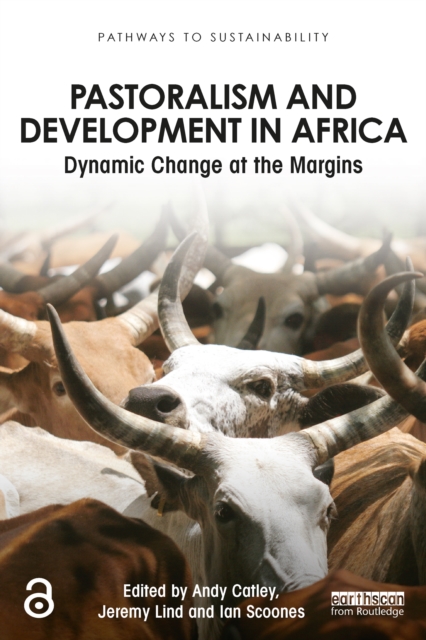
Pastoralism and Development in Africa
Once again, the Horn of Africa has been in the headlines. And once again the news has been bad: drought, famine, conflict, hunger, suffering and death. The finger of blame has been pointed in numerous directions: to the changing climate, to environmental degradation, to overpopulation, to geopolitics and conflict, to aid agency failures, and more. But it is not all disaster and catastrophe. Many successful development efforts at ‘the margins’ often remain hidden, informal, sometimes illegal; and rarely in line with standard development prescriptions. If we shift our gaze from the capital cities to the regional centres and their hinterlands, then a very different perspective emerges. These are the places where pastoralists live. They have for centuries struggled with drought, conflict and famine. They are resourceful, entrepreneurial and innovative peoples. Yet they have been ignored and marginalised by the states that control their territory and the development agencies who are supposed to help them. This book argues that, while we should not ignore the profound difficulties of creating secure livelihoods in the Greater Horn of Africa, there is much to be learned from development successes, large and small. This book will be of great interest to students and scholars with an interest in development studies and human geography, with a particular emphasis on Africa. It will also appeal to development policy-makers and practitioners.
eBook


Tourism in Africa
This report is the first to examine tourism in Africa comprehensively and regionally and the first to recommend practical, evidence-based measures enabling the sector s economic and development power. This gives new impetus to the continent s development progress by leveraging tourism in pursuit of lasting poverty alleviation and the creation of significantly more jobs and opportunities for all Africans.
eBook


The Routledge Handbook of EU-Africa Relations
This handbook provides a comprehensive overview of the changing dynamics in the relationship between the African continent and the EU, provided by leading experts in the field.
Structured into five parts, the handbook provides an incisive look at the past, present and potential futures of EU-Africa relations. The cutting-edge chapters cover themes like multilateralism, development assistance, institutions, gender equality and science and technology, among others. Thoroughly researched, this book provides original reflections from a diversity of conceptual and theoretical perspectives, from experts in Africa, Europe and beyond. The handbook thus offers rich and comprehensive analyses of contemporary global politics as manifested in Africa and Europe.
The Routledge Handbook of EU-Africa Relations will be an essential reference for scholars, students, researchers, policymakers and practitioners interested and working in a range of fields within the (sub)disciplines of African and EU studies, European politics and international studies.
The Routledge Handbook of EU-Africa Relations is part of the mini-series Europe in the World Handbooks examining EU-regional relations and established by Professor Wei Shen.
eBook

Africa in transformation : economic development in the age of doubt
\"Lopes delivers an overview of the critical development issues facing the African continent today. He offers readers a blueprint of policies to address issues, and an intense, heartfelt meditation on the meaning of economic development in the age of democratic doubts, identity crises, global fears and threatening issues of sustainability\"-- Page [4] of cover.
Book

Deforestation trends in the congo basin
The Congo Basin represents 70 percent of the African continent's forest cover and constitutes a large portion of Africa's biodiversity. The objective of the two-year exercise was to analyze and get a better grasp of the deforestation dynamics in the Basin. The primary goal of the exercise was to give stakeholders (and particularly policy makers) a thorough understanding of how economic activities (agriculture, transport, mining, energy, and logging) could impact the region's forest cover through an in-depth analysis of the connections between economic developments and forest loss. Historically, the Congo Basin forest has been under comparatively little pressure, but there are signs that this situation is likely to change as pressure on the forest and other ecosystems increases. Until very recently, low population density, unrest and war, and low levels of development hampered conversion of forests into other land uses; however, satellite-based monitoring data now show that the annual rates of gross deforestation in the Basin have doubled since 1990. There is indeed some evidence that the Basin forests may be at a turning point of heading to higher deforestation and forest degradation rates. The forest ecosystems have not yet suffered the damage observed in other tropical regions (Amazonia, Southeast Asia) and are quite well preserved. The low deforestation rates mainly result from a combination of such factors as poor infrastructure, low population densities, and political instability that have led to the so-called passive protection. However, signs that the Congo Basin forests could be under increasing pressure from a variety of forces-both internal and external range from mineral extraction, road development, agribusiness, and biofuels to agriculture expansion for subsistence and population growth. All of these factors could drastically amplify the pressure on natural forests in the coming decades and trigger the transition from the 'high forest/low deforestation' profile into a more intense pace of deforestation.
eBook