
Catalogue Search | MBRL


Are you sure you want to remove the book from the shelf?

{{itemTitle}}
31,972
result(s) for
"Economic development Europe."
Sort by:


Why Europe Grew Rich and Asia Did Not
Why Europe Grew Rich and Asia Did Not provides a striking new answer to the classic question of why Europe industrialised from the late eighteenth century and Asia did not. Drawing significantly from the case of India, Prasannan Parthasarathi shows that in the seventeenth and eighteenth centuries the advanced regions of Europe and Asia were more alike than different, both characterized by sophisticated and growing economies. Their subsequent divergence can be attributed to different competitive and ecological pressures that in turn produced varied state policies and economic outcomes. This account breaks with conventional views, which hold that divergence occurred because Europe possessed superior markets, rationality, science or institutions. It offers instead a groundbreaking rereading of global economic development that ranges from India, Japan and China to Britain, France and the Ottoman Empire and from the textile and coal industries to the roles of science, technology and the state.
eBook


Austerities and Aspirations
This monograph provides an analysis of the economic performance and living standard in Czechoslovakia and its successor states, Hungary, and Poland since 1945. The novelty of the book lies in its broad comparative perspective: it places East Central Europe in a wider European framework that underlines the themes of regional disparities and European commonalities. Going beyond the traditional growth paradigm, the author systematically studies the historical patterns of consumption, leisure, and quality of life-aspects that Tomka argues can best be considered in relation to one other. By adopting this \"triple approach,\" he undertakes a truly interdisciplinary research drawing from history, economics, sociology, and demography.
As a result of Tomka's three-pillar comparative analysis, the book makes a major contribution to the debates on the dynamics of economic growth in communist and postcommunist East Central Europe, on the socialist consumer culture along with its transformation after 1990, and on how the accounts on East Central Europe can be integrated into the emerging field of historical quality of life research.
eBook


Unwrapping the European social model
The notion of the European Social Model (ESM) has been one of the fastest growing in European political and academic discourse in recent years. It is conventionally used to describe the European experience of simultaneously promoting sustainable economic growth and social cohesion. However, the concept has suffered from a lack of clear definition. And where definitions have been found in the literature, they do not necessarily converge. This book presents the outcome of a project coordinated by the European Trade Union Institute in which experts from different countries and social scientific disciplines (sociology, political science and economics) were invited to reflect on both the meaning and political status of the concept of the ESM. In addition to analysing the ambiguities and multiple meanings attributed to the concept, the authors unpick the underlying assumptions and make use of a new approach - the ESM as political project - with which European countries can build consensus and share a common understanding. Offering a new analytical framework and with new empirical evidence, Unwrapping the European Social Model is essential reading for all those involved in European social policy research, education, policy and practice.
eBook

Examining the role of national promotional banks in the European economy : emerging research and opportunities
\"This book is a pivotal reference source for the latest perspectives on the performance and evaluation of National Promotional Banks (NPBs) within European economic contexts and their impact on social welfare. Featuring relevant coverage across innovative topics, such as funding, productivity, and financial structure indicators\"-- Provided by publisher.
Book
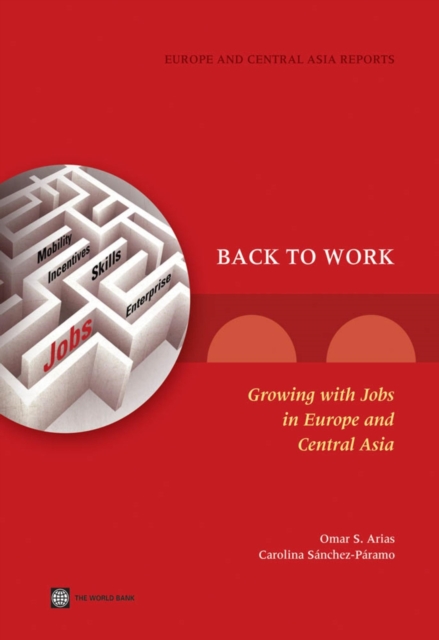
Back to work
Creating more and better jobs is perhaps the most critical challenge to boosting shared prosperity in Europe and Central Asia (ECA). This report examines the role of reforms, firms, skills, incentives and barriers to work, and labor mobility through the lens of two contextual factors: the legacy of centralized planned economies and the mounting demographic pressures associated with rapid aging in some countries and soaring numbers of youth entering the workforce in others. The main findings of the report are: 1) market reforms pay off in terms of jobs and productivity, although with a lag; 2) a small fraction of superstar high-growth firms, largely young, account for most of new jobs created in the region; 3) skills gaps hinder employment prospects, especially of youth and older workers, due to the inadequate response of the education and training systems to changes in the demand for skills; 4) employment is hindered by high implicit taxes on work for those transitioning to formal jobs from inactivity or unemployment and barriers that affect especially women, minorities, youth, and older workers; and 5) low internal labor mobility prevents labor relocation to places with greater job creation potential.
eBook

Why Europe grew rich and Asia did not : global economic divergence, 1600-1850
\"Why Europe Grew Rich and Asia Did Not provides a striking new answer to the classic question of why Europe industrialised from the late eighteenth century and Asia did not. Drawing significantly from the case of India, Prasannan Parthasarathi shows that in the seventeenth and eighteenth centuries the advanced regions of Europe and Asia were more alike than different, both characterized by sophisticated and growing economies. Their subsequent divergence can be attributed to different competitive and ecological pressures that in turn produced varied state policies and economic outcomes. This account breaks with conventional views, which hold that divergence occurred because Europe possessed superior markets, rationality, science or institutions. It offers instead a groundbreaking rereading of global economic development that ranges from India, Japan and China to Britain, France and the Ottoman Empire and from the textile and coal industries to the roles of science, technology and the state\"-- Provided by publisher.
Book
Jobs and growth
Five years after the onset of the global financial crisis, Europe's economy is still fragile. Notwithstanding recent positive signs amid calmer financial markets, medium-term growth is likely to remain frail owing to continuing weaknesses and vulnerabilities at the country level and in the fabric of European institutions and banks, especially in the euro area. In addition, unemployment in many countries has reached very high levels. The IMF research collected in this volume provides a number of guideposts that offer an opportunity for stronger and better-balanced growth and employment in Europe after what has been a long and dismal period of crisis.
eBook