
Catalogue Search | MBRL


Are you sure you want to remove the book from the shelf?

{{itemTitle}}
20,639
result(s) for
"Economic development India."
Sort by:

The Indian renaissance
India's recent economic performance has attracted world attention but the country is re-awakening not just as an economy but as a civilization. After a thousand years of the decline, it now has a genuine opportunity to re-establish itself as a major global power.
eBook

The political economy of India's growth episodes
This book presents an ethical framework which evaluates the legitimacy of the practice of ghostwriting. It explores the connection between personal authenticity and the use of ghostwriters in corporate, political, legal, higher education, and scientific contexts. It then examines the history of ghostwriting as a professional practice and introduces a model for ethical analysis. In this book, the authors shrewdly address crucial ethical questions such as: When is it acceptable for a leader to claim the words of a ghostwriter as their own? When may this be inappropriate or even dangerously misleading? What are the consequences when public awareness of this practice leads to cynicism about the authenticity of leaders and their communications? And when, if ever, is the use of a ghostwriter ethical? This book will be welcomed by scholars and practitioners alike as an original and timely contribution to the literature of business, politics, and communications.
Book

Democracy, Development and Decentralisation in India
Offering new insights into the political economy of contemporary India, this book considers how and why unequal patterns of economic growth have taken shape within the context of a democratic and decentralising political system, and how this has impacted upon the processes of economic development.
eBook

An alternative development agenda for India
\"This book provides a revamped, transformative, and fiscally sustainable developmental agenda for India to radically improve the well-being and livelihoods of its citizens. Grounded in a 'people first' approach, this alternative agenda focuses on seven vital development and inter-connected areas, including health, education, food and nutrition, child development, gender, livelihood and jobs, and urbanization. The volume highlights the systemic issues plaguing these sectors and offers pragmatic and implementable solutions to address them. The author takes cognizance of the COVID-19 pandemic and draws attention to the limitations of the current public policies and suggests cost-effective interventions and strategies that focus on the poor. The volume discusses crucial themes of universalizing healthcare, battling malnutrition and food insecurity, ensuring quality schooling, unshackling gendered mindsets, enhancing livelihoods and improving the urban quality of life to spell out a pragmatic and workable development agenda for India. Accessible and reader-friendly, the book will be an essential read for scholars and researchers of development studies, economics, public policy, governance, development policy, public administration, political studies, South Asia studies. It will also be of interest to professionals in the development sector\"-- Provided by publisher.
Book
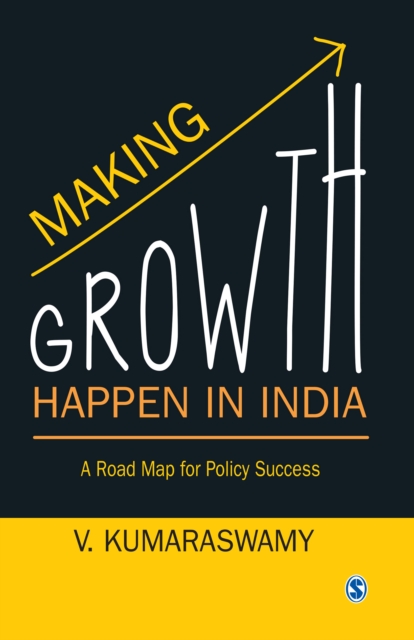
Making growth happen in India : a road map for policy success
For India's economic reforms policy to succeed, its programmes should be firmly anchored in the reality of the social and micro-institutional context-something our policy makers often regrettably ignore. To break out of 8 or 9 per cent growth rates, we need more appropriate skill sets, development of proper attitudinal infrastructure, increased capital productivity, a more optimal savings rate and deliberate creation of socially productive market structures in several areas such as healthcare, public distribution and higher education. Employment is the best way to deliver growth to the vast multitude and reconcile the growth fixation of reformists and socialistic obsession with distribution. The book suggests several unconventional growth engines which can potentially deliver both and make 12 per cent growth rates realistically possible. The book is aimed at people who aspire to take part, debate and shape our destiny but may not have the time for deeper research or patience with economic jargons.
eBook


Dream Zones
Dream Zones explores the dreamed of and desired futures that constitute, sustain and disrupt capitalism in contemporary India. Drawing on five years of research in and around India's Special Economic Zones (SEZs), the book follows the stories of regional politicians, corporate executives, rural farmers, industrial workers and social activists to show how the pursuit of growth, profit and development shapes the politics of industrialisation and liberalisation. This book offers a timely reminder that the global economy is shaped by sentiment as much as reason and that un-realised expectations are the grounds on which new hopes for the future are sown.
eBook


Displacement and Resettlement in India
In the past ten years or so, displacement by development projects has gone on almost untamed under the globalization pressures to meet the demand for land from local and increasingly foreign investors. Focusing on India, this book looks at the complex issue of resettling people who are displaced for the sake of development.
The book discusses how the affected farming communities are fiercely opposing the development projects that often leave them worse off than before, and how this conflict is a matter of serious concern for the planners, as it could discourage potential capital inflows and put India's growth trajectory into jeopardy. It analyses the challenge of protecting the interests of farmers, and at the same time ensuring that these issues do not hinder the path of development. The book goes on to highlight the emerging approaches to resettlement that promise a more equitable development outcome.
A timely analysis of displacement and resettlement, this book has an appeal beyond South Asian Studies alone. It is of interest to policy makers, planners, administrators, and scholars in the field of resettlement and development studies.
eBook