
Catalogue Search | MBRL


Are you sure you want to remove the book from the shelf?

{{itemTitle}}
1,380
result(s) for
"Economic development Islamic countries."
Sort by:


Development Models in Muslim Contexts
This book examines the characteristics of the Chinese economic development model and its reception in Africa and Latin America. It also investigates the current competition over governance models in the Muslim world and asks which model or models will guide development in Muslim countries.
eBook

Economic development and islamic finance
Over the last three decades, the concepts of Islamic finance and Islamic economics have captured the attention of researchers. The growing market for transactions compatible with Islamic law (Shari-áh) is further evidence of growing interest in this mode of finance. By some estimates, the total volume of Islamic financial assets has grown by 15 to 20 percent a year since 1990 and now exceeds 1.3 trillion. The growth of the Islamic financial sector in 2006-10 period surpassed the growth of conventional financial sector in all segments of the market, ranging from commercial banking, investment banking, and fund management to insurance in several Muslim-majority countries. The growth of this market has been driven by the high demand for Shari-áh-compliant products, as well as the increasing liquidity in Gulf region due to high oil revenues.Following on from the significant developments that have occurred in what is viewed as the core area for this marketthe predominantly Muslim countrieswe are now witnessing the globalization of Islamic finance. In recent years, significant interest in Islamic finance has emerged in the worlds leading conventional financial centers, including London, New York, and Hong Kong, and Western investors are increasingly considering investment in Islamic financial products.Although Islamic finance is one of the fastest growing segments of emerging global financial markets, it is often stated that the market is far below its true potential. At the same time, the concepts of Islamic finance are not fully explained and exploitedespecially in the areas of economic development, inclusion, access to finance, and public policy. This volume attempts to highlight some of the key features of Islamic finance relevant to economic development. The objective of the volume is to improve understanding of the perspective of Islamic
finance on economic development, social and economic justice, human welfare, and economic growth.
eBook


The Political Economy of Muslim Countries
The book looks in detail at the economic conditions of Muslim countries specifically, offering a thorough political analysis at the same time. It focuses on a broad range of economic factors and takes into consideration reports such as the World Development Index. It explores striking differences and similarities among carefully chosen Muslim countries. Mainly because of its broad use of different disciplines, it will be of interest to students of political science, economics and history.
eBook

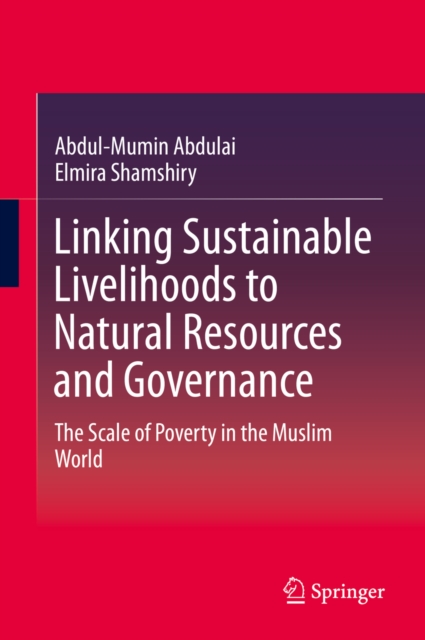
Linking Sustainable Livelihoods to Natural Resources and Governance
This book investigates the current level and trend of poverty in the Muslim World, including selected countries in Africa, the Middle East and Central Asia, East Asia, the Pacific and South America. Authors explore themes of poverty reduction, poverty alleviation and the extent of influences on social and economic development, particularly natural resource endowments (especially mineral resources) and their utilization. Chapters explore theory and practice, including governance and programmes, and take a detailed look at Zakat as a faith-based policy tool, to reduce poverty and improve livelihoods and thus contribute to better environmental stewardship. The final chapters look at development questions in the Muslim World and make policy recommendations, including a proposed multi-dimensional development collaboration model called the Development Collaboration Octagon Model (DeCOM). Readers will discover theoretical explanations of poverty and how poverty hampers the development of many nations because the poor are unable to partake actively in the development process. Poverty indicators and measurement are discussed, and trends of economic growth including productivity, manufacturing, trade patterns, investment and saving activity, and socio-economic developments are all explored: supporting data is presented in tables and figures, throughout this text. Authors explore the potency and success stories of public poverty alleviation strategies and programmes pursued in the Muslim world, especially the extent to which the institution of Zakat has been effectively incorporated into public poverty alleviation strategies. Policy options required to enhance social and economic development are proposed, to help pull the poor out of the poverty trap into the mainstream economy in the Muslim world. This work will appeal to anyone wishing to scrutinise poverty, its parameters and its relationship with the development of countries in the Muslim world. Scholars in the fields of economics, sociology, geography and Islamic studies will all find something of value here.
eBook

Development models in Muslim contexts
Recent discussions of the 'Chinese economic development model', the emergence of an alternative 'Muslim model' over the past quarter century and the faltering globalisation of the 'Washington Consensus' all point to the need to investigate more systematically the nature of these models and their competitive attractions. This is especially the case in the Muslim world which both spans different economic and geographic categories and is itself the progenitor of a development model. The 'Chinese model' has attracted the greatest attention in step with that country's phenomenal growth and therefor
Book