
Catalogue Search | MBRL


Are you sure you want to remove the book from the shelf?

{{itemTitle}}
3,789
result(s) for
"Economic development Political aspects Developing countries."
Sort by:


Beyond the Developmental State
Moving beyond abstract economic models and superficial descriptions of the market, Beyond the Developmental State analyses the economic, political and ideological interests which underpin current socio-economic processes. Through this approach, the contributors show the close interrelation between states and markets in both national and international contexts. Drawing on a wide range of case studies and themes, the book exposes the theoretical and empirical limitations of the developmental state paradigm, offering alternatives as well as discussing the policy implications and challenges they raise. For scholars, students and practitioners of development, Beyond the Developmental State presents a decisive break with the old dogmas of both neoliberal orthodoxy and theories of 'market-imperfection', and outlines theoretically and empirically grounded alternatives.
eBook


Growth against democracy
Growth against Democracy: Savage Developmentalism in the Modern World, by H.L.T. Quan is a compelling interrogation of the ways in which we have thought about modernity, capitalism, and democracy, and how those ideas inform neoliberal economics, diplomacy, and impact human life. To explicate contemporary theories of development, Quan introduces the concept of “savage developmentalism,” with its attendant distortions of the ideals of equality and freedom and assumptions that foment antidemocratic social and political forms. By outlining the pitfalls of security-obsessed developmental approaches, Growth against Democracy troubles the simple notion that modernity is inherently superior and development will benefit everyone. It shows how capitalists' needs for market, finance, and profitability often lead to development programs that engender expansionism, dispossession, and repression. Drawing on political theory, international political economy, critical ethnic studies, legal studies, and feminist analytics, this groundbreaking study exemplifies how multi-disciplinary scholarship best addresses the increasingly complex and multi-layered issues facing humanity today. It analyzes the linkages between development and national security, and provides sustained attention to the making of foreign policy, the development of capitalism and corporate globalization. The book highlights three critical examples of where savage developmentalism has eventuated worse living conditions, severe social repression, and displacement: Brazilian-Japanese economic relations in Brazil under military rule (1964-1985); China’s aggressive courting of African good will and resources; and, the United States’ reconstruction of Iraq. These three major historical cases represent some of the most momentous global development in the last sixty years, and never before have such powerful cases been analyzed in the same monograph. Growth against Democracy helps re-evaluate the promises of progress, security, and freedom, and broadens our ideas about and priorities for humane public policy at the national and global levels.
eBook

Trading away from conflict
While economic growth in developing countries over the last ten years has lifted more people out of poverty than in any previous time, more than one billion people still live in countries affected by violent conflict. Conflict weakens governance, undermines economic development and threatens both national and regional stability. Trade shocks, in particular, can have widely varying impacts on conflict. This report sets out to empirically test these linkages between trade shocks and conflict via cross-country and intra-country analysis. On the basis of the analysis, it offers trade-related policy directions to reduce this risk in fragile economies. The results provide convincing evidence that trade and trade policy have a large impact on the risk and intensity of conflict. This report is composed of three main chapters. Chapter 1 develops a conceptual framework mapping the different channels through which trade may affect conflict and political stability. The framework is based on simple economic theory and the available empirical evidence on the impact of trade related changes on conflict and stability. It then tests this framework empirically through the analysis of cross-country data and through case studies of Nigeria and the Israeli-Palestinian conflict. The hope is that these types of intra-country analyses could be replicated in other countries, since they use data that are available in different countries, especially in sub-Saharan Africa. Chapter 2 uses the same conceptual framework to show how differences in underlying conditions affect the relationship between trade-related changes and conflict. Following a review of the literature on the drivers of conflict, it examines the importance of four groups of grievances: conditions in neighboring countries, factors increasing grievance, government institutions, and policies that affect the transmission of changes in international prices to the domestic market. These relationships are tested using cross-country data and case studies of Nigeria and the Israeli-Palestinian conflict. Finally, chapter 3 uses the existing evidence, as well as evidence generated in this report, to discuss how the policies governing trade can reduce the probability and intensity of conflicts. Two appendixes include detailed information on the modeling framework, the data issues and the estimation results.
eBook


Development and Democracy
Developing societies failed to create their own technological base for progress. How did this affect the prospects for democracy? This volume examines the conflicting relations between technology and development as they unfold in a new and ever more challenging environment.
eBook

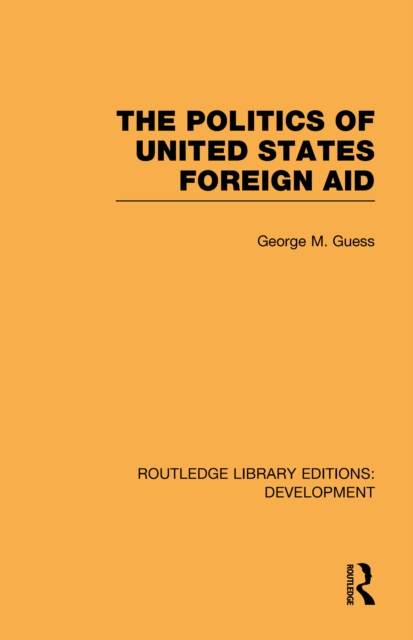
The Politics of United States Foreign Aid
First published in 1987, this reissue explores contemporary United States foreign aid policies and thinking in the Reagan era. The author argues that aid policy is often confused as a result of bureaucratic decision-making processes. The book contrasts the experience of the many countries where aid-giving has produced unwished-for effects with the few countries where the desired results have occurred. The author concludes by arguing for a new approach to aid-giving by the United States.
1. The Political Economy of US Foreign Aid: Past and Present 2. Critical Perspectives on Foreign Aid 3. The Bureaucratic Role Conflict Model 4. US Aid to Latin America 5. US Aid to Asia 6. US Aid to the Middle East 7. Conclusion
eBook