
Catalogue Search | MBRL


Are you sure you want to remove the book from the shelf?

{{itemTitle}}
15,345
result(s) for
"Economic development Political aspects."
Sort by:

The political economy of India's growth episodes
This book presents an ethical framework which evaluates the legitimacy of the practice of ghostwriting. It explores the connection between personal authenticity and the use of ghostwriters in corporate, political, legal, higher education, and scientific contexts. It then examines the history of ghostwriting as a professional practice and introduces a model for ethical analysis. In this book, the authors shrewdly address crucial ethical questions such as: When is it acceptable for a leader to claim the words of a ghostwriter as their own? When may this be inappropriate or even dangerously misleading? What are the consequences when public awareness of this practice leads to cynicism about the authenticity of leaders and their communications? And when, if ever, is the use of a ghostwriter ethical? This book will be welcomed by scholars and practitioners alike as an original and timely contribution to the literature of business, politics, and communications.
Book

Development, Sexual Rights and Global Governance
Drawing on gender, queer and postcolonial studies and representing different regional perspectives, this book critically examines the relationship among gender, sexuality, global governance, development and queer social movements in the global South.
eBook

Making democratic governance work : how regimes shape prosperity, welfare, and peace
\"Is democratic governance good for economic prosperity? Does it accelerate progress towards social welfare and human development? Does it generate a peace-dividend and reduce conflict at home? Within the international community, democracy and governance are widely advocated as intrinsically desirable goals. Nevertheless, alternative schools of thought dispute their consequences and the most effective strategy for achieving critical developmental objectives. This book argues that both liberal democracy and state capacity need to be strengthened to ensure effective development, within the constraints posed by structural conditions. Liberal democracy allows citizens to express their demands, hold public officials to account and rid themselves of ineffective leaders. Yet rising public demands that cannot be met by the state generate disillusionment with incumbent officeholders, the regime, or ultimately the promise of liberal democracy ideals. Thus governance capacity also plays a vital role in advancing human security, enabling states to respond effectively to citizen's demands\"-- Provided by publisher.
Book

Growth against democracy
Growth against Democracy: Savage Developmentalism in the Modern World, by H.L.T. Quan is a compelling interrogation of the ways in which we have thought about modernity, capitalism, and democracy, and how those ideas inform neoliberal economics, diplomacy, and impact human life. To explicate contemporary theories of development, Quan introduces the concept of “savage developmentalism,” with its attendant distortions of the ideals of equality and freedom and assumptions that foment antidemocratic social and political forms. By outlining the pitfalls of security-obsessed developmental approaches, Growth against Democracy troubles the simple notion that modernity is inherently superior and development will benefit everyone. It shows how capitalists' needs for market, finance, and profitability often lead to development programs that engender expansionism, dispossession, and repression. Drawing on political theory, international political economy, critical ethnic studies, legal studies, and feminist analytics, this groundbreaking study exemplifies how multi-disciplinary scholarship best addresses the increasingly complex and multi-layered issues facing humanity today. It analyzes the linkages between development and national security, and provides sustained attention to the making of foreign policy, the development of capitalism and corporate globalization. The book highlights three critical examples of where savage developmentalism has eventuated worse living conditions, severe social repression, and displacement: Brazilian-Japanese economic relations in Brazil under military rule (1964-1985); China’s aggressive courting of African good will and resources; and, the United States’ reconstruction of Iraq. These three major historical cases represent some of the most momentous global development in the last sixty years, and never before have such powerful cases been analyzed in the same monograph. Growth against Democracy helps re-evaluate the promises of progress, security, and freedom, and broadens our ideas about and priorities for humane public policy at the national and global levels.
eBook


Hypocrisy Trap
As the preeminent international development agency for the past sixty years, the World Bank has attracted equal amounts of criticism and praise. Critics are especially quick to decry the World Bank's hypocrisy--the pervasive gaps between the organization's talk, decisions, and actions. In the wake of the Paul Wolfowitz leadership scandal in May 2006, perceptions of hypocrisy have exacted a heavy toll on the Bank's authority and fueled strong demands for wide-scale reform. Yet what exactly does the hypocrisy of the World Bank look like, and what or who causes it? InHypocrisy Trap, Catherine Weaver explores how the characteristics of change in a complex international organization make hypocrisy difficult to resolve, especially after its exposure becomes a critical threat to the organization's legitimacy and survival.
Using a rich sociological model and several years of field research, Weaver delves into the political and cultural worlds within and outside of the Bank to uncover the tensions that incite and perpetuate organized hypocrisy. She examines the sources and dynamics of hypocrisy in the critical cases of the Bank's governance and anticorruption agenda, and its recent Strategic Compact reorganization. The first book to unravel the puzzle of organized hypocrisy in relation to reform at the World Bank,Hypocrisy Trapultimately enriches our understanding of culture, behavior, and change in international organizations.
eBook

Inequality and democratization : an elite-competition approach
\"Research on the economic origins of democracy and dictatorship has shifted away from the impact of growth and turned toward the question of how different patterns of growth - equal or unequal - shape regime change. This book offers a new theory of the historical relationship between economic modernization and the emergence of democracy on a global scale, focusing on the effects of land and income inequality. Contrary to most mainstream arguments, Ben W. Ansell and David J. Samuels suggest that democracy is more likely to emerge when rising, yet politically disenfranchised, groups demand more influence because they have more to lose, rather than when threats of redistribution to elite interests are low\"-- Provided by publisher.
Book
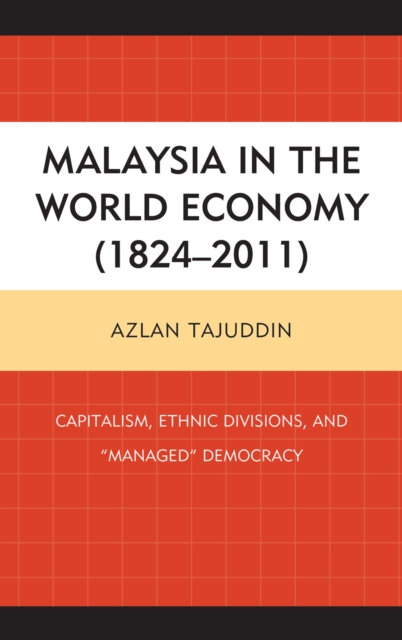
Malaysia in the World Economy (1824-2011)
Does the industrial development of a country entail the democratization of its political system?Malaysia in the World Economy examines this theme with regards to Malaysia in the period between 1824 and 2011.
eBook

The political economy of sustainable development : valuation, distribution, governance
The author shows how sustainable development may be organized, valued and distributed by introducing situational contracting as an interactive and contextual mode of governance. Situational contracting provides a road map for where we want to go, serving the prevailing ideology in implementing the trade between efficiency and fairness.-- Provided by Publisher.
Book

Contested Powers
In the global North the commoditization of creativity and knowledge under the banner of a creative economy is being posed as the post-industrial answer to dependency on labour and natural resources. Not only does it promise a more stable and sustainable future, but an economy focused on intellectual property is more environmentally friendly, so it is suggested. Contested Powers argues that the fixes being offered by this model are bluffs; development as witnessed in Latin American energy politics and governance remains hindered by a global division of labour and nature that puts the capacity for technological advancement in private hands. The authors call for a multi-layered understanding of sovereignty, arguing that it holds the key to undermining rigid accounts of the relationship between carbon and democracy, energy and development, and energy and political expression. Furthermore, a critical focus on energy politics is crucial to wider debates on development and sustainability. Contested Powers is essential reading for those wondering how energy resources are converted into political power and why we still value the energy we take from our surroundings more than the means of its extraction.
eBook