
Catalogue Search | MBRL


Are you sure you want to remove the book from the shelf?

{{itemTitle}}
1,960
result(s) for
"Economic development Uganda."
Sort by:


Developmentality
Drawing on ethnographic fieldwork within the World Bank and a Ugandan ministry, this book critically examines how the new aid architecture recasts aid relations as a partnership. While intended to alter an asymmetrical relationship by fostering greater recipient participation and ownership, this book demonstrates how donors still seek to retain control through other indirect and informal means. The concept of developmentality shows how the World Bank's ability to steer a client's behavior is disguised by the underlying ideas of partnership, ownership, and participation, which come with other instruments through which the Bank manipulates the aid recipient into aligning with its own policies and practices.
eBook
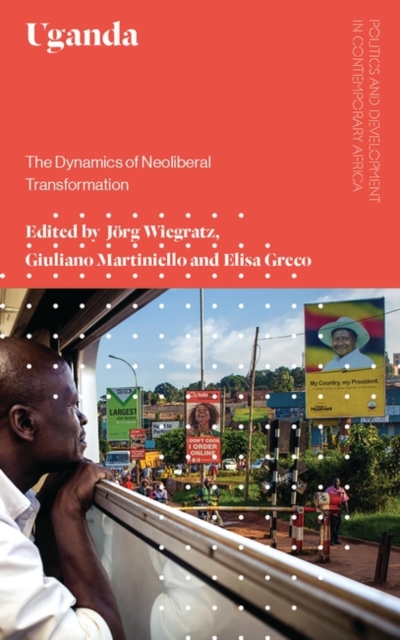
Uganda : the dynamics of neoliberal transformation
For the last three decades, Uganda has been one of the fastest growing economies in Africa. Globally praised as an African success story and heavily backed by international financial institutions, development agencies and bilateral donors, the country has become an exemplar of economic and political reform for those who espouse a neoliberal model of development. The neoliberal policies and the resulting restructuring of the country have been accompanied by narratives of progress, prosperity, and modernisation and justified in the name of development. But this self-celebratory narrative, which is critiqued by many in Uganda, masks the disruptive social impact of these reforms and silences the complex and persistent crises resulting from neoliberal transformation. Bringing together a range of leading scholars on the country, this collection represents a timely contribution to the debate around the New Uganda, one which confronts the often sanitised and largely depoliticised accounts of the Museveni government and its proponents. Harnessing a wealth of empirical materials, the contributors offer a critical, multi-disciplinary analysis of the unprecedented political, socio-economic, cultural and ecological transformations brought about by neoliberal capitalist restructuring since the 1980s. The result is the most comprehensive collective study to date of a neoliberal market society in contemporary Africa, offering crucial insights for other countries in the Global South.
eBook

Gender and economic growth in Uganda : unleashing the power of women
Men and women both play significant, though different, economic roles in Uganda (both contribute around 50% of GDP and women are 39% of business owners). Gender inequality in access to and control of productive assets and resources acts as a brake to womens economic participation and limits economic growth. Labor and time constraints differentially affect womens and mens capacity to engage in business activity, with significant consequences for agricultural productivity in the context of strategic exports. It is therefore important for Uganda to unleash the full productive potential of female as well as male economic actors, if it is to achieve high and sustained rates of pro-poor growth. This book considers the relationship between gender and economic growth in Uganda in the specific context of promoting womens business and entrepreneurship. Building on the findings of the FIAS Uganda Administrative Barriers to Investment Report, 2003, Gender and Economic Growth in Uganda identifies specific legal and administrative barriers to investment that have a gender dimension.
eBook

Advancing the Ugandan Economy
Internal conflicts, dictatorship, and economic disintegration characterized the first twenty-five years of Uganda's independence from British colonial rule, which culminated in the reign of Idi Amin and a violent civil war. The country has since achieved an astounding turnaround of stability and growth. Advancing the Ugandan Economy is a first-hand look at the remarkable policy changes that took place from 1986 to 2012 and their effect in contrast with the turbulent events after independence. Ezra Suruma held several key positions in the Ugandan government during the nation's transition period, including minister of finance. His insightful recounting of those times demonstrates that African countries can achieve economic stability and sustain rapid growth when they meet at least two interdependent conditions: establishing a stable and secure political framework and unleashing entrepreneurialism. Suruma also highlights the strategic areas that still require fundamental reform if Uganda is to become a modern state and shares his vision for the future of his country. Rarely in African history has so much positive political and economic transformation of a country been achieved in such a short time. Suruma's account of the commitment, determination, vision, and dexterity of the Ugandan government holds invaluable lessons in managing the still complex policy challenges facing the African continent.
eBook


Advancing the Ugandan Economy
The first twenty-five years of Uganda's independence from British colonial rule were characterized by internal conflicts, dictatorship, and economic disintegration. Sincethen, the country has benefited from relative political and economic stability and economic growth. Advancing the Ugandan Economy is an account of the remarkable policychanges that took place from 1986 to 2012 and their effect in contrast with the turbulent, violent events after independence.Author Ezra Suruma demonstrates that African countries can achieve economic stability and sustain rapid growth when they meet at least t
Book

Uganda: Fourth Review Under the Policy Support Instrument and Request for Modification of Assessment Criteria - Staff Report; Staff Supplement; Press Release
In recent years, the IMF has released a growing number of reports and other documents covering economic and financial developments and trends in member countries. Each report, prepared by a staff team after discussions with government officials, is published at the option of the member country.
eBook

Beyond Macroeconomic Stability: The Quest for Industrialization in Uganda
Uganda has registered one of the most impressive economic turnarounds of recent decades. The amelioration of conflict and wide ranging economic reforms kick-started rapid economic growth that has now been sustained for some 20 years. But there is a strong sense in policy making circles that despite macroeconomic stability and reasonably well functioning markets, economic growth has not translated into significant structural transformation. This paper considers (i) Uganda's record of economic transformation relative to the high growth Asian countries and (ii) the contending explanations as to why more transformation and higher growth has proved elusive.
eBook

Quality or volume? An economic evaluation of coffee development strategies for Uganda
The article identifies challenges and opportunities for the Ugandan robusta coffee industry in the context of the global coffee crisis. It presents a qualitative and quantitative evaluation of development strategies through which Uganda might promote its largest export commodity. It is suggested that Uganda would benefit from moderately increasing robusta production, while a further decline in output could undermine its current price premium in the market. There may also be important benefits associated with increasing the value of Ugandan robusta through improvements in quality.
Journal Article