
Catalogue Search | MBRL


Are you sure you want to remove the book from the shelf?

{{itemTitle}}
16,669
result(s) for
"Economic externalities"
Sort by:

The cost of globalization : dangers to the earth and its people
\"This volume examines the many pitfalls of globalization from the perspective of impoverished and indigenous peoples, including the widening wealth gap, the struggle for restoration of dispossessed lands and cultural rights, global warming and ecological annihilation, and the experiences of women in underdeveloped regions who receive little benefit from their labor and are subject to violence\"-- Provided by publisher.
Book

Optimal Bundling of Technological Products with Network Externality
For many high-tech and Internet-related products, utility to consumers depends in part on the size of the user base, a phenomenon called network externality. A firm with a portfolio of these and other products-that are often asymmetric in their degree of network externality or marginal cost-may have to look beyond the traditional strategies of pure components, pure bundling, and mixed bundling. One such strategic alternative in a two-product case would be a so-called mixed bundling-1 under which the bundle and product 1 are offered, but the other product can only be purchased in a bundled form. The purpose of this study is to compare and contrast the impact of such asymmetry or symmetry in (direct) network externality and cost on the choice of bundling strategies. We model a monopolist firm that has a product in each of two categories and faces heterogeneous consumers. Results suggest that pure bundling is more profitable when both products have low marginal costs or high network externality whereas pure components or mixed bundling-1 is more profitable when the products diverge in their costs and network externality (e.g., only one product has network externality). Traditional mixed bundling is optimal in other instances.
Journal Article

Global warming and economic externalities
Despite worldwide policy efforts such as the Kyoto Protocol, the emission of greenhouse gases (GHG) remains a negative externality. Economic equilibrium paths in the presence of such an uncorrected externality are inefficient; as a consequence, there is no real economic opportunity cost to correcting this externality by mitigating global warming. Mitigation investment using resources diverted from conventional investments can raise the economic well-being of both current and future generations. The economic literature on GHG emissions misleadingly focuses attention on the intergenerational equity aspects of mitigation by using a hybrid constrained optimal path as the \"business-as-usual\" benchmark. We calibrate a simple Keynes-Ramsey growth model to illustrate the significant potential Pareto improvement from mitigation investment and to explain the equilibrium concept appropriate to modeling an uncorrected negative externality.
Journal Article

Will Road Infrastructure Become the New Engine of Urban Growth? A Consideration of the Economic Externalities
Highway accessibility plays a vital role in supporting local economic development, particularly in regions lacking access to sea or river ports. Recognizing the functional transformation of road infrastructure, the Chinese government has made substantial investments in its expansion. Nevertheless, a theoretical gap remains in justifying whether such investments yield significant economic returns. Drawing on the theory of economic externalities, this study investigates the causal relationship between highway development and regional economic growth, and assesses whether highway construction leads to an acceleration in growth rates. Utilizing panel data from 14 Chinese cities spanning 2000 to 2014, the synthetic control method (SCM) is employed to evaluate the economic externalities of highway investment. The results indicate a positive impact on surrounding industries. Furthermore, a growth rate forecasting analysis based on Back-Propagation Neural Networks (BPNNs) is conducted using industrial enterprise data from 2005 to 2014. The growth rate in the treated city is 1.144%, which is close to the real number 1.117%, higher than the number for the weighted control group, which is 1.000%. The findings suggest that the growth rate of total industrial output improved significantly, confirming the existence of positive spillover effects. This not only enriches the empirical literature on transport infrastructure but also provides targeted enlightenment for the sustainable development of urban economy in terms of policy guidance.
Journal Article
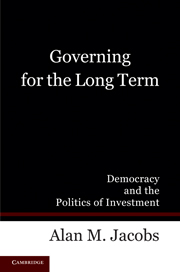
Governing for the Long Term
In Governing for the Long Term, Alan M. Jacobs investigates the conditions under which elected governments invest in long-term social benefits at short-term social cost. Jacobs contends that, along the path to adoption, investment-oriented policies must surmount three distinct hurdles to future-oriented state action: a problem of electoral risk, rooted in the scarcity of voter attention; a problem of prediction, deriving from the complexity of long-term policy effects; and a problem of institutional capacity, arising from interest groups' preferences for distributive gains over intertemporal bargains. Testing this argument through a four-country historical analysis of pension policymaking, the book illuminates crucial differences between the causal logics of distributive and intertemporal politics and makes a case for bringing trade-offs over time to the center of the study of policymaking.
eBook

Contracting with Externalities
The paper studies contracting between one principal and N agents in the presence of multilateral externalities. When the principal commits to publicly observed bilateral contracts, inefficiencies arise due to the externalities on agents' reservation utilities. In contrast, when the principal's offers are privately observed, inefficiencies are due to the externalities at efficient outcomes. When the principal can condition her trade with each agent on others' messages, she implements an efficient outcome, while threatening deviators with the harshest possible punishment. However, in the presence of noise that goes to zero more slowly than N goes to infinity, asymptotically agents become nonpivotal, and inefficiency obtains.
Journal Article

THE ECONOMICS OF DENSITY: EVIDENCE FROM THE BERLIN WALL
This paper develops a quantitative model of internal city structure that features agglomeration and dispersion forces and an arbitrary number of heterogeneous city blocks. The model remains tractable and amenable to empirical analysis because of stochastic shocks to commuting decisions, which yield a gravity equation for commuting flows. To structurally estimate agglomeration and dispersion forces, we use data on thousands of city blocks in Berlin for 1936, 1986, and 2006 and exogenous variation from the city's division and reunification. We estimate substantial and highly localized production and residential externalities. We show that the model with the estimated agglomeration parameters can account both qualitatively and quantitatively for the observed changes in city structure. We show how our quantitative framework can be used to undertake counterfactuals for changes in the organization of economic activity within cities in response, for example, to changes in the transport network.
Journal Article

Showrooming and Webrooming: Information Externalities Between Online and Offline Sellers
In a product market where consumers are open to uninformed purchases, we study competition between a traditional and an online retailer in the presence of showrooming. Several results are obtained. First, showrooming intensifies competition and lowers both firms’ profits, thus supporting traditional and online retailers’ recent strategy of carrying more exclusive varieties. Second, lowering consumer search costs may aggravate showrooming and decrease the traditional retailer’s profits for intermediate search costs. Third, opening an online store expands the demand of the traditional retailer but intensifies competition, thus lowering its profits under certain conditions. Fourth, a return policy by the online retailer alleviates showrooming and relaxes competition but weakly reduces its demand, increasing its profits only for intermediate search costs. The return policy (weakly) increases the traditional retailer’s profits. Fifth, when search cost is not high enough, price matching by the traditional retailer may also intensify competition and hurt its profits. We then examine how webrooming interacts with showrooming. When webrooming resolves partial match uncertainty, it may increase both firms’ profits by inducing more consumers to participate.
The online appendix is available at
https://doi.org/10.1287/mksc.2018.1084
.
Journal Article

How to Get What You Want When You Do Not Know What You Want: A Model of Incentives, Organizational Structure, and Learning
In this paper we present a model of the interplay among learning, managerial intervention, and the allocation of decision rights in the context of a generalized agency problem. Within this context, actors face not only conflicting interests but also diverging cognitive “visions” of the right course of action. We assume that a principal may obtain the implementation of desired organizational policies by means of appropriate design of the allocation of decisions or by means of costly intervention through authority or incentives, and we analyze their consequences for organizational control and learning. We show that the structure of allocation of decision rights is very powerful in terms of control, but when the principal is uncertain about the course of action, organizational structure and managerial intervention complement each other in nontrivial ways and must be carefully tuned. We also show that there is a general advantage in maximizing the partitioning decision rights, because it allows both higher control and higher levels of learning.
Journal Article

Collective Action Federalism: A General Theory of Article I, Section 8
The Framers of the United States Constitution wrote Article I, Section 8 in order to address some daunting collective action problems facing the young nation. They especially wanted to protect the states from military warfare by foreigners and from commercial warfare against one another. The states acted individually when they needed to act collectively, and Congress lacked power under the Articles of Confederation to address these problems. Section 8 thus authorized Congress to promote the \"general Welfare\" of the United States by tackling many collective action problems that the states could not solve on their own. Subsequent interpretations of Section 8, both outside and inside the courts, often have focused on the presence or absence of collective action problems involving multiple states—but not always. For example, the Supreme Court of the United States, in trying to distinguish the \"truly national\" from the \"truly local\" in the context of the Commerce Clause, United States v. Morrisoa 529 U.S. 598, 617-18 (2000), has differentiated \"economic\" activity, which Congress may regulate, from \"noneconomic\" activity, which Congress may not regulate. A federal constitution ideally gives the central and state governments the power to do what each does best. But economic activity does not generally cause collective action problems among the states, and noneconomic activity is not generally free from collective action problems. Consequently, Congress is not generally better at regulating economic activity, and the states are not generally better at regulating noneconomic activity. The distinction between economic and noneconomic activity seems mostly irrelevant to the problems of federalism. We propose a better foundation for American federalism in Section 8. Our theory distinguishes activities that pose collective action problems from those that do not. This approach flows directly from the relative advantages of the federal government and the states. We show that Section 8 mostly concerns collective action problems created by interstate externalities and national markets. We conclude that Section 8 authorizes Congress to tax, spend, and regulate to solve these collective action problems. Collective action federalism finds that the limits and expanse of congressional power in Section 8 turn on the difference between individual and collective action by the states. The theory uses this distinction to differentiate interstate commerce from intrastate commerce, not the economic/noneconomic distinction. Our distinction best explains why Congress may not ordinarily use its commerce power to regulate such crimes as assault or gun possession in schools. Collective action federalism also identifies a constitutional \"hook\" for Congress to regulate multi-state problems of collective action that may not involve commerce: Clause I of Section 8 authorizes some forms of regulation of noneconomic harms that spill over state boundaries, such as contagious diseases and certain kinds of environmental pollution.
Journal Article