
Catalogue Search | MBRL


Are you sure you want to remove the book from the shelf?

{{itemTitle}}
134,977
result(s) for
"Economics, Mathematical."
Sort by:

Monopsony in Motion
What happens if an employer cuts wages by one cent? Much of labor economics is built on the assumption that all the workers will quit immediately. Here, Alan Manning mounts a systematic challenge to the standard model of perfect competition.Monopsony in Motionstands apart by analyzing labor markets from the real-world perspective that employers have significant market (or monopsony) power over their workers. Arguing that this power derives from frictions in the labor market that make it time-consuming and costly for workers to change jobs, Manning re-examines much of labor economics based on this alternative and equally plausible assumption.
The book addresses the theoretical implications of monopsony and presents a wealth of empirical evidence. Our understanding of the distribution of wages, unemployment, and human capital can all be improved by recognizing that employers have some monopsony power over their workers. Also considered are policy issues including the minimum wage, equal pay legislation, and caps on working hours. In a monopsonistic labor market, concludes Manning, the \"free\" market can no longer be sustained as an ideal and labor economists need to be more open-minded in their evaluation of labor market policies.Monopsony in Motionwill represent for some a new fundamental text in the advanced study of labor economics, and for others, an invaluable alternative perspective that henceforth must be taken into account in any serious consideration of the subject.
eBook


The World in the Model
During the last two centuries, the way economic science is done has changed radically: it has become a social science based on mathematical models in place of words. This book describes and analyses that change - both historically and philosophically - using a series of case studies to illuminate the nature and the implications of these changes. It is not a technical book; it is written for the intelligent person who wants to understand how economics works from the inside out. This book will be of interest to economists and science studies scholars (historians, sociologists and philosophers of science). But it also aims at a wider readership in the public intellectual sphere, building on the current interest in all things economic and on the recent failure of the so-called economic model, which has shaped our beliefs and the world we live in.
eBook


How Economists Model the World into Numbers
Economics is dominated by model building, therefore a comprehension of how such models work is vital to understanding the discipline. This book provides a critical analysis of the economist's favourite tool, and as such will be an enlightening read for some, and an intriguing one for others.
1. Introduction 2. A New Practice 3. Autonomy 4. Designs of Experiments 5. Measurement 6. Rigor 7. Conclusions
'Boumans has written a rich, deeply informed and insightful book'.
- Kevin D. Hoover, Duke University, USA; Journal of Economic Methodology, Vol. 16, No. 4, December 2009, 417–434
eBook

Simulation in computational finance and economics : tools and emerging applications
\"This book presents a thorough collection of works, covering several rich and highly productive areas of research including Risk Management, Agent-Based Simulation, and Payment Methods and Systems, topics that have found new motivations after the strong recession experienced in the last few years\"--Provided by publisher.
Book

Designing Economic Mechanisms
A mechanism is a mathematical structure that models institutions through which economic activity is guided and coordinated. There are many such institutions; markets are the most familiar ones. Lawmakers, administrators and officers of private companies create institutions in order to achieve desired goals. They seek to do so in ways that economize on the resources needed to operate the institutions, and that provide incentives that induce the required behaviors. This book presents systematic procedures for designing mechanisms that achieve specified performance, and economize on the resources required to operate the mechanism. The systematic design procedures are algorithms for designing informationally efficient mechanisms. Most of the book deals with these procedures of design. When there are finitely many environments to be dealt with, and there is a Nash-implementing mechanism, our algorithms can be used to make that mechanism into an informationally efficient one. Informationally efficient dominant strategy implementation is also studied.
eBook
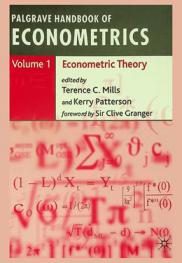
Palgrave handbook of econometrics
Palgrave Handbooks of Econometrics comprises 'landmark' essays by the world's leading scholars and provides authoritative guidance in key areas of econometrics. With definitive contributions on the subject, the Handbook is an essential source for reference for professional econometricians, economists, researchers and students. Following the successful Palgrave Handbook of Econometrics: Volume 1, this second volume brings together leading academics working in econometrics today and explores applied econometrics. Volume 2 contains contributions on subjects including growth/development econometrics, computing, microeconomics, macroeconomics, finance, spatial and urban economics and international economics. -- Back cover.

Theory of Games and Economic Behavior (60th Anniversary Commemorative Edition)
This is the classic work upon which modern-day game theory is based. What began more than sixty years ago as a modest proposal that a mathematician and an economist write a short paper together blossomed, in 1944, when Princeton University Press publishedTheory of Games and Economic Behavior. In it, John von Neumann and Oskar Morgenstern conceived a groundbreaking mathematical theory of economic and social organization, based on a theory of games of strategy. Not only would this revolutionize economics, but the entirely new field of scientific inquiry it yielded--game theory--has since been widely used to analyze a host of real-world phenomena from arms races to optimal policy choices of presidential candidates, from vaccination policy to major league baseball salary negotiations. And it is today established throughout both the social sciences and a wide range of other sciences.
This sixtieth anniversary edition includes not only the original text but also an introduction by Harold Kuhn, an afterword by Ariel Rubinstein, and reviews and articles on the book that appeared at the time of its original publication in theNew York Times, ttheAmerican Economic Review, and a variety of other publications. Together, these writings provide readers a matchless opportunity to more fully appreciate a work whose influence will yet resound for generations to come.
eBook