
Catalogue Search | MBRL


Are you sure you want to remove the book from the shelf?

{{itemTitle}}
299
result(s) for
"Ecoterrorism."
Sort by:

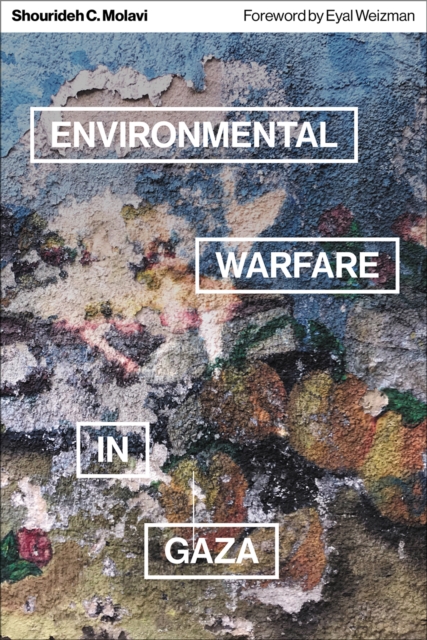
Environmental Warfare in Gaza
The perimeter around the occupied Gaza Strip is formed by a sophisticated system of fences, forts and surveillance technologies. With each Israeli incursion, a military no-go area, or a 'buffer zone', is established along Gaza's 'borders', extending deep into Palestinian residential areas and farmlands— further compounding the Gaza Strip's isolation from the rest of Palestine.
Since 2014, the bulldozing of Palestinian lands by the Israeli occupation forces has been complemented by unannounced aerial spraying of military herbicides, extending the reach of Israeli violence into the realm of chemical warfare. Today, the spraying has destroyed entire swaths of arable land in Gaza, forcibly changing a once-lush Palestinian landscape, and providing the Israeli army with better visibility to fire at Palestinian targets with lethal force from a distance.
This book is a vivid document of this latest stage of Israeli warfare, including original maps, images and visualisations which deepen our understanding of its environmental and human impact. It collects new documents, original archival materials, stills of drone footage, first-hand testimonies of farmers, organisers and protesters, and documents affected vegetation in Gaza as 'silent witnesses' to Israeli settler-colonial violence.
eBook


Preface
The issues addressed in this EPL issue comprise the future of UNEP, human rights approach to environment protection, going beyond sustainability, a new architecture for the Third Pole Region (TPR), standing to sue for natural resources and ecocide, challenge of plastic pollution, greening the world trade and environmental terrorism. [...]his life became intertwined with the life of UNEP. [...]Greg Rose has raised the age-old approach of 'scorched earth' mostly followed in the armed conflicts by different parties.
Journal Article

Icon : the persona sequence
\"A year ago, International Assembly delegate Suyana Sapaki barely survived an attempt on her life. Now she's climbing the social ranks, dating the American Face, and poised for greatness. She has everything she wants, but the secret that drives her can't stay hidden forever. When she quickly saves herself from a life-threatening political scandal, she gains a new enemy: the public eye. Daniel Park was hoping for the story of a lifetime. And he got her. He's been following Suyana for a year. But what do you do when this person you thought you knew has vanished inside the shell, and dangers are building all around you?\"--Amazon.com.
Book

The Devouring I/Eye: Critiquing Fatherly Fairy Tales, Heroic Myths, and Patriarchal History and Science in Sexing the Cherry
1 The novel's revision of various genres, including myth, fairy tale, literary text, historical record, paintings, and maps intensifies its political engagement with patriarchal and colonial ways of knowing, decrying biases inherent in much literary production and historical record and suggesting the development of visual perspective increased human opportunities for objectification and colonization by over-emphasizing the seeing/reading eye: observation/objectification (I) and ownership/possession (my). The omission of the complicit, traitorous woman and the emphasis on all twelve sisters sharing the same fate of arranged marriage is significant because Sexing the Cherry displays female solidarity in various communities of nuns, prostitutes, sisters, and dancers and castigates the strict social, sexual, and economic control exerted by the father and his allies in the original. Fighting for control, he corrects Fortunata: 'That you escaped, yes, but that you flew away and walked on a wire that stretched from the steeple of the church to the mast of a ship at anchor in the bay. \"Fortunata's Story,\" is a conflation of the myths of Artemis and her relationships with human Acteon and giant Orion that explains the dancer's her way of life and her devotion to the Greek goddess of the moon and the hunt.4 This myth, like the tale of Fortunata's sisters, is altered.
Journal Article


Climate Change, Environmental Terrorism, Eco-Terrorism and Emerging Threats
The footprint of human advancement has accelerated a climate variability with no
precedents, further driving devastating natural and social events. The decrease
in basic resources like water, has already been identified as a driver of
violent conflicts, which have given way to the strengthening of terrorist
organizations that used the environment as a tool of coercion. The damage caused
to the earth’s ecosystem has additionally raised a wave of defensive activism
that was initially considered as eco-terrorism. While the original eco-movements
had not induced fatalities, recent extremist organizations are showing a more
violent anti-progress and pro-environment agenda. Added to these, the response
of the states against environmental activism initiatives, has spiked some
concerns over the repression of civil liberties, which may have the potential to
fuel the angering of extreme individuals, who can be prompted to take
radicalized action. Using open source data, this article shows that
environmental terrorism represents an increasing security threat, which in the
future, might be worsened by the individual radicalization of marginalized
environmental extremists.
Journal Article


Covert rewilding: Modelling the detection of an unofficial translocation of Tasmanian devils to the Australian mainland
Covert rewilding is the secret and illegal translocation of species in the pursuit of conservation objectives. Recent history contains multiple covert rewilding events, frequently occurring after official permission was denied. In order to better understand the phenomenon, I formulate covert rewilding as an optimisation problem, with the goal of creating a population that is too large to be eradicated once it is detected. I then consider a hypothetical covert rewilding of Tasmanian devils Sarcophilus harrisii to the Australian mainland. Three different release locations would allow a covert devil population to remain undetected for years, by which time its size and distribution may preclude eradication. Optimal release locations also represent optimal locations for official surveillance, but a more effective approach to halting covert rewilding could be a more permissive stance towards legal rewilding.
Journal Article