
Catalogue Search | MBRL


Are you sure you want to remove the book from the shelf?

{{itemTitle}}
164
result(s) for
"Ecotheology"
Sort by:

Old English Ecotheology
This book examines the impact of environmental crises on early medieval English theology and poetry. Like their modern counterparts, theologians at the turn of the first millennium understood the interconnectedness of the Earth community, and affirmed the independent subjectivity of other-than-humans. The author argues for the existence of a specific Old English ecotheology, and demonstrates the influence of that theology on contemporaneous poetry. Taking the Exeter Book as a microcosm of the poetic corpus, she explores the impact of early medieval apocalypticism and environmental anxiety on Old English wisdom poems, riddles, elegies, and saints’ lives.
eBook

Bonhoeffer and climate change : theology and ethics for the Anthropocene
Where is the voice of theology in the public discourse around anthropogenic climate change? How do we understand the human relationship to Earth and the ecology of which we are a part? How can we account for the human attempt to dominate nature and the devastation we have caused to our own home? Dianne Rayson addresses these questions. She uses the creation theology of Dietrich Bonhoeffer to examine what it means to be human in the post-Holocene age. Employing a range of Bonhoeffer's texts, Rayson posits that Bonhoeffer's Christological theology and this-worldly ethical orientation provide the tools for an Earthly Christianity. She responds to Bonhoeffer's question, \"who actually is Jesus Christ, for us, today?\" and proposes a Bonhoefferian ecoethic.-- Source other than the Library of Congress.
Book

John Buchanan of Zomba: Disgraced missionary or pioneer of ecotheology?
This article notes that tree-planting and environmental stewardship were prominent during the early years of Blantyre Mission, particularly through the work of artisan missionary John Buchanan. His appreciation of the Malawi environment included both concern for sustainability and ambition to develop successful commercial enterprise. Although implicated in a scandal that led to his dismissal from Blantyre Mission, he continued his work at Zomba, where he developed a successful estate. His coffee plantation offered opportunities for the workers to attend both church and school, which many opted to do. The pioneering plantation was hailed as the fulfilment of the vision that David Livingstone had developed for central Africa. A determined opponent of the East African slave trade, Buchanan advocated increasing British influence and, as Acting Consul, declared the British Protectorate in 1889. He was also instrumental in encouraging European settlers to acquire land and establish plantations in Malawi, seeing this as a strategy to counter the slave trade and oblivious to the negative effects on the Malawian community of alienation of some of the best land in the country. After a decade in Malawi, he calculated that he had preached 1000 sermons and collected 1000 plants – a distinctive combination. His contemporary relevance lies in his role as a champion of Malawi’s trees. He understood that sustaining its tree cover was of vital importance to the environment and was active himself as a tree planter. Although lacking training in academic theology, he made the connection between his evangelical Christian faith and his sense of environmental responsibility. In this regard he can be considered a pioneer of ecotheology. Intradisciplinary and/or interdisciplinary implications: This article draws on the disciplines of history, missiology and environmental science. It interrogates the understanding of faith that led to John Buchanan’s advocacy of environmental stewardship as an integral element in his understanding of Christian mission.
Journal Article

The new possible : visions of our world beyond crisis
\"In the midst of loss and death and suffering, our charge is to figure out what freedom really means--and how we take steps to get there. The uprising of 2020 marked a new phase in the unfolding Movement for Black Lives. The brutal killings of Ahmaud Arbery, George Floyd, and Breonna Taylor, and countless other injustices large and small, were the match that lit the spark of the largest protest movement in US history, a historic uprising against racism and the politics of disposability that the Covid-19 pandemic lays bare. In this urgent and incisive collection of new interviews bookended by two new essays, Marc Lamont Hill critically examines the \"pre-existing conditions\" that have led us to this moment of crisis and upheaval, guiding us through both the perils and possibilities, and helping us imagine an abolitionist future.\"--Barnesandnoble.com
Book

Conversión ecológica en clave de los Ejercicios Espirituales de San Ignacio de Loyola
¿Tienen las espiritualidades al interior de la Iglesia Católica elementos relevantes que aportar en la transición hacia estilos de vida que apunten más decididamente hacia la sustentabilidad? Respondiendo a esta pregunta, el artículo explora el potencial de los Ejercicios Espirituales de San Ignacio de Loyola de suscitar una conversión ecológica. Además de mostrar la complejidad de la pregunta, no hay evidencia de que el factor religioso esté siendo significativo en la toma de decisiones hacia la sustentabilidad, ni existe una comprensión unívoca de lo que implica la conversión ecológica. Se analizan cuatro estrategias de respuesta en busca de una criteriología que permita responder a la pregunta: el recurso a las experiencias de San Ignacio; el análisis de la teología subyacente a las meditaciones y contemplaciones principales; los valores propiciados por los Ejercicios Espirituales pertinentes en el contexto de la crisis ecológica; y la posibilidad de insertar temáticamente la cuestión ecológica en algunos momentos clave del proceso.Mientras que las dos primeras estrategias muestran la no contradicción de los Ejercicios Espirituales con la creciente sensibilidad ecológica, las dos últimas habilitan indirectamente al texto/proceso para suscitar una conversión ecológica. Queda pendiente la elaboración de un directorio de cómo proponer los Ejercicios Espirituales en clave ecológica que recoja las experiencias y prácticas actuales. El análisis de las cuatro estrategias de respuesta sirve de matriz, a su vez, para examinar el enfoque de cualquier otra espiritualidad cristiana en vistas de la conversión ecológica de sus practicantes.
Journal Article
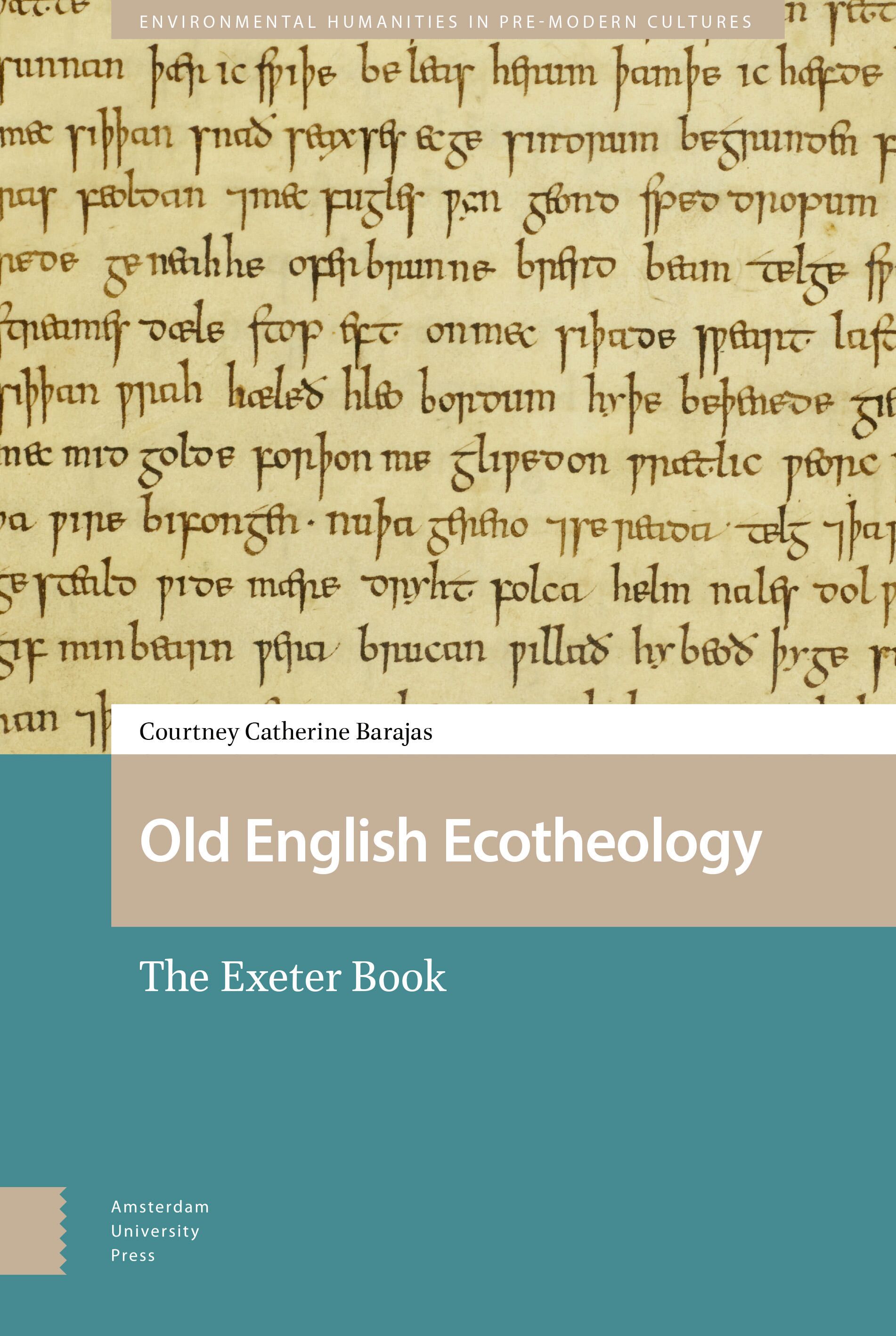
Old English Ecotheology
Old English Ecotheology examines the impact of environmental crises on early medieval English theology and poetry. Like their modern counterparts, theologians at the turn of the first millennium understood the interconnectedness of the Earth community, and affirmed the independent subjectivity of other-than-humans. The author argues for the existence of a specific Old English ecotheology, and demonstrates the influence of that theology on contemporaneous poetry. Taking the Exeter Book as a microcosm of the poetic corpus, she explores the impact of early medieval apocalypticism and environmental anxiety on Old English wisdom poems, riddles, elegies, and saints' lives.
eBook

Old English Ecotheology
Old English Ecotheology examines the impact of environmental crises on early medieval English theology and poetry. Like their modern counterparts, theologians at the turn of the first millennium understood the interconnectedness of the Earth community, and affirmed the independent subjectivity of other-than-humans. The author argues for the existence of a specific Old English ecotheology, and demonstrates the influence of that theology on contemporaneous poetry. Taking the Exeter Book as a microcosm of the poetic corpus, she explores the impact of early medieval apocalypticism and environmental anxiety on Old English wisdom poems, riddles, elegies, and saints' lives.
eBook
Where ecospirituality is grounded: Nature as place
Place is a fundamental dimension of human existence, yet its meaning remains complex and contested across disciplines. This article examines how the notion of nature as place can be understood as a core category within ecospirituality. Drawing on selected interdisciplinary themes from ecophilosophy and ecotheology, the article argues that the significance of nature as place in ecospirituality can be articulated through a conceptual trajectory that includes the physical-geographical concreteness of place, the interrelation between humans and nature, the cultivation of emotional awareness and ultimately the transformative potential of aesthetic experiences in nature. Intradisciplinary and/or interdisciplinary implications: Taken together, these perspectives offer valuable resources for a deeper understanding of nature as place in ecospirituality and demonstrate that nature as place functions as a precondition for fostering ethical awareness of our surrounding nature.
Journal Article

From marginalisation to mission: Akit’s indigenous ecological knowledge for transformissional ecotheology
This study introduces the concept of transformissional ecotheology (TE) as a multidisciplinary framework that integrates indigenous ecological knowledge (IEK) with Christian theological discourse to address contemporary environmental challenges. Focussing on the Akit Tribe of Karimun Island, Indonesia, the research explores the tribe’s deep ecological wisdom and spiritual practices, which are rooted in a profound interconnectedness with nature. A hybrid-method approach was employed, integrating literature from sociology, theology and environmental studies, and combining both qualitative and quantitative data collection methods. Data were gathered through in-depth interviews, focus group discussions, participant observation, document analysis and surveys. The study investigates how the Akit’s ecological practices, such as ambek secukupnye [taking only what is needed], Betabek [salutary respect], the Bele [defending] rituals and other traditional practices can inform and transform contemporary Christian theology. The findings indicate that the ecological knowledge of the Akit Tribe plays a crucial role in addressing environmental challenges. The socio-historical context shapes these challenges and their responses, underscoring the need for a transformative approach that integrates spiritual and ecological perspectives. The study concludes that a cultural approach based on the Akit Tribe’s wisdom can strengthen the framework of TE, promoting effective global theological and ecological interventions.ContributionThis study significantly advances the integration of IEK with theological discourse, offering a framework for addressing local, national and global ecological challenges through culturally resonant and sustainable practices.
Journal Article