
Catalogue Search | MBRL


Are you sure you want to remove the book from the shelf?

{{itemTitle}}
13,521
result(s) for
"Ecuador"
Sort by:


In the Shadow of Tungurahua
In the Shadow of Tungurahua relates the stories of the people of Penipe, Ecuador living in and between several villages around the volcano Tungurahua and two resettlement communities built for people displaced by government operations following volcanic eruptions in 1999 and 2006. The stories take shape in ways that influence prevailing ideas about how disasters are produced and reproduced, in this case by shifting assemblages of the state first formed during Spanish colonialism attempting to settle (make \"legible\") and govern Indigenous and campesino populations and places. The disasters unfolding around Tungurahua at the turn of the 21st century also provide lessons in the humanitarian politics of disaster—questions of deservingness, reproducing inequality, and the reproduction of bare life. But this is also a story of how people responded to confront hardships and craft new futures, about forms of cooperation to cope with and adapt to disaster, and the potential for locally derived disaster recovery projects and politics.
eBook


Remembering the hacienda : religion, authority, and social change in highland Ecuador
From the colonial period through the mid-twentieth century, haciendas dominated the Latin American countryside. In the Ecuadorian Andes, Runa-Quichua-speaking indigenous people-worked on these large agrarian estates as virtual serfs. In Remembering the Hacienda: Religion, Authority, and Social Change in Highland Ecuador, Barry Lyons probes the workings of power on haciendas and explores the hacienda's contemporary legacy. Lyons lived for three years in a Runa village and conducted in-depth interviews with elderly former hacienda laborers. He combines their wrenching accounts with archival evidence to paint an astonishing portrait of daily life on haciendas. Lyons also develops an innovative analysis of hacienda discipline and authority relations. Remembering the Hacienda explains the role of religion as well as the reshaping of Runa culture and identity under the impact of land reform and liberation theology. This beautifully written book is a major contribution to the understanding of social control and domination. It will be valuable reading for a broad audience in anthropology, history, Latin American studies, and religious studies.
eBook


Ordinary Families, Extraordinary Lives: Assets and Poverty Reduction in Guayaquil, 1978-2004
Fifty years after Oscar Lewis's famous depiction of five Mexican families caught in a \"culture of poverty,\" Caroline Moser tells a very different story of five neighborhood women and their families strategically accumulating assets to escape poverty in the Ecuadoran city of Guayaquil. InOrdinary Families, Extraordinary Lives, Moser shows how a more sophisticated understanding of the complexities of asset accumulation as well as poverty itself can help counter inaccurate stereotypes about global poverty. It provides invaluable insight into strategies that may help people in developing countries improve their wellbeing.
The similar socioeconomic characteristics and economic circumstances of the Guayaquil families in 1978, when Moser began her research, set the stage for a natural experiment. By 2004, these circumstances varied widely. Moser captures the causes and consequences of these developments through economic data, anthropological narrative, and personal photos. She then places this compelling story within the broader context of political, economic, and spatial changes in Guayaquil and Ecuador.
Moser describes how households in a Third World urban slum relentlessly and systematically fought to accumulate human, social, and financial capital assets. Her longitudinal account of their odyssey captures long-term trends and changes in perception that are missed in snapshot assessments. Chapters in this holistic story cover diverse issues such as housing and infrastructure, community mobilization and political negotiation, employment, family dynamics, violence, and emigration.
eBook

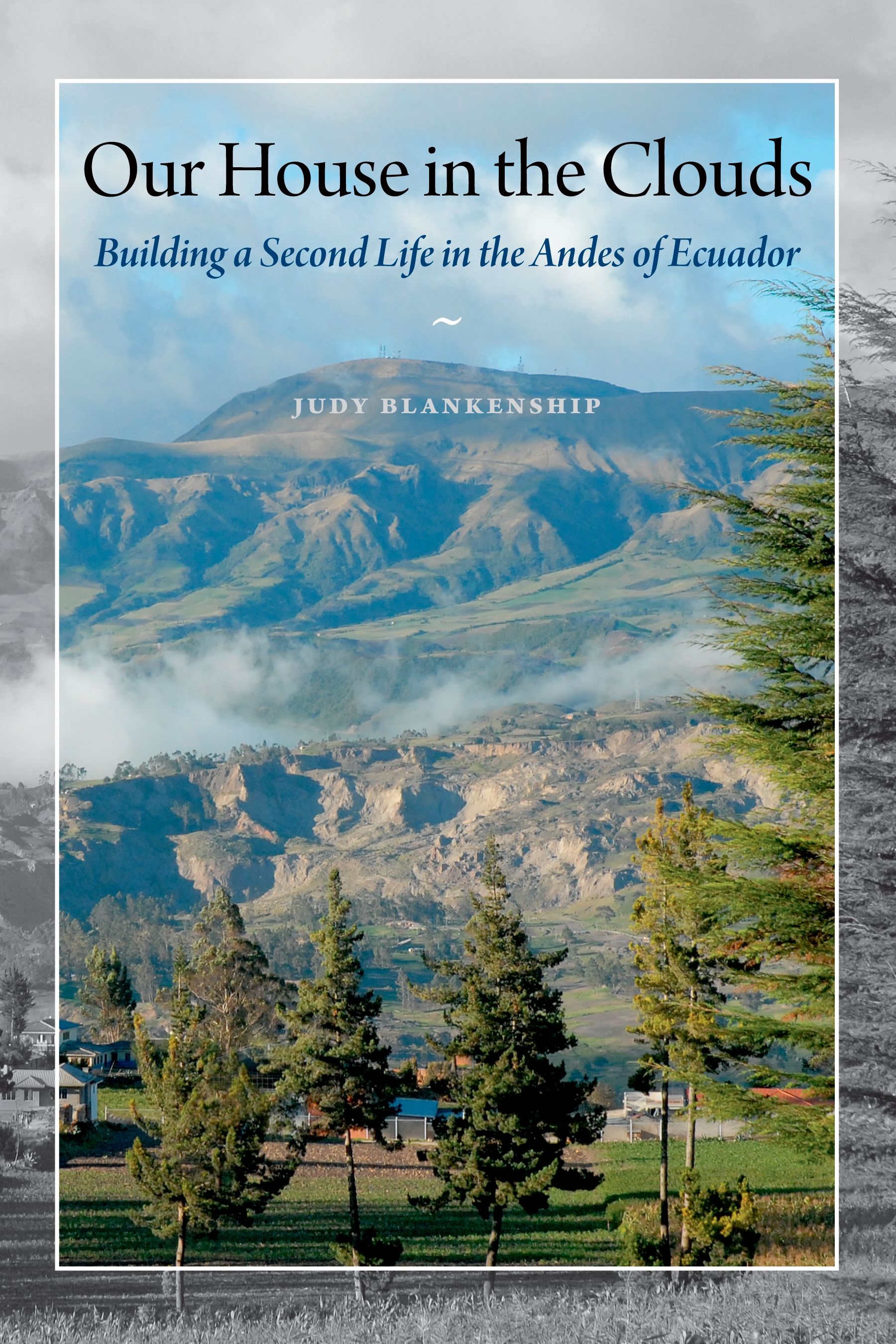
Our House in the Clouds
While many baby boomers are downsizing to a simpler retirement lifestyle, photographer and writer Judy Blankenship and her husband Michael Jenkins took a more challenging leap in deciding to build a house on the side of a mountain in southern Ecuador. They now live half the year in Cañar, an indigenous community they came to know in the early nineties when Blankenship taught photography there. They are the only extranjeros (outsiders) in this homely, chilly town at 10,100 feet, where every afternoon a spectacular mass of clouds rolls up from the river valley below and envelopes the town. In this absorbing memoir, Blankenship tells the interwoven stories of building their house in the clouds and strengthening their ties to the community. Although she and Michael had spent considerable time in Cañar before deciding to move there, they still had much to learn about local customs as they navigated the process of building a house with traditional materials using a local architect and craftspeople. Likewise, fulfilling their obligations as neighbors in a community based on reciprocity presented its own challenges and rewards. Blankenship writes vividly of the rituals of births, baptisms, marriages, festival days, and deaths that counterpoint her and Michael’s solitary pursuits of reading, writing, listening to opera, playing chess, and cooking. Their story will appeal to anyone contemplating a second life, as well as those seeking a deeper understanding of daily life in the developing world.
eBook


City at the Center of the World
In the seventeenth century, local Jesuits and Franciscans imagined Quito as the \"new Rome.\" It was the site of miracles and home of saintly inhabitants, the origin of crusades into the surrounding wilderness, and the purveyor of civilization to the entire region. By the early twentieth century, elites envisioned the city as the heart of a modern, advanced society-poised at the physical and metaphysical centers of the world.In this original cultural history, Ernesto Capello analyzes the formation of memory, myth, and modernity through the eyes of Quito's diverse populations. By employing Mikhail Bakhtin's concept of chronotopes, Capello views the configuration of time and space in narratives that defined Quito's identity and its place in the world. He explores the proliferation of these imaginings in architecture, museums, monuments, tourism, art, urban planning, literature, religion, indigenous rights, and politics. To Capello, these tropes began to crystallize at the end of the nineteenth century, serving as a tool for distinct groups who laid claim to history for economic or political gain during the upheavals of modernism.As Capello reveals, Quito's society and its stories mutually constituted each other. In the process of both destroying and renewing elements of the past, each chronotope fed and perpetuated itself. Modern Quito thus emerged at the crux of Hispanism and Liberalism, as an independent global society struggling to keep the memory of its colonial and indigenous roots alive.
eBook