
Catalogue Search | MBRL


Are you sure you want to remove the book from the shelf?

{{itemTitle}}
582
result(s) for
"Education, Higher Computer network resources."
Sort by:


The Decentring of the Traditional University
The Decentring of the Traditional University provides a unique perspective on the implications of media change for learning and literacy that allows us to peer into the future of (self) education. Each chapter draws on socio-cultural and activity theory to investigate how resourceful students are breaking away from traditional modes of instruction and educating themselves through engagement with a globally interconnected web-based participatory culture.
The argument is developed with reference to the findings of an ethnographic study that focused on university students' informal uses of social and participatory media. Each chapter draws attention to the shifting locus of agency for regulating and managing learning and describes an emergent genre of learning activity. For example, Francis explores how students are cultivating and nurturing globally distributed funds of living knowledge that transcend institutional boundaries and describes students learning through serious play in virtually figured worlds that support radically personalised lifelong learning agendas. These stories also highlight the challenges and choices learners confront as they struggle to negotiate the faultlines of media convergence and master the new media literacies required to exploit the full potential of Web 2.0 as a learning resource.
Overall, this compelling argument proposes that we are witnessing a period of historic systemic change in the culture of university learning as an emergent web-based participatory culture starts to disrupt and displace a top-down culture industry model of education that has evolved around the medium of the book. As a result, Francis argues that we need to re-conceive higher education as an identity-project in which students work on their projective identities (or imagined future selves) through engagement with both formal and informal learning activities.
eBook

The War on Learning
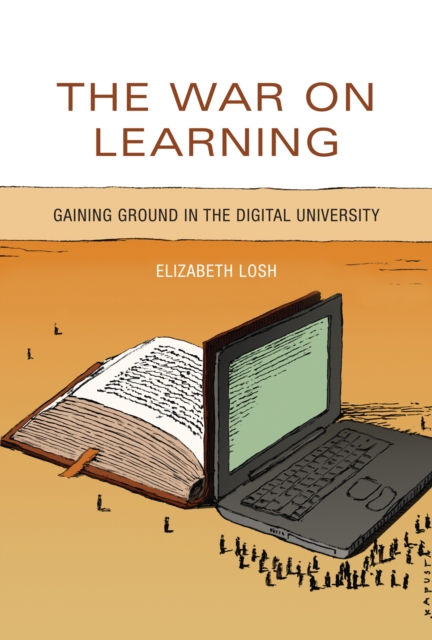
Behind the lectern stands the professor, deploying course management systems, online quizzes, wireless clickers, PowerPoint slides, podcasts, and plagiarism-detection software. In the seats are the students, armed with smartphones, laptops, tablets, music players, and social networking. Although these two forces seem poised to do battle with each other, they are really both taking part in a war on learning itself. In this book, Elizabeth Losh examines current efforts to \"reform\" higher education by applying technological solutions to problems in teaching and learning. She finds that many of these initiatives fail because they treat education as a product rather than a process. Highly touted schemes -- video games for the classroom, for example, or the distribution of iPads -- let students down because they promote consumption rather than intellectual development. Losh analyzes recent trends in postsecondary education and the rhetoric around them, often drawing on first-person accounts. In an effort to identify educational technologies that might actually work, she looks at strategies including MOOCs (massive open online courses), the gamification of subject matter, remix pedagogy, video lectures (from Randy Pausch to \"the Baked Professor\"), and educational virtual worlds. Finally, Losh outlines six basic principles of digital learning and describes several successful university-based initiatives. Her book will be essential reading for campus decision makers -- and for anyone who cares about education and technology.
eBook


Untangling the Web
Analyzes the role of the emerging global information infrastructure in helping higher-education institutions to improve learning and teaching, improve the creation of instructional and learning materials, create educational communities, ...
This report analyzes the role of the emerging global information infrastructure in helping higher-education institutions to improve learning and teaching, improve the creation of instructional and learning materials, create educational communities, compete with new providers, and address policy and planning issues. The authors recommend that institutions coordinate technology plans and purchases; unite behind a common vision to influence the political debate; and pursue options for inexpensive end-user machines. They argue that acquiring the tools and skills with which to create Web-based distance-learning courseware can be accomplished within existing budgets if colleges and universities use existing tools and training; shift staff time from teaching to creating software; nourish grassroots publication; and examine alternative models for delivering educational services, such as creating ultrashort courses for use on an as-needed basis. They warn, however, that the effective use of technologies may threaten the current structure of higher education more than just streamline it.
eBook

Virtual Victorians : networks, connections, technologies
\"Virtual Victorians offers new ways of thinking about issues of representation, technology, and media change in nineteenth-century literary culture, with specific deference to the emerging field of the digital humanities. The opening section, 'Navigating Networks,' deals with digital resources and asks how they are shaping the field of Victorian studies; the second, 'Virtual Imaginings,' considers Victorian technologies of virtual experience. As a whole, this volume demonstrates that understanding the aspirations and anxieties that attended Victorian virtuality will illuminate contemporary scholarly practice--and vice versa\"--Provided by publisher.
Book

Issues in web-based pedagogy
There has been an explosion of Web-based courses in higher education.Aiming at an interdisciplinary audience, the contributors draw upon diverse philosophical and empirical backgrounds to make claims about Web-based pedagogy.
eBook

Student Engagement in the Digital University
Student Engagement in the Digital University challenges mainstream conceptions and assumptions about students' engagement with digital resources in Higher Education. While engagement in online learning environments is often reduced to sets of transferable skills or typological categories, the authors propose that these experiences must be understood as embodied, socially situated, and taking place in complex networks of human and nonhuman actors. Using empirical data from a JISC-funded project on digital literacies, this book performs a sociomaterial analysis of student-technology interactions, complicating the optimistic and utopian narratives surrounding technology and education today and positing far-reaching implications for research, policy and practice.
eBook
Untangling the Web : applications of the Internet and other information technologies to higher learning
Examines benefits of the Internet and the World Wide Web for learning, instruction delivery, improving instruction and learning materials, and creating connected educational communities; analyzes planning and policy issues; US.
eBook