
Catalogue Search | MBRL


Are you sure you want to remove the book from the shelf?

{{itemTitle}}
6,537
result(s) for
"Education, Higher Economic aspects"
Sort by:

The market oriented university : transforming higher education
\"The next decade will be transformative for the higher education sector. Government funding is decreasing. Through their marketing activities universities have created the 'student consumer.' The student consumer is prepared to shop around, compare prices and value, and once purchased expects a return on their investment. Disruptive innovations are challenging traditional forms of learning and in many cases are viewed as better alternatives to traditional learning in the classroom. Competition from private educational providers is increasing. Their cost base is lower, and their customer focus is superior. In short, universities around the world are facing a perfect storm. While experts don't expect the higher education sector to collapse under these challenges, they do believe that for some institutions the future looks bleak. If universities are to avoid closures or mergers, they will need to adopt a market-oriented approach. This timely book urges readers to view students as customers and focuses on how universities need to reinvent themselves in order to stay relevant. Striking a difference between market-oriented and marketing, the authors provide various examples of institutions around the world that are making efforts to reposition themselves. Additionally, this book delves into the issue of undervalued faculty, arguing that education practices are in desperate need of being reimagined due to the abundance of MOOCs and adaptive and experiential learning practices within universities these days.\"--Back cover.
Book

Between Citizens and the State
This book tracks the dramatic outcomes of the federal government's growing involvement in higher education between World War I and the 1970s, and the conservative backlash against that involvement from the 1980s onward. Using cutting-edge analysis, Christopher Loss recovers higher education's central importance to the larger social and political history of the United States in the twentieth century, and chronicles its transformation into a key mediating institution between citizens and the state.
Framed around the three major federal higher education policies of the twentieth century--the 1944 GI Bill, the 1958 National Defense Education Act, and the 1965 Higher Education Act--the book charts the federal government's various efforts to deploy education to ready citizens for the national, bureaucratized, and increasingly global world in which they lived. Loss details the myriad ways in which academic leaders and students shaped, and were shaped by, the state's shifting political agenda as it moved from a preoccupation with economic security during the Great Depression, to national security during World War II and the Cold War, to securing the rights of African Americans, women, and other previously marginalized groups during the 1960s and '70s. Along the way, Loss reappraises the origins of higher education's current-day diversity regime, the growth of identity group politics, and the privatization of citizenship at the close of the twentieth century.
At a time when people's faith in government and higher education is being sorely tested, this book sheds new light on the close relations between American higher education and politics.
eBook


The politics of performance funding for higher education : origins, discontinuations, and transformations
The first nation-wide analysis of the politics of performance funding in higher education. Performance funding ties state support of colleges and universities directly to institutional performance on specific outcomes, including retention, number of credits accrued, graduation, and job placement. The theory is that introducing market-like forces will prod institutions to become more efficient and effective. In The Politics of Performance Funding for Higher Education, Kevin J. Dougherty and Rebecca S. Natow explore the sometimes puzzling evolution of this mode of funding higher education. Drawing on an eight-state study of performance funding in Florida, Illinois, Indiana, Missouri, Ohio, South Carolina, Tennessee, and Washington, Dougherty and Natow shed light on the social and political factors affecting the origins, evolution, and demise of these programs. Their findings uncover patterns of frequent adoption, discontinuation, and re-adoption. Of the thirty-six states that have ever adopted performance funding, two-thirds discontinued it, although many of those later re-adopted it. Even when performance funding programs persist over time, they can undergo considerable changes in both the amount of state funding and in the indicators used to allocate funding. Yet performance funding continues to attract interest from federal and state officials, state policy associations, and major foundations as a way of improving educational outcomes. The authors explore the various forces, actors, and motives behind the adoption, discontinuation, and transformation of performance funding programs. They compare U.S. programs to international models, and they gauge the likely future of performance funding, given the volatility of the political forces driving it. Aimed at educators, sociologists, political scientists, and policy makers, this book will be hailed as the definitive assessment of the origins and evolution of performance funding.
eBook

The tertiary education imperative : knowledge, skills and values for development
\"The world of tertiary education has changed significantly in the past fifteen years. Developing countries have seen tremendous enrollment growth, especially in the private sector. Many nations are facing an exponentially rising demand as more young people graduate from high school as a result of the successful implementation of the Education for All agenda. The launch of the Sustainable Development Goals by the United Nations in September 2015 has given renewed consideration to the importance of education for development and the urgency of putting in place viable financing strategies.00Against this background this book explores the crucial role played by tertiary education towards achieving the Sustainable Development Goals. It observes that tertiary education finds itself at a crossroad today, as national systems are pulled in several directions by a combination of factors - crisis factors, rupture factors, and stimulation factors - bringing about both opportunities and challenges. How these forces in the tertiary education ecosystem play out in each country will determine the new ?perils? and ?promises? that are likely to shape the contribution of tertiary education to economic and social development in the years to come.\"--Cover page 4.
Book

The production of living knowledge
Evaluating higher education institutions-particularly the rise of the \"global university\"-and their rapidly changing role in the global era, Gigi Roggero finds the system in crisis. In his groundbreaking book,The Production of Living Knowledge, Roggero examines the university system as a key site of conflict and transformation within \"cognitive capitalism\"-a regime in which knowledge has become increasingly central to the production process at large. Based on extensive fieldwork carried out through the activist method ofconricerca, or \"co-research,\" wherein researchers are also subjects, Roggero's book situates the crisis of the university and the changing composition of its labor force against the backdrop of the global economic crisis.
Combining a discussion of radical experiments in education, new student movements, and autonomist Marxian (or post-operaista) social theory, Roggero produces a distinctly transnational and methodologically innovative critique of the global university from the perspective of what he calls \"living knowledge.\"
In light of new student struggles in the United States and across the world, this first English-language edition is particularly timely.
eBook

Matching visibility and performance : a standing challenge for world-class universities
World-class universities (WCU) are regarded as cornerstone institutions of any academic system and imperative to develop a nation?s competitiveness in the global knowledge economy. Visibility and performance are among the most watched concepts in relation to develop WCUs, but remain complicated in nature and with no agreed upon definitions. Existing literature have focused on how to raise universities? prestige, status, impact and rankings in the global and regional arena on the one hand, and how to enhance universities? quality, efficiency, effectiveness and academic output on the other. However, whether visibility is a legitimate indicator of performance, or vice versa, is yet to be answered. This book provides insights of developing academic excellence from global, national and institutional perspectives, and intends to stimulate discussion on how universities can be?globally visible and locally engaged? and how visibility and performance can be integrated and balanced in practice.
Book
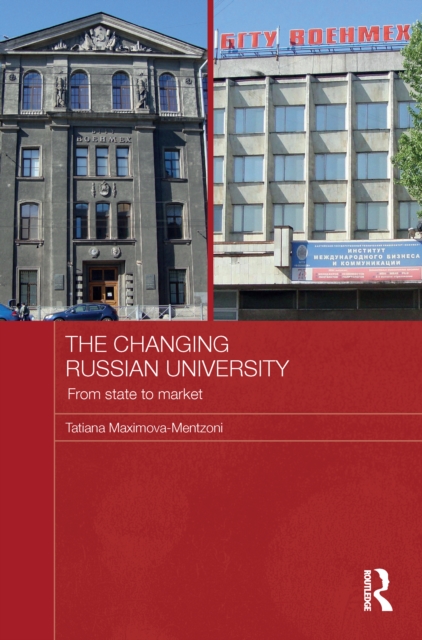
The changing Russian university
When the Soviet Union collapsed universities were freed from state control and left to themselves. This forced universities to be much more market-oriented. This book explores this transformation from the end of the Soviet Union until the present. Based on extensive original research, the book charts the struggles of universities, showing how chaos and decline came to what had been one of the triumphs of the Soviet Union - a higher education system which provided a high standard of advanced education to large numbers of people and made major research achievements. The book shows how a lack of funds, lack of commercial experience and the ending of former means of support such as strong university-state industry links brought about huge disruption; how universities responded with a range of measures such as charging for tutoring and examinations, handling research on a commercial basis and new forms of co-operation; and how all this impacted on subjects of study and on underlying ideas about what a university is for. The book argues that the shock to the system in Russia was so severe that the Russian case serves as an excellent 'survival guide' to universities experiencing similar changes in other parts of the world. By investigating the phenomenon of Russian universities becoming more market-oriented the book contributes to developing further the marketization concept. It summarizes the existing knowledge in this field of study, offers a new framework for analysis of the phenomenon of university marketization and discusses the marketization of Russian universities in the light of comparative studies. (HRK / Abstract übernommen).
eBook


Higher Education in the UK and the US
Higher Education in the UK and the US: Converging University Models in a Global Academic World? compares current trends in two educational systems. It focuses on ideologies, structures, economics, marketisation, access, admittance and the student experience from an interdisciplinary perspective.
eBook