
Catalogue Search | MBRL


Are you sure you want to remove the book from the shelf?

{{itemTitle}}
81
result(s) for
"Education, Higher Germany Philosophy."
Sort by:

Classical humanism and the challenge of modernity : debates on classical education in 19th-century Germany
This book challenges the common view that classical education in 19th-century Germany was dominated by a progressive ideal called 'neohumanism'. The prevailing ideal of education at the German Gymnasien was emphatically traditional and is best described as classical humanism. Moreover, this 19th-century classical humanism dynamically related to modern society and should therefore be seen as the continuation of a living tradition.
Book

Classical Humanism and the Challenge of Modernity
In scholarship, classical (Renaissance) humanism is usually strictly distinguished from 'neo-humanism', which, especially in Germany, flourished at the beginning of the 19 th century. While most classical humanists focused on the practical imitation of Latin stylistic models, 'neohumanism' is commonly believed to have been mainly inspired by typically modern values, such as authenticity and historicity.
Bas van Bommel shows that whereas 'neohumanism' was mainly adhered to at the German universities, at the Gymnasien a much more traditional educational ideal prevailed, which is best described as 'classical humanism.' This ideal involved the prioritisation of the Romans above the Greeks, as well as the belief that imitation of Roman and Greek models brings about man's aesthetic and moral elevation.
Van Bommel makes clear that 19 th century classical humanism dynamically related to modern society. On the one hand, classical humanists explained the value of classical education in typically modern terms. On the other hand, competitors of the classical Gymnasium laid claim to values that were ultimately derived from classical humanism. 19 th century classical humanism should therefore not be seen as a dried-out remnant of a dying past, but as the continuation of a living tradition.
eBook


Organizing Enlightenment : information overload and the invention of the modern research university
The Enlightenment-era concerns that gave rise to the modern research university can illuminate contemporary debates about knowledge in the digital age.
Since its inception, the research university has been the central institution of knowledge in the West. Today its intellectual authority is being challenged on many fronts, above all by radical technological change. Organizing Enlightenment tells the story of how the university emerged in the early nineteenth century at a similarly fraught moment of cultural anxiety about revolutionary technologies and their disruptive effects on established institutions of knowledge.
Drawing on the histories of science, the university, and print, as well as media theory and philosophy, Chad Wellmon explains how the research university and the ethic of disciplinarity it created emerged as the final and most lasting technology of the Enlightenment. Organizing Enlightenment reveals higher education's story as one not only of the production of knowledge but also of the formation of a particular type of person: the disciplinary self. In order to survive, the university would have to institutionalize a new order of knowledge, one that was self-organizing, internally coherent, and embodied in the very character of the modern, critical scholar.
eBook
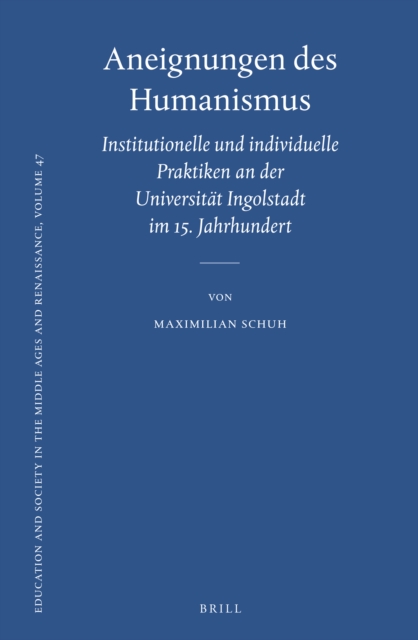
Aneignungen des Humanismus
Aneignungen des Humanismus describes the reception and adaptation of new educational ideas at the University of Ingolstadt in the later Middle Ages. Based on manuscript research, this study explains how the process of adopting new educational procedures relates to the broader contexts for social, economic and institutional framework of teaching and learning in the 15th century.
eBook

International Mobility and Social Capital in the Academic Field
The relationship between the international mobility of academic researchers and social capital is complex. On the one hand, the literature suggests that social capital facilitates the international mobility of academics which, in turn, promotes the accumulation of international social capital, enhances research productivity, and advances careers. On the other hand, international mobility can isolate researchers from the national social capital in their origin countries. In this paper, I present the results of 42 interviews in Canada and Germany to examine how academics in both countries have experienced the connection between international mobility and social capital. In addition to revealing the complexity of this connection, the results show that social capital facilitates international mobility and that mobility sometimes creates social capital. However, mobility can also lead to the loss of national social capital that negatively affects early-career researchers in particular. (HRK / Abstract übernommen).
Journal Article

Revisiting “The American Scholar”
Ralph Waldo Emerson’s deeply individualistic doctrine of “self-reliance” is generally viewed as antagonistic to most of the moral and political reform movements of 19th century America. But this account ignores the connection between the ethos of self-reliance and Emerson’s vision of reformed higher education as developed in his influential lecture “The American Scholar.” Emerson’s presentation of the ideal of scholarship supports a conception of the university as a venue of contested academic space capable of providing a model for robust critique of the prevailing materialist and conformist tendencies of American mass democracy. In this respect, Emerson arguably provides a very early and homegrown American argument for academic freedom that may repay further consideration today.
Journal Article
The managerial turn in higher education?
The managerial turn in academia is currently broadly discussed. Based on empirical data gathered from a sample that includes all German universities, we can give a broad and fine-grained account of this turn. What we can clearly see is that whole new categories of administrative management positions have been created over the last years. Furthermore, within the non-academic staff we can see a profound restructuration. Lower-level positions like those for clerical work decreased, while higher-level positions in the administration increased. However, and in contrast to studies of countries, we do not observe a general shift from academic to non-academic positions. In addition to the statistical analysis of survey data and personnel data, we conducted seventy in-depth interviews with heads of administrative management units, in particular those being created over the last two decades, for example, on quality control, technology transfer, and career service. Although we clearly see important changes indicating a managerial turn in higher education, core characteristics of a professional organization whose basic processes are ultimately controlled by academics and not by administrators or managers have been retained. These findings call for further cross-national research.
Journal Article

German Professors' Motivation to Act as Peer Reviewers in Accreditation and Evaluation Procedures
Acting as a reviewer is considered a substantial part of the role-bundle of the academic profession (quality assurance (QA) and quality enhancement (QE) role). Research literature about peer review, for example, for journals and grants, shows that acting as a peer reviewer adds to an academic's reputation. However, little is known about academics' motivation to act as reviewers. Based on self-determination theory, the multidimensional work motivation scale (Gagné et al. 2015) is used for a survey of German professors acting as reviewers. The results of factor analysis show no intrinsic motivation to act as a reviewer in accreditation and evaluation procedures. Presumably, due to socialization effects, identified motivation among professors is higher compared to introjected motivation or to extrinsic motivation. A preference for HEI leadership/management predicts identified motivation to act as a reviewer, but a preference for teaching does not. Overall, the results suggest that professors acting as peer reviewers in accreditation and evaluation procedures accept the ambivalence of being self-determined in exercising the QA and QE professional role and of involuntarily being a management tool for higher education governance. The findings suggest that peer reviewing - also of research - is based on identified (and introjected) and not intrinsic motivation, for example, socialized acceptance of journal peer review as the best or most suitable mechanism of QA and QE.
Journal Article
University vs. Research Institute? The Dual Pillars of German Science Production, 1950–2010
The world’s third largest producer of scientific research, Germany, is the origin of the research university and the independent, extra-university research institute. Its dual-pillar research policy differentiates these organizational forms functionally: universities specialize in advanced research-based teaching; institutes specialize intensely on research. Over the past decades this policy affected each sector differently: while universities suffered a lingering “legitimation crisis,” institutes enjoyed deepening “favored sponsorship”—financial and reputational advantages. Universities led the nation’s reestablishment of scientific prominence among the highly competitive European and global science systems after WWII. But sectoral analysis of contributions to science, technology, engineering, mathematics, and medical and health journal publications (1950–2010) finds that Germany’s small to medium-sized independent research institutes have made significant, growing contributions, particularly in publishing in higher impact journals proportionally more than their size. Simultaneously—despite dual-pillar policy implications—the university sector continues to be absolutely and relatively successful; not eclipsed by the institutes. Universities have consistently produced two-thirds of the nation’s publications in the highest quality journals since at least 1980 and have increased publications at a logarithmic rate; higher than the international mean. Indeed, they led Germany into the global mega-science style of production. Contrary to assumed benefits of functional differentiation, our results indicate that relative to their size, each sector has produced approximately similar publication records. While institutes have succeeded, the larger university sector, despite much less funding growth, has remained fundamental to German science production. Considering these findings, we discuss the future utility of the dual-pillar policy.
Journal Article