
Catalogue Search | MBRL


Are you sure you want to remove the book from the shelf?

{{itemTitle}}
363
result(s) for
"Education, Secondary Computer network resources."
Sort by:

Teaching on the education frontier : instructional strategies for online and blended classrooms, grades 5-12
\"A groundbreaking guide to facilitating online and blended coursesThis comprehensive resource offers teachers in grades K-12 a hands-on guide to the rapidly growing field of online and blended teaching. With clear examples and explanations, Kristin Kipp shows how to structure online and blended courses for student engagement, build relationships with online students, facilitate discussion boards, collaborate online, design online assessments, and much more. Shows how to create a successful online or blended classroom Illustrates the essential differences between face-to-face instruction and online teaching Foreword by Susan Patrick of the International Association for K-12 Online Learning This is an essential handbook for learning how to teach online and improve student achievement\"-- Provided by publisher.
Book
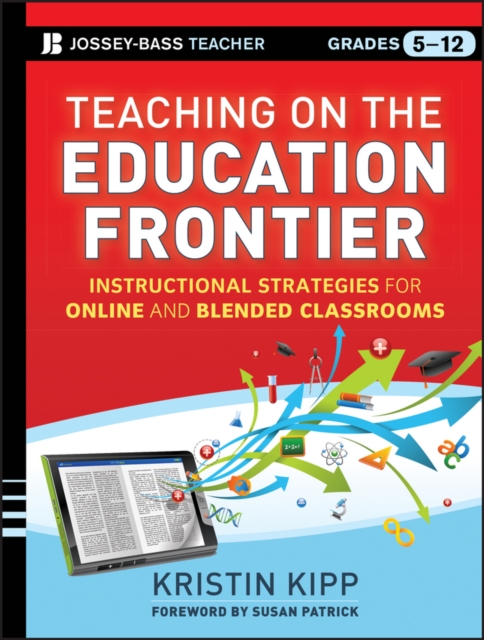
Teaching on the Education Frontier
A groundbreaking guide to facilitating online and blended courses
This comprehensive resource offers teachers in grades K-12 a hands-on guide to the rapidly growing field of online and blended teaching. With clear examples and explanations, Kristin Kipp shows how to structure online and blended courses for student engagement, build relationships with online students, facilitate discussion boards, collaborate online, design online assessments, and much more.
* Shows how to create a successful online or blended classroom
* Illustrates the essential differences between face-to-face instruction and online teaching
* Foreword by Susan Patrick of the International Association for K-12 Online Learning
This is an essential handbook for learning how to teach online and improve student achievement.
eBook
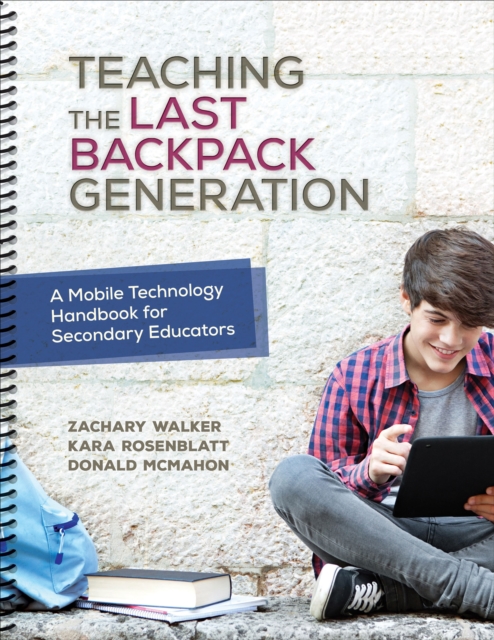
Teaching the Last Backpack Generation
“It is difficult to keep up with the ever-growing list of available technology tools. The authors present a comprehensive guide that will help any educator find the best tools to ensure the purposeful integration of technology in the classroom.” Eric Sheninger, Author of Digital Leadership and International Speaker Senior Fellow, International Center for Leadership in Education “This is a well thought out, practical guide on tech integration for teachers at all levels of the spectrum. It gives flexible considerations and planning points for individuals on solo dives or for small/large groups redesigning their learning spaces and approaches to teaching.” Derek L. McCoy, Principal Spring Lake Middle School, 2014 NASSP Digital Principal of the Year “This is an extraordinary example of how “one book fits all.” Here is one of the richest, most comprehensive and user-friendly collections of practical ideas, strategies and tips for using technology to reach and teach today’s students. While technology will continue to change, this book — with its emphasis on ways to use technology to maximize student involvement and learning — will be invaluable for many, many years to come.” Dr. Boyce Heidenreich, Former Principal and Administrator “With a focus on teaching 21st century skills, the strategies presented in this workbook not only strengthen a student’s ability to engage technology, but also to problem solve through creativity, collaboration, communication, and critical thinking. This book is an essential item for the successful integration of technology, PBL, and soft skill acquisition. Teaching the Last Backpack Generation is a catalyst for good teaching and learning!” Terry L. Roller, Director of High School Education Tuscaloosa City Schools
eBook

Machine Learning and the Five Big Ideas in AI
This article provides an in-depth look at how K-12 students should be introduced to Machine Learning and the knowledge and skills they will develop as a result. We begin with an overview of the AI4K12 Initiative, which is developing national guidelines for teaching AI in K-12, and briefly discuss each of the “Five Big Ideas in AI” that serve as the organizing framework for the guidelines. We then discuss the general format and structure of the guidelines and grade band progression charts and provide a theoretical framework that highlights the developmental appropriateness of the knowledge and skills we want to impart to students and the learning experiences we expect them to engage in. Development of the guidelines is informed by best practices from Learning Sciences and CS Education research, and by the need for alignment with CSTA’s K-12 Computer Science Standards, Common Core standards, and Next Generation Science Standards (NGSS). The remainder of the article provides an in-depth exploration of the AI4K12 Big Idea 3 (Learning) grade band progression chart to unpack the concepts we expect students to master at each grade band. We present examples to illustrate the progressions from two perspectives: horizontal (across grade bands) and vertical (across concepts for a given grade band). Finally, we discuss how these guidelines can be used to create learning experiences that make connections across the Five Big Ideas, and free online tools that facilitate these experiences.
Journal Article
Developing and Validating the Artificial Intelligence Literacy Concept Inventory: an Instrument to Assess Artificial Intelligence Literacy among Middle School Students
The rapid expansion of Artificial Intelligence (AI) in our society makes it urgent and necessary to develop young students’ AI literacy so that they can become informed citizens and critical consumers of AI technology. Over the past decade many efforts have focused on developing curricular materials that make AI concepts accessible and engaging to young learners; and yet, limited research investigated how to assess learners’ AI literacy, which is critically important to inform the teaching and learning of AI. This paper addresses this issue by reporting the development and validation findings of the AI Literacy Concept Inventory Assessment (AI-CI), a set of multiple-choice questions designed to assess understanding of AI literacy concepts among middle school students. The AI-CI consists of 20 multiple choice questions examining student understanding of four topics: AI general concepts, logic systems, machine learning general concepts, and supervised learning. The content validity of AI-CI was established through multiple rounds of expert panel reviews with AI educators and experts, observations of student learning of AI, and cognitive validation interviews. The validity of the AI-CI was established with a sample of 981 students and the pre-posttest reliability was established with a sample of 108 middle school students who learned AI through experiencing the Developing AI literacy (DAILy) curriculum. The findings show that the AI-CI is a valid and reliable tool to assess AI literacy at the middle school level.
Journal Article

Implications of social network sites for teaching and learning. Where we are and where we want to go
This conceptual paper deals with some of the implications that the use of social network sites, though not originally developed and conceived for learning purposes, have for schools and academic activities when they are used as tools able to modify and innovate teaching/learning practices and academic culture. Beside the differences that characterize the two contexts, the attention that social network tools are progressively gaining in schools and higher education practices and pedagogies requires adjustments in learning and teaching that should be constantly considered by educators and policy makers. These environments are also presenting new and crucial opportunities for teacher training and teachers’ professional development. The purpose of the study is to reflect on some significant challenges and opportunities offered by social network sites, and how to exploit the latter, in relation to a number of themes. These themes have been identified as those that deserve better comprehension and further research investigation: communication between students and teachers and appropriate professional behaviours; pedagogical and technological challenges related to incorporating social networking practices into teaching and academic practices; how social networking can be exploited for teachers’ professional training and development. The study also provides some implications for policy and practice.
Journal Article

“We are much closer here”: exploring the use of WhatsApp as a learning environment in a secondary school mathematics class
In this study, we examined a mathematics teacher’s communicative acts on an instant messaging tool, WhatsApp, and its role in creating a sustained learning environment between secondary-school students and a teacher in Turkey. The interactions of a mathematics teacher and his students (n = 38) over two years were explored. The WhatsApp group increased interaction in out-of-school hours. Analysis of the teacher’s communicative acts was the leading force that encouraged the group to continue to interact. The teacher portrayed an informal and sincere presentation of himself on social media. A constructive communication style between teacher and students was fostered by connecting through WhatsApp in out-of-school hours, when the teacher’s informal communicative acts have facilitated their learning.
Journal Article

Social comparison feedback in online teacher training and its impact on asynchronous collaboration
In the area of online teacher training, asynchronous collaboration faces several challenges such as limited learner engagement and low interaction quality, thereby hindering its overall effectiveness. Drawing on social comparison theory, providing social comparison feedback to teacher-learners in online asynchronous collaborative learning offers benefits, but also has drawbacks. While social comparison has been explored in diverse fields, its role in education remains unclear. In this study, we selected 95 primary and secondary school teachers participating in an online training course. Using randomized controlled trial design, we provided the experimental group with social comparison feedback, while the control group received only self-referential feedback. We used epistemic network analysis, lag sequential analysis, and social network analysis to identify the impact of social comparison feedback on group-regulated focus, group-interactive behaviors, and social network structures. The results showed that social comparison feedback significantly enhanced teachers’ online asynchronous collaborative learning.
Journal Article
E-Moderating
Professor Gilly Salmon has achieved continuity and illumination of the seminal five stage model, together with new research-based developments, in her much-awaited third edition of E-Moderating – the most quoted and successful guide for e-learning practitioners.
Never content to offer superficial revisions or simple \"solutions\" against the pace of technological advances, the expanding interest and requirements for online learning, and the changes they have wrought, E-Moderating, Third Edition offers a richness of applied topics that will directly impact learners and teachers of all kinds. The book is carefully crafted and supported with evidence, examples, and resources for practical guidelines, making it potentially transformational for all practitioners.
E-Moderating, Third Edition includes:
updates of literature, key terms, case studies and projects
fresh examples of the use of the five stage model around the world, at different levels of education and across disciplines
guidelines for moderating for podcasting and virtual worlds
illustrations from the latest All Things in Moderation development programmes (www.atimod.com)
new resources for practitioners
a companion website: www.e-moderating.com.
\"The book is carefully crafted and supported with evidence, examples, and resources for practical guidelines, making it potentially transformational for all practitioners. This is a “must have” book for researchers and practitioners alike.\" ― Charalambos Vrasidas, Ed ucational Media International
I. Concepts and Cases
1. E-moderating
2. 5 stage model (text)
3. 5 stage model (21 st century technologies)
4. E-moderating qualities and roles
5. Training e-moderators
6. Developing E-moderating skills
7. Participants’ experience
8. Future e-moderating
II. Resources for Practitioners
Scaffolding online learning
Achieving online socialisation
Achieving knowledge sharing
Developing e-moderators
Costs
Summarising and Weaving
Taming Online time
Promoting cultural understandings
Creating presence
Housekeeping
Promoting Active Participation
Assessing learning
Evaluating conferencing
E-moderating for synchronous conferencing
E-moderating for virtual worlds
E-moderating for Podcasting
Monitoring E-moderating
Encouraging self-managing groups
Helping online novices
Understanding lurking
What’s going on?
What will we call ourselves?
Communicating online
References
Index
eBook

Prediction of students’ performance in online learning using supervised machine learning
PurposeThis study leverages social network analysis (SNA) to visualise the way students interacted with online resources and uses the data obtained from SNA as features for supervised machine learning algorithms to predict whether a student will successfully complete a course.Design/methodology/approachThe exploration and visualisation of the data were first carried out to gain a better understanding of the students, the course(s) each student was enrolled in and each course’s virtual learning resources. Following this, the construction of the social network graphs was performed to depict how each student behaved online before the degree centralities were computed for each of the nodes in a social network graph. Data pre-processing to assign labels based on the final result a student obtained in a course was then performed before we trained and tested models to predict which students did or did not graduate.FindingsThe study’s findings demonstrate that the constructed predictive model has good performance, as shown by the accuracy, precision, recall and f-measure metrics. The outcomes also showed that students’ use of online resources is a crucial element that influences how well they perform in their academics.Originality/valueThe similarity index is as low as 9%.
Journal Article