
Catalogue Search | MBRL


Are you sure you want to remove the book from the shelf?

{{itemTitle}}
10
result(s) for
"Educational equalization -- Data processing"
Sort by:


Equity in Data
Building a better data culture can be the path to better results and greater equity in schools. But what do we mean by data? Your students are not just statistics. They aren't simply a set of numbers or faceless dots on a proficiency scale. They are vibrant collections of experiences, thoughts, perspectives, emotions, wants, and dreams. And taken collectively, all of that information is data--and should be valued as such. \"Equity in Data\" not only unpacks the problematic nature of current approaches to data but also helps educators demystify and democratize data. It shows how we can bake equity into our data work and illuminate the disparities, stories, and truths that make our schools safer and stronger--and that help our students grow and thrive. To this end, the authors introduce a four-part framework for how to create an equitable data culture (along with a complementary set of data principles). They demonstrate how we can rethink our approach to data in the interest of equity by making five shifts: (1) Expand our understanding of data; (2) Strengthen our knowledge of data principles; (3) Break through our fear of data; (4) Decolonize our data gathering processes; and (5) Turn data into meaningful, equitable action. We have an opportunity to realign school data with what students want out of their educational experiences. When we put equity first, we put students first.
eBook

FinnishED Leadership
Inspired by the culture of educational leadership in Finland, a consistent top-performer in international student assessment, this beneficial resource presents easy-to-adopt strategies to improve overall educational performance.
eBook

FinnishED Leadership: Four Ideas to Improve Schools
Improve overall school performance from start to Finnish! Finland's consistent performance in international student assessments has caused much curiosity in recent years. Educators around the world are exploring what Finland does well and how they remain at the top. Pasi Sahlberg has hosted multiple delegations of educators in Finland seeking ideas and tools to apply to their home districts, and has determined real change can begin with four uncomplicated ideas. Focusing on leading learners, this book considers topics like: Physical activity is crucial for substantial learning Enhancing equity is an essential component of success Embedding ideas into your current leadership practices takes perseverance Finland's particular brand of leadership culture in education is an ideal model for improving educational performance anywhere
eBook

Assessing Sector Performance and Inequality in Education
This book gathers in one volume all the information needed to use ADePT Edu, the software platform created by the World Bank for the reporting and analysis of education indicators and education inequality. It includes a primer on education data availability, an operating manual for the software, a technical explanation of all the education indicators generated, and an overview of global education inequality using ADePT Edu. The World Bank developed ADePT Edu to fill the need for a user-friendly program designed to give everyone the ability to organize and analyze education data from households. ADePT Edu can be used with any household survey with the aid of its user friendly interface, generating education tables and graphics that comply with international standards for performance indicators. Because this volume is a compendium its chapters can be consulted independently of each other, depending on the need of users.
eBook
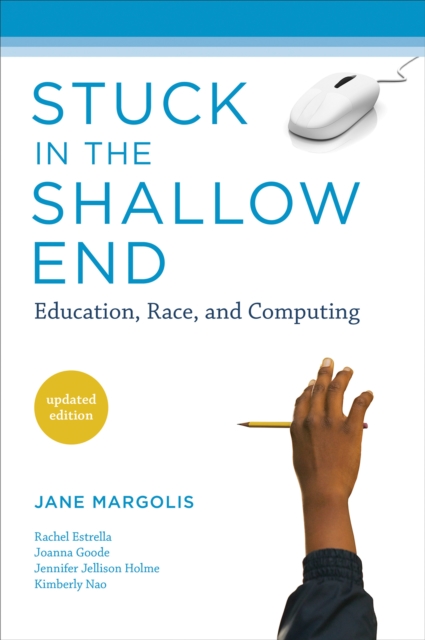
Stuck in the Shallow End
The number of African Americans and Latino/as receiving undergraduate and advanced degrees in computer science is disproportionately low, according to recent surveys. And relatively few African American and Latino/a high school students receive the kind of institutional encouragement, educational opportunities, and preparation needed for them to choose computer science as a field of study and profession. In Stuck in the Shallow End, Jane Margolis looks at the daily experiences of students and teachers in three Los Angeles public high schools: an overcrowded urban high school, a math and science magnet school, and a well-funded school in an affluent neighborhood. She finds an insidious \"virtual segregation\" that maintains inequality. Two of the three schools studied offer only low-level, how-to (keyboarding, cutting and pasting) introductory computing classes. The third and wealthiest school offers advanced courses, but very few students of color enroll in them. The race gap in computer science, Margolis finds, is one example of the way students of color are denied a wide range of occupational and educational futures. Margolis traces the interplay of school structures (such factors as course offerings and student-to-counselor ratios) and belief systems -- including teachers' assumptions about their students and students' assumptions about themselves. Stuck in the Shallow End is a story of how inequality is reproduced in America -- and how students and teachers, given the necessary tools, can change the system.
eBook