
Catalogue Search | MBRL


Are you sure you want to remove the book from the shelf?

{{itemTitle}}
22
result(s) for
"Educational equalization Australia."
Sort by:


Contemporary Issues of Equity in Education
Contemporary Issues of Equity in Education argues that equity and social justice must be brought back to the centre of discussions about education. It traces international, system-wide and local effects of policies that increase marketization and competition between students, schools and systems, whilst erasing wider considerations of the socio-cultural contexts that shape educational experiences and outcomes. Leading researchers interrogate the design of educational systems for social justic.
eBook


A 'formidable challenge' : Australia's quest for equity in Indigenous education
Indigenous education in Australia has been the subject of ongoing policy focus and repeated official inquiry as the nation grapples with trying to achieve equity for these students. Perspectives from recent developments in the USA and Canada highlight the similarity of challenges. This article employs a multidisciplinary approach to social theory to examine the underlying causes of the creation of a plateau effect of progress in this area. The article argues that the lack of progress is a reflection of a complex set of underlying factors, many of which are under acknowledged in educational debates. The author suggests that a wide range of social factors affects pragmatic solutions such as improving attendance, curriculum health, support and quality teaching. Arising from this examination is the need for a new governance model for Indigenous education involving both horizontal and vertical policy-making structures. [Author abstract, ed]
Journal Article
Refugee and immigrant students
The focus of this book is on educational equity issues affecting immigrants and refugees around the world. Chapters highlight educational approaches that build from experiential knowledge, draw upon multiple languages, consider group identity, grapple with the complexities of inclusion, address family concerns, promote parental involvement, involve liaison with community agencies, and view cultural differences as educational strengths. While the book does not shy away from exploring the more challenging aspects of the refugee and immigrant experience, it avoids dwelling on victimology and rejects applying a deficit framework. Rather it offers hope, emphasizing the potential strengths of refugees, including their cultural capital and survival skills. The authors also make cogent suggestions for structural, pedagogical, and conceptual reform, with targets ranging from individual teachers to educational systems to social, economic, political, and cultural contexts.
eBook

Socio-economic status, cultural diversity and the aspirations of secondary students in the Western Suburbs of Melbourne, Australia
Using data from a recent survey of Australian secondary students, we find that those from higher socio-economic backgrounds are more likely to aspire to attend university. The same can be said for students who do not speak English at home. We find that students with an ethnic minority background are more likely to perceive higher levels of support from parents. However, we find that all students believe they receive encouragement from their parents to do well at school (rather than discouragement or disinterest), and that there is little difference in the level of importance placed on the views of parents between students from English and non-English speaking background. While interest in university education is strong across all socio-economic groups, particularly for students who do not speak English at home, there is a considerable gap between aspirations and enrolment levels. We suggest that this 'aspirations gap' is larger for students from low socio-economic backgrounds. This analysis also supports growing evidence that the postcode methodology for allocating socio-economic status to individuals is unreliable. (HRK / Abstract übernommen).
Journal Article
The attainability of university degrees and their labour market benefits for young Australians
I used data from the 1995 cohort of the Longitudinal Surveys of Australian Youth to investigate the factors associated with the attainment of Australian university degrees and estimate their domestic labour market benefits. I considered vertical and horizontal stratification in education and examined monetary and non-monetary benefits. The probabilities of attaining a university degree differed significantly by individual and family background. Individual's family backgrounds significantly predicted the prestige of their universities, but not their fields of study. University graduates enjoyed higher income and occupational prestige relative to non-graduates. Among university graduates, income and occupational benefits differed significantly by fields of study but less by the prestige of universities. These findings indicate that vertical stratification in education plays an important role in the intergenerational transmission of social status in Australia. My findings suggest that policies should ensure equal access to higher education for young people from disadvantaged backgrounds. Strategies to reduce inequality in higher education are discussed.(HRK / Abstract übernommen).
Journal Article
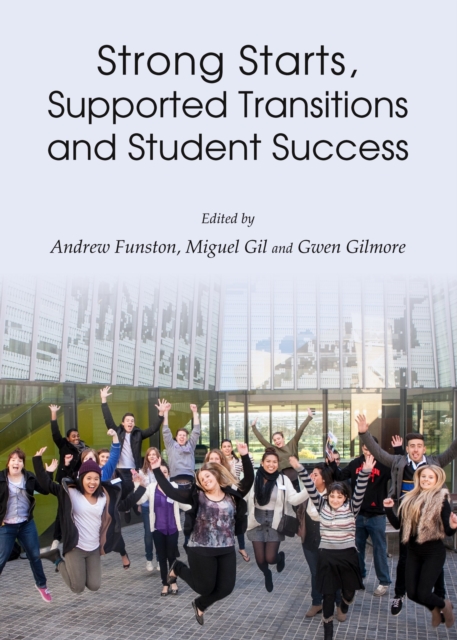
Strong Starts, Supported Transitions and Student Success
The shift to mass participation in higher education is a welcome international trend. In Australia the number of young adults attempting a degree course at university has increased by close to twenty five percent in less than a decade. Campuses are becoming more culturally and linguistically diverse. More university students are coming from poorer families and disadvantaged educational backgrounds. The authors of Strong Starts, Supported Transitions and Student Success celebrate the diversity.
eBook

Parents influencing secondary students' university aspirations : A multilevel approach using school-SES
Students' university aspirational capacity and expectancies are key factors in predicting future university participation. Aspirations and expectations to attend university are strongly influenced by parent educational socialisation and school culture. This study investigates associations between students' university discussions with parents and their aspirations and expectations for university, and whether this link is particularly salient for students from disadvantaged schools. As well, differences in students' exposure to university are examined. Students (N = 548, 57% female) from Perth's south-west metropolitan region in Western Australia were surveyed. Multilevel analysis revealed that students from low socio-economic status (SES) schools who reported more frequent university discussions with parents had higher aspirations and expectations for university than students from similar SES schools who had fewer university discussions with parents. Furthermore, university discussions with parents predicted higher levels of aspirations for university and this link is stronger for students from lower SES schools. The effect of school-SES for the university expectations model was similar, though of weaker influence. Exposure to university is greater for students in high-SES schools. Therefore, students and parents in low-SES areas may benefit by increasing university exposure to develop knowledge and discussions about university, and support aspirations to grow expectations to attend university. [Author abstract]
Journal Article
Educating Girls
Originally published in 1989. This book addresses a number of issues integral to the education of girls in Australia. Among these are: teacher practices inside and outside the classroom, co-education versus single-sex schooling, curriculum design, students’ self-esteem and long-term aspirations. Intervention programs which tackle these issues – in mathematics, science and sport – are described and evaluated. Throughout, the collection functions as a meeting ground for practice and current research.
Introduction Shirley N. Sampson 1. Girls’ Expectations Millicent E. Poole and David G. Beswick 2. Is ‘Gender-inclusive’ Curriculum the Answer for Girls? Victoria Foster 3. Girls, PE and Sports Henny Oldenhove 4. Tasmanian Schools Co-operate San Fitzgibbon 5. A Rural Girls’ Self-Esteem Project Lyn Martinez, Anne Diamond and Leonie Daws 6. Living Curricula Terry Evans 7. Do Girls Count in Mathematics? Gilah C. Leder 8. The Family Maths Project Jocelyn Vasey 9. A Rescue Operation Mary Barnes 10. In Favour of Compulsory Science Lesley H. Parker and Jenny A. Offer 11. A Science Teachers’ Collective The McClintock Collective 12. Are Boys a Barrier for Girls in Science? Shirley N. Sampson 13. From Single-Sex to Coed Schools Herbert W. Marsh, Lee Owens, Margaret R. Marsh and Ian D. Smith
eBook