
Catalogue Search | MBRL


Are you sure you want to remove the book from the shelf?

{{itemTitle}}
971
result(s) for
"Educational output"
Sort by:

Equity and Parity in Primary Education: A Study on Performance in Language and Mathematics Using Hierarchical Linear Models
Education plays a crucial role in the development and consolidation of equality in society, which is reflected in the SDGs of the UN 2030 Agenda. Knowing the educational performance of schools is necessary to diagnose needs, evaluate proposals and undertake improvements in education policies. This study pursued a twofold objective: (1) to assess the equity and parity of Andalusian schools in relation to the competencies of mathematical reasoning and linguistic communication and (2) to study the relationship among educational performance, equity and parity in these competences. Hierarchical linear model research was designed and implemented in a population of 79,806 schoolchildren and 2092 schools. The results confirmed differences in equity and parity among schools. A relation was found between higher effectiveness and higher parity. Nonpublic schools are not more efficient than public schools; rather, it is the average economic and sociocultural status of schools that controls for their effectiveness. In conclusion, the educational system does not guarantee the same opportunities for all children; thus, the equity and parity of educational systems should be key criteria for their evaluation, ensuring that quality education reaches everyone equally. Further implications are also discussed.
Journal Article

The role and impact of public-private partnerships in education
Enhancing the role of private sector partners in education can lead to significant improvements in education service delivery. However, the realization of such benefits depends in great part on the design of the partnership between the public and private sectors, on the overall regulatory framework of the country, and on the governmental capacity to oversee and enforce its contracts with the private sector. Under the right terms, private sector participation in education can increase efficiency, choice, and access to education services, particularly for students who tend to fail in traditional education settings. Private-for-profit schools across the world are already serving a vast range of usersâ€\"from elite families to children in poor communities. Through balanced public-private partnerships (PPPs) in education, governments can leverage the specialized skills offered by private organizations as well as overcome operating restrictions such as salary scales and work rules that limit public sector responses. 'The Role and Impact of Public-Private Partnerships in Education' presents a conceptualization of the issues related to PPPs in education, a detailed review of rigorous evaluations, and guidleines on how to create successful PPPs. The book shows how this approach can facilitate service delivery, lead to additional financing, expand equitable access, and improve learning outcomes. The book also discusses the best way to set up these arrangements in practice. This information will be of particular interest to policymakers, teachers, researchers, and development practitioners.
eBook

Value-added assessment in higher education
Evaluation of the effectiveness of higher education has received unprecedented attention from stakeholders at many levels. The Voluntary System of Accountability (VSA) is one of the initiatives to evaluate institutional core educational outcomes (e.g., critical thinking, written communication) using standardized tests. As promising as the VSA method is for calculating a valueadded score and allowing results to be comparable across institutions, it has a few potential methodological limitations. This study proposed an alternative way of value-added computation which takes advantage of multilevel models and considers important institution-level variables. The institutional value-added ranking was significantly different for some of the institutions (i.e., from being ranked at the bottom to performing better than 50% of the institutions) between these two methods, which may lead to substantially different consequences for those institutions, should the results be considered for accountability purposes.
Journal Article


In Search of General Theory
Most subfields of research in political science are today at an intellectual plateau well short of general theory. Many have been at that plateau since about 1980. Several reasons might account for this situation, including the challenge of constructing general theory. I argue, however, that some of our must common educational and research practices also retard theoretical progress. I describe those practices and their unfortunate consequences, but also explicate a series of research strategies that would help advance our theoretical work. As a foundation for the preceding arguments, I characterize the theory-building ambitions of the discipline, our progress toward general theory, and how advances toward such theory can be mapped for any science.
Journal Article

The impact of social and economic factors on the academic performance of youth in Slovenia
In this research, we assessed the impact of the socio-economic status (average net wages, the registered unemployment rate), education structure and demographic risk (the age dependency ratio) of residents of different Slovenian municipalities on scores on the nationwide, external assessment of knowledge given to pupils in grade 9 of primary school. The analysis was conducted using data for 201 Slovenian municipalities where the National Assessment of Knowledge (NAK) was given to 9th-grade primary school pupils in the years 2012, 2013 and 2014. This test assesses learners' knowledge of the Slovene language and mathematics. The data were used to calculate basic descriptive statistics, as well as coefficients, correlations and validated regression models. The findings show that registered unemployment rate, average educational attainment and the age dependency ratio influence achievements in mathematics. The findings for the Slovene portion of the National Assessment of Knowledge are not as expressive, but do indicate that the registered unemployment rate and age dependency ratio have an impact.
Journal Article
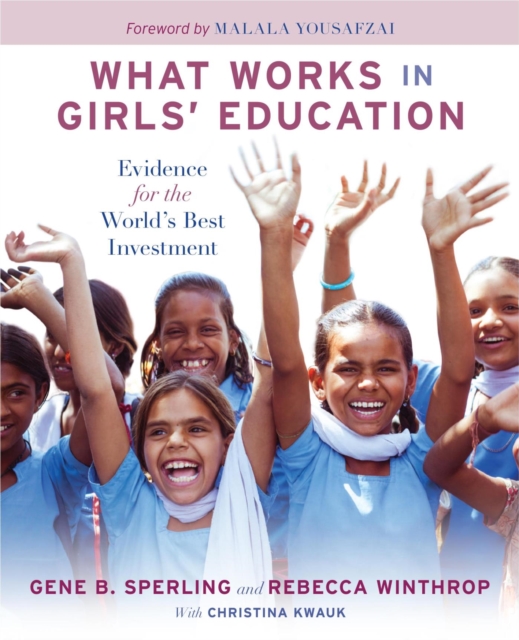
What Works in Girls' Education
Hard-headed evidence on why the returns from investing in girls are so high that no nation or family can afford not to educate their girls. Gene Sperling, author of the seminal 2004 report published by the Council on Foreign Relations, and Rebecca Winthrop, director of the Center for Universal Education, have written this definitive book on the importance of girls' education. As Malala Yousafzai expresses in her foreword, the idea that any child could be denied an education due to poverty, custom, the law, or terrorist threats is just wrong and unimaginable. More than 1,000 studies have provided evidence that high-quality girls' education around the world leads to wide-ranging returns: Better outcomes in economic areas of growth and incomes Reduced rates of infant and maternal mortality Reduced rates of child marriage Reduced rates of the incidence of HIV/AIDS and malaria Increased agricultural productivity Increased resilience to natural disasters Women's empowerment What Works in Girls' Education is a compelling work for both concerned global citizens, and any academic, expert, nongovernmental organization (NGO) staff member, policymaker, or journalist seeking to dive into the evidence and policies on girls' education.
eBook

Education at a Glance 2014
Education at a Glance: OECD Indicators is the authoritative source for accurate and relevant information on the state of education around the world. It provides data on the structure, finances, and performance of education systems in the OECD’s 34 member countries, as well as a number of partner countries.In the 2014 edition, new material includes:• Data from the Survey of Adult Skills, a product of the OECD Programme for the International Assessment of Adult Competencies (PIAAC), on attainment, employment, intergenerational education mobility, earnings, and social outcomes related to skills proficiency.
• New indicators on private institutions, on what it takes to become a teacher, and on the availability of, and participation in, professional development activities for teachers.
• Data from the 2013 OECD Teaching and Learning International Survey (TALIS) in several indicators.
• Analysis of the impact of the recent economic crisis on the interplay among educational attainment, employment, earnings and public finance.
• More in-depth information related to upper secondary completion rates.
• A detailed examination of the types and use of student loans.
• For the first time, data from Colombia and Latvia.The Excel™ spreadsheets used to create the tables and charts in Education at a Glance are available via the StatLinks provided throughout. The tables and charts, as well as the complete OECD Online Education Database, are freely available via the OECD Education website at www.oecd.org/edu/eag.htm . A data update released in January 2015 is available at http://data.oecd.org/chart/4eJL .
eBook

Sorting, peers, and achievement of Aboriginal students in British Columbia
We examine the contribution of differences in school environments to the gap in education outcomes between Aboriginal and non-Aboriginal students. We find both substantial school-level segregation of Aboriginal and non-Aboriginal students and a substantial gap in test scores. Conventional achievement gap decompositions attribute roughly half of the grade 7 test score gap to between-school differences and half to withinschool differences. The segregation of Aboriginal students suggests that peer effects might explain some of these between-school achievement differences. However, we find that peer effects associated with a greater proportion of Aboriginal peers, if anything, improve value-added exam outcomes of Aboriginal students. On examine la contribution des différences dans les environnements scolaires pour expliquer l'écart entre les résultats éducationnels des étudiants aborigènes et non-aborigènes. On découvre à la fois un degré de ségrégation substantiel entre étudiants aborigènes et nonaborigènes, et un écart substantiel dans les résultats des tests. La décomposition conventionnelle des écarts de résultats pour les élèves de 7 e année attribue en gros la moitié des écarts à des différences entre écoles, et l'autre moitié à des différences à l'intérieur des écoles. La ségrégation des élèves aborigènes suggère que l'effet des pairs pourrait expliquer une portion des différences entre écoles. Cependant, on découvre que les effets de pairs associés à la présence d'une plus grande portion de pairs, s'ils ont un impact quelconque, améliorent les résultats des étudiants aborigènes dans les examens qui mesure les progrès.
Journal Article
The role of building learning cities in the rejuvenation of Africa
Although Africa has been home to famous ancient cities in the past, its modern conurbation areas are poor living spaces characterised by squalor, poor planning and human misery. The authors of this paper argue that the learning city concept, still almost unknown in Africa, holds enormous potential for redressing the dysfunctional state of things and for guiding future orderly development of African cities. There have been timid attempts at operationalising the learning city concept, for example in the Western Cape (South Africa) between 2004 and 2006, in Gaborone (Botswana) between 2008 and 2010, and in Lagos State (Nigeria) from 2007 onwards. Furthermore, two African governments, namely those of Nigeria (2005) and South Africa (2006), joined the global \"Cities Alliance\" partnership, which operates a \"Cities without slums action plan\". However, many of these projects have not been successful, and the authors of this article identify five factors which have stood in the way of their proper take-off. Based on this analysis, the authors then propose a model for future learning city projects in Africa. It is a process model that uses critical awareness-building promoted by civil society organisations and government and harnesses the pressure of other social dynamics such as ethnic culture clusters. The authors then offer three policy recommendations and conclude by expressing their hope that the learning city concept will take hold and unfold its potential in Africa in the foreseeable future. Bien que l'Afrique ait été le berceau de cités célèbres, ses conurbations modernes sont des espaces de vie précaires marqués par des conditions de vie désastreuses, l'absence d'urbanisme et la misère humaine. Les auteurs de cet article soutiennent que le concept de ville apprenante, encore presque inconnu en Afrique, renferme un potentiel considérable pour remédier à cette situation déplorable, et pour guider à l'avenir un développement structuré des villes africaines. Il a existé des tentatives timides de transposer le concept de ville apprenante, par exemple au Cap (Afrique du Sud) entre 2004 et 2006, à Gaborone (Botswana) entre 2008 et 2010, et dans l'État de Lagos (Nigéria) à partir de 2007. En outre, deux gouvernements africains, ceux du Nigéria (2005) et de l'Afrique du Sud (2006), ont rejoint le partenariat mondial Alliance des Villes, qui applique un plan d'action «Villes sans bidonvilles». Néanmoins, un grand nombre de ces projets ne sont pas concluants, et les auteurs identifient cinq facteurs qui font obstacle à un démarrage réussi. À partir de cette analyse, ils proposent un modèle pour les futurs projets de ville apprenante en Afrique. Il s'agit d'un modèle de processus qui tire profit d'une sensibilisation critique encouragée par les organisations de la société civile et les gouvernements, et qui exploite la pression d'autres dynamiques sociales telles que les groupes ethnoculturels. Les auteurs énoncent finalement trois recommandations stratégiques et concluent en exprimant l'espoir de voir le concept de ville apprenante se répandre et déployer son potentiel en Afrique dans un avenir proche.
Journal Article