
Catalogue Search | MBRL


Are you sure you want to remove the book from the shelf?

{{itemTitle}}
16,480
result(s) for
"Educational technology Planning."
Sort by:

What school leaders need to know about digital technologies and social media
\"Educational technology experts explain how to best integrate technology into K-12 schools, from blogs, wikis and podcasts to online learning, open-source courseware, and educational gaming to social networking, online mind-mapping, and using mobile phones\"-- Provided by publisher.
eBook

Practical Design Patterns for Teaching and Learning with Technology
These are challenging times in which to be an educator. The constant flow of innovation offers new opportunities to support learners in an environment of ever-shifting demands. Educators work as they have always done: making the most of the resources at hand, and dealing with constraints, to provide experiences which foster growth. This was John Dewey's ideal of education 80 years ago and it is still relevant today. This view sees education as a practice that achieves its goals through creative processes involving both craft and design. Craft is visible in the resources that educators produce and in their interactions with learners. Design, though, is tacit, and educators are often unaware of their own design practices. The rapid pace of change is shifting the balance from craft to design, requiring that educators' design work become visible, shareable and malleable.
eBook

Project management in the ed tech era : how to successfully plan and manage your school's next innovation
\"This book is focused on project planning and project management of IT projects in the education realm\"-- Provided by publisher.
Book
Planning for Technology
This is a book for school leaders, tech coordinators, and curriculum leaders on how to plan and provide for technology use in schools to support and enhance learning. The second edition reflects the dramatic changes that have happened in the educational technology landscape since then. It includes a new emphasis on 21st Century skills and learning as well as strategies for addressing the new Common Core State Standards mandates. College and career readiness, the rapid growth in the development and use of mobile technologies, and the spread of 1:1 learning and BYOD initiatives are also new topics addressed by the authors. School leaders are increasingly held accountable for incorporating technology in order to meet the demands of the new standards and ultimately to prepare students for college, career, and life. The second edition includes a thorough update in these areas and brings the book into currency. It's a practical and readable resource full of useful tools, checklists, samples, templates, and examples throughout the text to help school leaders and leadership teams implement strategies.
eBook

Building School 2.0
Ninety-five propositions for creating more relevant, more caring schools
There is a growing desire to reexamine education and learning. Educators use the phrase \"school 2.0\" to think about what schools will look like in the future. Moving beyond a basic examination of using technology for classroom instruction, Building School 2.0: How to Create the Schools We Need is a larger discussion of how education, learning, and our physical school spaces can—and should—change because of the changing nature of our lives brought on by these technologies.
Well known for their work in creating Science Leadership Academy (SLA), a technology-rich, collaborative, learner-centricschool in Philadelphia, founding principal Chris Lehmann and former SLA teacher Zac Chase are uniquely qualified to write about changing how we educate. The best strategies, they contend, enable networked learning that allows research, creativity, communication, and collaboration to help prepare students to be functional citizens within a modern society. Their model includes discussions of the following key concepts:
* Technology must be ubiquitous, necessary, and invisible
* Classrooms must be learner-centric and use backwards design principles
* Good technology can be better than new technology
* Teachers must serve as mentors and bring real-world experiences to students
Each section of Building School 2.0 presents a thesis designed to help educators and administrators to examine specific practices in their schools, and to then take their conclusions from theory to practice. Collectively, the theses represent a new vision of school, built off of the best of what has come before us, but with an eye toward a future we cannot fully imagine.
eBook

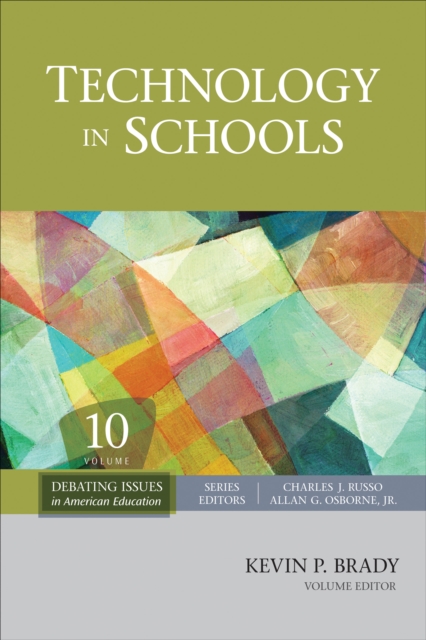
Technology in schools
Written by experts in the field, this volume in the Debating Issues in American Education reference series provides readers with illustrated views of the topic of technology in schools and offers resources for further exploration.
eBook