
Catalogue Search | MBRL


Are you sure you want to remove the book from the shelf?

{{itemTitle}}
29,107
result(s) for
"Educational tests and measurements"
Sort by:

The perfect test
\"Some ten years from today, American schools have tried every possible education fad. Common national standards, year-round schools, takeover of school boards, and even the super-qualified teacher program have failed to improve low U.S. achievement on international assessments. That all changes when Grant and Jennifer Wilson, both Stanford Ph. D. graduates, create what they believe are the perfect tests. The Venus Assessment System, the first national tests in U.S. history, flip American education on its ear, making U.S. students number one in the world in math and science. But then Jennifer Wilson discovers a secret list of names, students who are exceptions to the high-stakes consequences of the test. So secret that some people are willing to kill for it.\"--Publisher's description.
Book

Adapting educational and psychological tests for cross-cultural assessment
Adapting Educational and Psychological Tests for Cross-Cultural Assessment critically examines and advances new methods and practices for adapting tests for cross-cultural assessment and research. The International Test Commission (ITC) guidelines for test adaptation and conceptual and methodological issues in test adaptation are described in detail, and questions of ethics and concern for validity of test scores in cross-cultural contexts are carefully examined. Advances in test translation and adaptation methodology, including statistical identification of flawed test items, establishing equivalence of different language versions of a test, and methodologies for comparing tests in multiple languages, are reviewed and evaluated. The book also focuses on adapting ability, achievement, and personality tests for cross-cultural assessment in educational, industrial, and clinical settings.
This book furthers the ITC's mission of stimulating research on timely topics associated with assessment. It provides an excellent resource for courses in psychometric methods, test construction, and educational and/or psychological assessment, testing, and measurement. Written by internationally known scholars in psychometric methods and cross-cultural psychology, the collection of chapters should also provide essential information for educators and psychologists involved in cross-cultural assessment, as well as students aspiring to such careers.
Contents: Preface. Part I: Cross-Cultural Adaptation of Educational and Psychological Tests: Theoretical and Methodological Issues. R.K. Hambleton, Issues, Designs, and Technical Guidelines for Adapting Tests Into Multiple Languages and Cultures. F.J.R. van de Vijver, Y.H. Poortinga, Conceptual and Methodological Issues in Adapting Tests. T. Oakland, Selected Ethical Issues Relevant to Test Adaptations. S.G. Sireci, L. Patsula, R.K. Hambleton, Statistical Methods for Identifying Flaws in the Test Adaptation Process. S.G. Sireci, Using Bilinguals to Evaluate the Comparability of Different Language Versions of a Test. L.L. Cook, A.P. Schmitt-Cascallar, Establishing Score Comparability for Tests Given in Different Languages. L.L. Cook, A.P. Schmitt-Cascallar, C. Brown, Adapting Achievement and Aptitude Tests: A Review of Methodological Issues. Part II: Cross-Cultural Adaptation of Educational and Psychological Tests: Applications to Achievement, Aptitude, and Personality Tests. C.T. Fitzgerald, Test Adaptation in a Large-Scale Certification Program. C.Y. Maldonado, K.F. Geisinger, Conversion of the Wechsler Adult Intelligence Scale Into Spanish: An Early Test Adaption Effort of Considerable Consequence. N.K. Tanzer, Developing Tests for Use in Multiple Languages and Cultures: A Plea for Simultaneous Development. F. Drasgow, T.M. Probst, The Psychometrics of Adaptation: Evaluating Measurement Equivalence Across Languages and Cultures. M. Beller, N. Gafni, P. Hanani, Constructing, Adapting, and Validating Admissions Tests in Multiple Languages: The Israeli Case. P.F. Merenda, Cross-Cultural Adaptation of Educational and Psychological Testing. C.D. Spielberger, M.S. Moscoso, T.M. Brunner, Cross-Cultural Assessment of Emotional States and Personality Traits.
eBook

Are you really a genius? : timeless tests for the irritatingly intelligent
A collection of brain-teasers, questions and challenges to test the reader's intelligence.
Book

Exemplars of Assessment in Higher Education
Co-published with \"While assessment may feel to constituents like an activity of accountability simply for accreditors, it is most appropriate to approach assessment as an activity of accountability for students. Assessment results that improve institutional effectiveness, heighten student learning, and better align resources serve to make institutions stronger for the benefit of their students, and those results also serve the institution or program well during the holistic evaluation required through accreditation.\" - from the foreword by Heather Perfetti, President of the Middle States Commission on Higher EducationColleges and universities struggle to understand precisely what is being asked for by accreditors, and this book answers that question by sharing examples of success reported by schools specifically recommended by accreditors. This compendium gathers examples of assessment practice in twenty-four higher education institutions: twenty-three in the U.S. and one in Australia. All institutions represented in this book were suggested by their accreditor as having an effective assessment approach in one or more of the following assessment focused areas: assessment in the disciplines, co-curricular, course/program/institutional assessment, equity and inclusion, general education, online learning, program review, scholarship of teaching and learning, student learning, or technology. These examples recommended by accrediting agencies makes this a unique contribution to the assessment literature. The book is organized in four parts. Part One is focused on student learning and assessment and includes ten chapters. The primary focus for Part Two is student learning assessment from a disciplinary perspective and includes four chapters. Part Three has a faculty engagement and assessment focus, and Part Four includes four chapters on institutional effectiveness and assessment, with a focus on strategic planning.This book is a publication of the Association for the
eBook


Developing and Validating Test Items
Since test items are the building blocks of any test, learning how to develop and validate test items has always been critical to the teaching-learning process. As they grow in importance and use, testing programs increasingly supplement the use of selected-response (multiple-choice) items with constructed-response formats. This trend is expected to continue. As a result, a new item writing book is needed, one that provides comprehensive coverage of both types of items and of the validity theory underlying them.
This book is an outgrowth of the author's previous book, Developing and Validating Multiple-Choice Test Items, 3e (Haladyna, 2004). That book achieved distinction as the leading source of guidance on creating and validating selected-response test items. Like its predecessor, the content of this new book is based on both an extensive review of the literature and on its author's long experience in the testing field. It is very timely in this era of burgeoning testing programs, especially when these items are delivered in a computer-based environment. Key features include ...
Comprehensive and Flexible - No other book so thoroughly covers the field of test item development and its various applications.
Focus on Validity - Validity, the most important consideration in testing, is stressed throughout and is based on the Standards for Educational and Psychological Testing, currently under revision by AERA, APA, and NCME
Illustrative Examples - The book presents various selected and constructed response formats and uses many examples to illustrate correct and incorrect ways of writing items. Strategies for training item writers and developing large numbers of items using algorithms and other item-generating methods are also presented.
Based on Theory and Research - A comprehensive review and synthesis
eBook


Enhancing Assessment in Higher Education
Co-published with AIR. Published in association with Assessment and accountability are now inescapable features of the landscape of higher education, and ensuring that these assessments are psychometrically sound has become a high priority for accrediting agencies and therefore also for higher education institutions. Bringing together the higher education assessment literature with the psychometric literature, this book focuses on how to practice sound assessment. This volume provides comprehensive and detailed descriptions of tools for and approaches to assessing student learning outcomes in higher education. The book is guided by the core purpose of assessment, which is to enable faculty, administrators, and student affairs professionals with the information they need to increase student learning by making changes in policies, curricula, and other programs. The book is divided into three sections: overview, assessment in higher education, and case studies. The central section looks at direct and indirect measures of student learning, and how to assure the validity, reliability, and fairness of both types. The first six chapters (the first two sections) alternate chapters written by experts in assessment in higher education and experts in psychometrics. The remaining three chapters are applications of assessment practices in three higher education institutions. Finally, the book includes a glossary of key terms in the field.
eBook

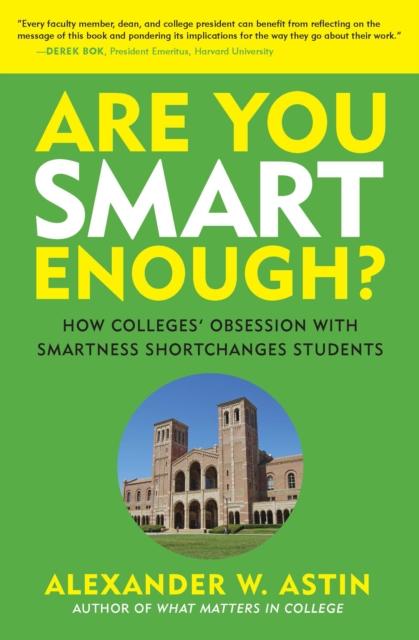
Are You Smart Enough?
This book explores the many ways in which the obsession with \"being smart\" distorts the life of a typical college or university, and how this obsession leads to a higher education that shortchanges the majority of students, and by extension, our society's need for an educated population. The author calls on his colleagues in higher education to return the focus to the true mission of developing the potential of each student: However \"smart\" they are when they get to college, both the student and the college should be able to show what they learned while there.Unfortunately, colleges and universities have embraced two very narrow definitions of smartness: the course grade and especially the standardized test. A large body of research shows that it will be very difficult for colleges to fulfill their stated mission unless they substantially broaden their conception to include student qualities such as leadership, social responsibility, honesty, empathy, and citizenship. Specifically, the book grapples with issues such as the following:
Why America's 3,000-plus colleges and universities have evolved into a hierarchical pecking order, where institutions compete with each other to recruit \"smart\" students, and where a handful of elite institutions at the top of the pecking order enroll the \"smartest\" students.
Why higher education favors its smartest students to the point where the \"not so smart\" students get second-class treatment.
Why so many colleges find it difficult to make good on their commitment to affirmative action and \"equality of opportunity.\"
Why college faculties tend to value being smart more than developing students' smartness (i.e., teaching and learning).
eBook