
Catalogue Search | MBRL


Are you sure you want to remove the book from the shelf?

{{itemTitle}}
31
result(s) for
"Egypt -- History, Naval"
Sort by:

Les fatimides et la mer (909-1171)
\"The Fatimids (10th - 12th centuries C.E) are known to have been the first Shiite caliphal dynasty and to have founded Cairo, the city that became their capital in 973 when they left Tunisia for Egypt. During their reign, the Fatimids built an effective war fleet that inflicted several defeats on Christian navies. This is the first study on the Fatimid naval force and, more generally, on the role of the sea for the Fatimids whose territories touched both the Mediterranean and the Red Sea. The documentation presented in this study demonstrates how, in the course of two centuries, this Ismaeli dynasty set up a maritime policy and developed a communication strategy in which their control of the sea helped legitimize their universalist claims against competing powers. \"-- Provided by publisher.
BOOK

The Ptolemies, the Sea and the Nile
With its emphasis on the dynasty's concern for control of the sea – both the Mediterranean and the Red Sea – and the Nile, this book offers a new and original perspective on Ptolemaic power in a key period of Hellenistic history. Within the developing Aegean empire of the Ptolemies, the role of the navy is examined together with that of its admirals. Egypt's close relationship to Rhodes is subjected to scrutiny, as is the constant threat of piracy to the transport of goods on the Nile and by sea. Along with the trade in grain came the exchange of other products. Ptolemaic kings used their wealth for luxury ships and the dissemination of royal portraiture was accompanied by royal cult. Alexandria, the new capital of Egypt, attracted poets, scholars and even philosophers; geographical exploration by sea was a feature of the period and observations of the time enjoyed a long afterlife.
eBook

The Ptolemies, the sea and the Nile : studies in waterborne power
\"With its emphasis on the dynasty's concern for control of the sea--both the Mediterranean and the Red Sea--and the Nile, this book offers a new and original perspective on Ptolemaic power in a key period of Hellenistic history. Within the developing Aegean empire of the Ptolemies, the role of the navy is examined together with that of its admirals. Egypt's close relationship to Rhodes is subjected to scrutiny, as is the constant threat of piracy to the transport of goods on the Nile and by sea. Along with the trade in grain came the exchange of other products. Ptolemaic kings used their wealth for luxury ships and the dissemination of royal portraiture was accompanied by royal cult. Alexandria, the new capital of Egypt, attracted poets, scholars and even philosophers; geographical exploration by sea was a feature of the period and observations of the time enjoyed a long afterlife\"-- Provided by publisher.
Book
Khedive Ismail's Army
Khedive Ismail's Army examines military failure in the age of imperialism.
On paper, the mid-nineteenth century Egyptian army seems a formidable regional power. It had a tradition of success, modern weapons, and mercenary officers with experience in major wars. Egypt's ruler, Khedive Ismail, hoped to combine the imported technology and brains with native manpower, and establish an Egyptian dominated Horn of Africa. His soldiers did conquer parts of the Sudan, but they suffered disastrous defeats during the Egyptian Abyssinian War of 1875 to 1876.Presenting the first detailed examination of the Egyptian Abyssinian War in English, this new book also looks at the root problems that made Ismail's soldiers ineffective. These include issues of class, racism, internal, and external politics, finance, and the rapidly changing world of mid-Nineteenth Century military technology. This book is aimed at military historians, and will be of interest to those studying the Middle East or North East Africa.
eBook

Muslim Fortresses in the Levant
During much of the twelfth century the Crusaders dominated the military scene in the Levant. The unification of Egypt and Syria by Saladin gradually changed the balance of power, which slowly begun to tilt in favour of the Muslims. This book examines the development and role of Muslim fortresses in the Levant at the time of the Crusaders and the Mongol invasion, situating the study within a broad historical, political and military context.
Exploring the unification of Egypt with a large part of Syria and its effect on the balance of power in the region, Raphael gives a historical overview of the resulting military strategies and construction of fortresses. A detailed architectural analysis is based on a survey of four Ayyubid and eight Mamluk fortresses situated in what are today the modern states of Jordan, Israel, Southern Turkey and Egypt (the Sinai Peninsula). The author then explores the connection between strongholds or military architecture, and the development of siege warfare and technology, and examines the influence of architecture and methods of rule on the concept of defence and the development of fortifications.
Drawing upon excavation reports, field surveys and contemporary Arabic sources, the book provides the Arabic architectural terminology and touches on the difficulties of reading the sources. Detailed maps of the fortresses in the region, the Mongol invasion routs, plans of sites and photographs assist the reader throughout the book, providing an important addition to existing literature in the areas of Medieval Archaeology, Medieval military history and Middle Eastern studies.
Kate Raphael is a postdoctoral researcher in the Department of Earth and Sciences at the Hebrew University of Jerusalem, Israel. She received her PhD in Medieval Islamic studies at the Hebrew University of Jerusalem, and her research currently focuses on environmental disasters in the Medieval Middle East.
Introduction 1. Ayyubid Fortresses in the Late Twelfth and Early Thirteenth Centuries: Muslims' Apprenticeship 2. Mongolian Siege Warfare and the Defense of Mamluk Fortresses 3. Laying the Foundations: Fortification Work Conducted during the Reign of Baybars (1260-1277), Qalāwūn (1280-1290) and Al-Ashraf Khalīl (1290-1293) 4. Mamluk Power on Display: Fortifications in the Second Half of the Thirteenth Century 5. Military Architecture versus Political and Military Organization
eBook
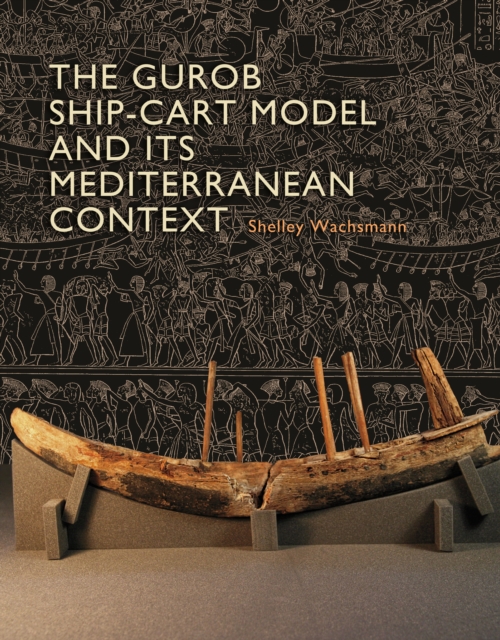
The Gurob ship-cart model and its Mediterranean context
When Shelley Wachsmann began his analysis of the small ship model excavated by assistants of famed Egyptologist W. M. F. Petrie in Gurob, Egypt, in 1920, he expected to produce a brief monograph that would shed light on the model and the ship type that it represented. Instead, Wachsmann discovered that the model held clues to the identities and cultures of the enigmatic Sea Peoples, to the religious practices of ancient Egypt and Greece, and to the oared ships used by the Bronze Age Mycenaean Greeks.Although found in Egypt, the prototype of the Gurob model was clearly an Aegean-style galley of a type used by both the Mycenaeans and the Sea Peoples. The model is the most detailed representation presently known of this vessel type, which played a major role in changing the course of world history. Contemporaneous textual evidence for Sherden-one of the Sea Peoples-settled in the region suggests that the model may be patterned after a galley of that culture. Bearing a typical Helladic bird-head decoration topping the stempost, with holes along the sheer strakes confirming the use of stanchions, the model was found with four wheels and other evidence for a wagon-like support structure, connecting it with European cultic prototypes.The online resources that accompany the book illustrate Wachsmann's research and analysis. They include 3D interactive models that allow readers to examine the Gurob model on their computers as if held in the hand, both in its present state and in two hypothetical reconstructions. The online component also contains high-resolution color photos of the model, maps and satellite photos of the site, and other related materials. Offering a wide range of insights and evidence for linkages among ancient Mediterranean peoples and traditions, The Gurob Ship-Cart Model and Its Mediterranean Context presents an invaluable asset for anyone interested in the complexities of cultural change in the eastern Mediterranean at the end of the Bronze Age and the beginning of the Iron Age.
eBook

British Military Intervention and the Struggle for Jordan
Within two years of their abortive invasion of the Suez Canal zone in 1956, British troops once again intervened in a major Middle Eastern country. The Jordan intervention of July 1958 took place despite the steady decline of the British position in the country over the previous three years. This book examines why the government led by Harold Macmillan remained ready to use military force to prop up the regime of King Hussein even though the United States had emerged as the main Western power in the Middle East after 1956. Incorporating a variety of archival material, Blackwell provides new historical insights into the origins of the Anglo-American use of military power to protect their interests in the Middle East.
eBook

En Route to Egypt: Akko in the Persian Period
It has been argued over the past forty years whether or not ancient empires were capable of developing long-term military planning, commonly referred to as grand strategy in academic discourse. Yet well-founded doubts are often neglected in evaluations of the background for the construction of large Mediterranean harbors. Achaemenid Akko has long been thought to have been built as a logistical center and regular point d'appui for Persian armies and fleets whenever they campaigned against a perennially-insubordinate Egypt. The construction of a Phoenician harbor in Akko has been dated as early as the time of Cambyses, late in the sixth century BCE. Here, Gambash claims that there is little ground for assuming Persian development and regular usage of Akko.
Journal Article

Muslims and Crusaders
Muslims and Crusaders combines chronological narrative, discussion of important areas of scholarly enquiry and evidence from Islamic primary sources to give a well-rounded survey of Christianity's wars in the Middle East, 1095-1382.
Revised, expanded, and updated to take account of the most recent scholarship, this second edition enables readers to achieve a broader and more complete perspective on the crusading period by presenting the crusades from the viewpoints of those against whom they were waged, the Muslim peoples of the Levant. The book introduces the reader to the most significant issues that affected Muslim responses to the European crusaders and their descendants who would go on to live in the Latin Christian states that were created in the region. It considers not only the military encounters between Muslims and crusaders, but also the personal, political, diplomatic, and trade interactions that took place between the Muslims and Franks away from the battlefield.
Engaging with a wide range of translated primary source documents, including chronicles, dynastic histories, religious and legal texts, and poetry, Muslims and Crusaders is ideal for students and historians of the crusades.
eBook