
Catalogue Search | MBRL


Are you sure you want to remove the book from the shelf?

{{itemTitle}}
8
result(s) for
"Egypt Foreign relations 1952-1970"
Sort by:

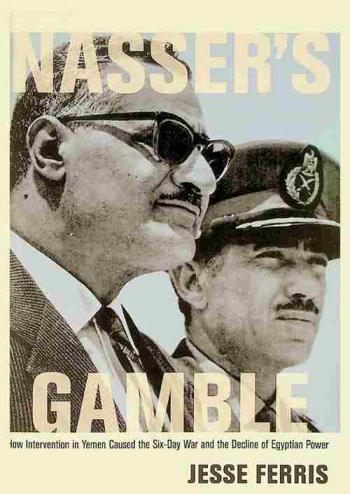
Nasser's Gamble
Nasser's Gambledraws on declassified documents from six countries and original material in Arabic, German, Hebrew, and Russian to present a new understanding of Egypt's disastrous five-year intervention in Yemen, which Egyptian president Gamal Abdel Nasser later referred to as \"my Vietnam.\" Jesse Ferris argues that Nasser's attempt to export the Egyptian revolution to Yemen played a decisive role in destabilizing Egypt's relations with the Cold War powers, tarnishing its image in the Arab world, ruining its economy, and driving its rulers to instigate the fatal series of missteps that led to war with Israel in 1967.
Viewing the Six Day War as an unintended consequence of the Saudi-Egyptian struggle over Yemen, Ferris demonstrates that the most important Cold War conflict in the Middle East was not the clash between Israel and its neighbors. It was the inter-Arab struggle between monarchies and republics over power and legitimacy. Egypt's defeat in the \"Arab Cold War\" set the stage for the rise of Saudi Arabia and political Islam.
Bold and provocative,Nasser's Gamblebrings to life a critical phase in the modern history of the Middle East. Its compelling analysis of Egypt's fall from power in the 1960s offers new insights into the decline of Arab nationalism, exposing the deep historical roots of the Arab Spring of 2011.
eBook

British strategy and intelligence in the Suez crisis
This volume traces the activities of the Secret Intelligence Service (SIS/MI6) and the Joint Intelligence Committee (JIC) during the Suez Crisis, one of the most infamous episodes of British foreign policy. In doing so it identifies broader lessons not only about the events of 1956, but about the place of intelligence in strategy itself. It provides both an exploration of the relationship between intelligence and strategy at the conceptual level, and also a historical account, and strategic analysis of, the performance of the Joint Intelligence Committee and the Secret Intelligence Service during this time.
Book

An incurable past : Nasser's Egypt then and now
Mid-century Egypt seems to shift its shape in light of ordinary peoples’ memories. In An Incurable Past , Mériam Belli examines collective memory, oral histories, and everyday communications to reveal not just the history of mid-twentieth-century Egypt but also the ways in which ordinary people experience and remember the past. Using official archives, government publications, press reportage, fiction, textbooks, cinema, art, and public rituals, Belli constructs a ground-breaking theoretical framework of historical utterances which provokes questions about the relationship between remembrance and reality. Belli argues that such personal testimonies and public representations allow us a deeper understanding of Egypt’s many sociocultural layers in the 1950s and 1960s. She spotlights three topics of vernacular expression in modern Egypt: education, the anti-colonial Limby Festival, and the 1968 apparition of the Virgin Mary at a Coptic Orthodox Church in Cairo. Linked by the mid-century shift from communal life to an industrial and individuated society, these expressions also disclose the contradictory influence of ideologically homogenizing state policies.
Examining history not as it was but as it is remembered, this book contextualizes the classist and deeply disappointing post-Nasserist period that has inspired today’s Egyptian revolutionaries.
eBook

Confronting the Costs of War
What determines the strategies by which a state mobilizes resources for war? And does war preparation strengthen or weaken the state in relation to society? In addressing these questions, Michael Barnett develops a novel theoretical framework that traces the connection between war preparation and changes in state-society relations, and applies that framework to Egypt from 1952 to 1977 and Israel from 1948 through 1977.Confronting the Costs of Waraddresses major issues in international relations, comparative politics, and Middle Eastern studies.
eBook


The Struggle for Egypt
The recent revolution in Egypt has shaken the Arab world to its roots. The most populous Arab country and the historical center of Arab intellectual life, Egypt is a linchpin of the US's Middle East strategy, receiving more aid than any nation except Israel. This is not the first time that the world and has turned its gaze to Egypt, however. A half century ago, Egypt under Nasser became the putative leader of the Arab world and a beacon for all developing nations. Yet in the decades prior to the 2011 revolution, it was ruled over by a sclerotic regime plagued by nepotism and corruption. During that time, its economy declined into near shambles, a severely overpopulated Cairo fell into disrepair, and it produced scores of violent Islamic extremists such as Ayman al-Zawahiri and Mohammed Atta. This book explains how this parlous state of affairs came to be, why the revolution occurred, and where Egypt might be headed next. A sweeping account of Egypt in the modern era, it incisively chronicles all of the nation's central historical episodes: the decline of British rule, the rise of Nasser and his quest to become a pan-Arab leader; Egypt's decision to make peace with Israel and ally with the United States; the assassination of Sadat; the emergence of the Muslim Brotherhood; and finally the demonstrations that convulsed Tahrir Square and overthrew an entrenched regime. Throughout Egypt's history, there has been an intense debate to define what Egypt is, what it stands for, and its relation to the world. Egyptians now have an opportunity finally to answer these questions. Doing so in a way that appeals to the vast majority of Egyptians, the book notes, will be difficult but ultimately necessary if Egypt is to become an economically dynamic and politically vibrant society.
eBook