
Catalogue Search | MBRL


Are you sure you want to remove the book from the shelf?

{{itemTitle}}
48
result(s) for
"Egypt Politics and government 21st century."
Sort by:


Contesting the Repressive State
This book advances research on the collective action dilemma in protest movements by examining protest mobilization leading up to, and during, the 2011 Egyptian Revolution and 2013 June 30th Coup in Cairo, Egypt. The book is organized chronologically and touches on why and how people make the decision to protest or not protest during different periods of the revolutionary process. The overarching question is: Why and how do individuals who are not members of political groups or organizers of political movements choose to engage or not engage in anti-government protest under a repressive regime? In answering the question, the book argues that individual decisions to protest or not protest are based on the intersection of the following three factors: political opportunity structures, mobilizing structures, and framing processes. It further demonstrates that the way these decisions to protest or not protest take place is through emotional mechanisms that are activated by specific combinations of these factors. The goal of the book is to investigate the relationship between key structural factors and the emotional responses they produce. By examining 170 interviews with individuals who either protested or did not protest, it explores how social media, violent government repression, changes in political opportunities, and the military influenced individual decisions to protest or not protest.
eBook


Egypt in Flux
No chapter in Egypt’s contemporary history has been more turbulent and unpredictable than the past three years. In a very short period of time, the Arab world’s most populous country has seen a transition from rule by an iron-fisted dictatorship to a populist uprising to military omnipotence to Islamist electoral victory to constitutional turmoil to societal polarization. Egypt’s iconic revolution has been neither victorious nor defeated. Egypt in Flux is a collection of essays on the political, social, economic, and cultural dimensions of change in the country’s ongoing revolutionary current. While written over a span of several years, the essays are timeless in the historical context they provide and their ability to chart the country's trajectory in the period ahead. From the conditions that precipitated the uprising and the eruption of national dissent to the derailing of the revolution, the author reflects on the pressing topics of the day while being mindful of the counterrevolutionary movements and the continuation of the unending uprising. From discussions about the illusion of fair and free elections, social inequities, and labor disparities to examinations of religion, sports, literature, and sexuality, the essays in this valuable and intellectually stimulating volume chart both the broad lines and the nuances of an unfinished revolution.
eBook

Militarizing the nation : the army, business, and revolution in Egypt
The Egyptian army decided to intervene and take down existing regimes three times in the post-colonial state: once in 1952, and again more recently in 2011 and 2013. In old and new cases of intervention, the military institution deployed the same nationalist rhetoric about its duty as the \"guardian\" of the nation and the protector of national security and unity. However, the new army of the last three years is not the same institution that existed sixty years ago. This book argues that a new military institution was born in Egypt in the 1980s, after the country fought its last war with its traditional enemy and signed a peace treaty. It is an army of \"neo-liberal officers,\" who run vast business enterprises, enjoy financial autonomy beyond public scrutiny, and intervene in politics with heavy leverage for reasons different than those of the old army--albeit by using the same nationalist rhetoric. Under such militarism, the country's existing economic crisis is growing acutely worse. The Egyptian pound has been drastically devalued, prices of basic goods have skyrocketed, unemployment rates have further increased, and foreign investors have not arrived to the country yet. As Abul-Magd explores the deep historical roots of the country's current fragile state, she also offers proscriptions for demilitarizing the nation, including divesting the Egyptian military of its business enterprises by curbing the financial support it receives from Arab Gulf states and other powers.
Book
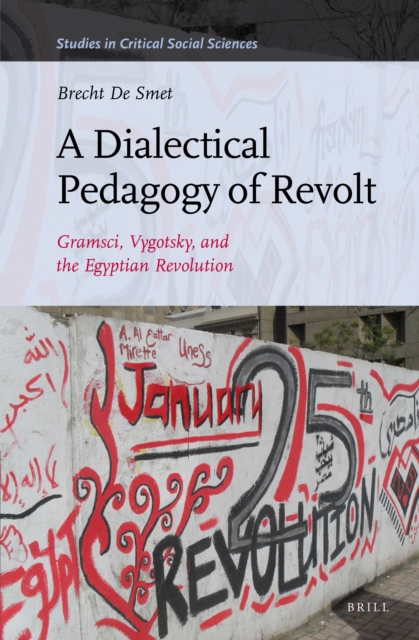
A Dialectical Pedagogy of Revolt
In A Dialectical Pedagogy of Revolt Brecht De Smet integrates the political thought of Antonio Gramsci with the cultural psychology of Lev Vygotsky into an original perspective on revolutionary subjectivity that is deployed to understand the Egyptian \"Tahrir\" Revolution.
eBook
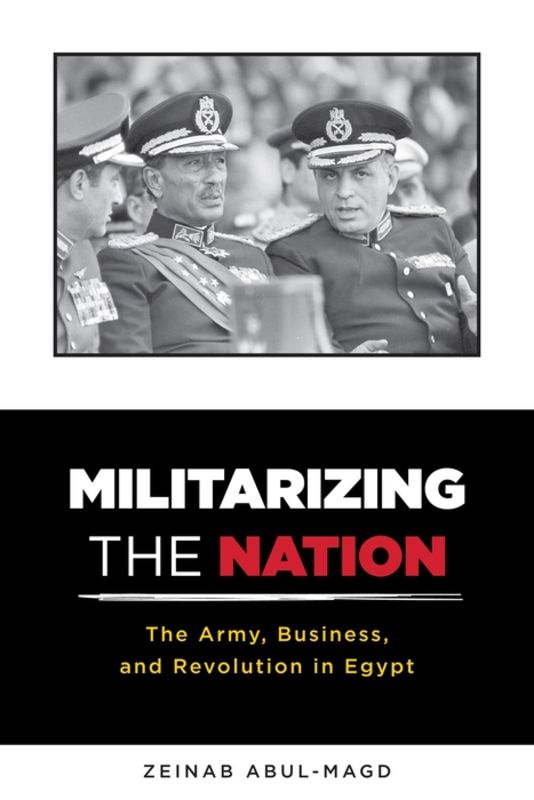
Militarizing the Nation
Egypt's army portrays itself as a faithful guardian \"saving the nation.\" Yet saving the nation has meant militarizing it. Zeinab Abul-Magd examines both the visible and often invisible efforts by Egypt's semi-autonomous military to hegemonize the country's politics, economy, and society over the past six decades. The Egyptian army has adapted to and benefited from crucial moments of change. It weathered the transition to socialism in the 1960s, market consumerism in the 1980s, and neoliberalism from the 1990s onward, all while enhancing its political supremacy and expanding a mammoth business empire. Most recently, the military has fought back two popular uprisings, retained full power in the wake of the Arab Spring, and increased its wealth. While adjusting to these shifts, military officers have successfully transformed urban milieus into ever-expanding military camps. These spaces now host a permanent armed presence that exercises continuous surveillance over everyday life. Egypt's military business enterprises have tapped into the consumer habits of the rich and poor alike, reaping unaccountable profits and optimizing social command. Using both a political economy approach and a Foucauldian perspective, Militarizing the Nation traces the genealogy of the Egyptian military for those eager to know how such a controversial power gains and maintains control.
eBook

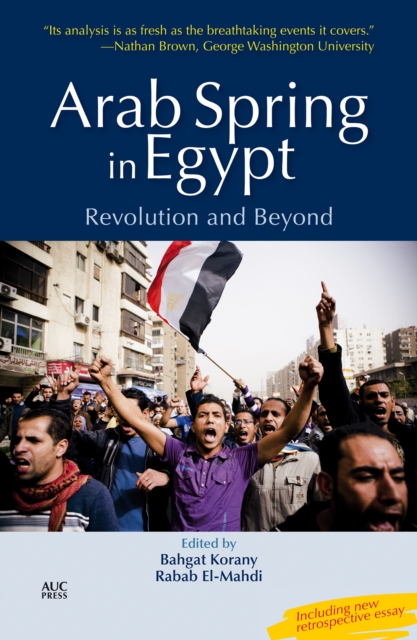
Arab Spring in Egypt
Beginning in Tunisia, and spreading to as many as seventeen Arab countries, the street protests of the ‘Arab Spring’ in 2011 empowered citizens and banished their fear of speaking out against governments. The Arab Spring belied Arab exceptionalism, widely assumed to be the natural state of stagnation in the Arab world amid global change and progress. The collapse in February 2011 of the regime in the region’s most populous country, Egypt, led to key questions of why, how, and with what consequences did this occur? Inspired by the “contentious politics\" school and Social Movement Theory, Arab Spring in Egypt addresses these issues, examining the reasons behind the collapse of Egypt’s authoritarian regime; analyzing the group dynamics in Tahrir Square of various factions: labor, youth, Islamists, and women; describing economic and external issues and comparing Egypt’s transition with that of Indonesia; and reflecting on the challenges of transition. “Its analysis is as fresh as the breathtaking events it covers.\"—Nathan Brown, George Washington University “Arab Spring in Egypt is a modern history study that brings much greater understanding to light about the views of modern Arab people and the future they see for their country.\"—Midwest Book Review
eBook