
Catalogue Search | MBRL


Are you sure you want to remove the book from the shelf?

{{itemTitle}}
24
result(s) for
"Eisenstein, Sergei, 1898-1948 Criticism and interpretation."
Sort by:


Harmony and dissent : film and avant-garde art movements in the early twentieth century
R. Bruce Elder argues that the authors of many of the manifestoes that announced in such lively ways the appearance of yet another artistic movement shared a common aspiration: they proposed to reformulate the visual, literary, and performing arts so that they might take on attributes of the cinema. The cinema, Elder argues, became, in the early decades of the twentieth century, a pivotal artistic force around which a remarkable variety and number of aesthetic forms took shape. To demonstrate this, Elder begins with a wide-ranging discussion that opens up some broad topics concerning modernity's cognitive (and perceptual) regime, with a view to establishing that a crisis within that regime engendered some peculiar, and highly questionable, epistemological beliefs and enthusiasms. Through this discussion, Elder advances the startling claim that a crisis of cognition precipitated by modernity engendered, by way of response, a peculiar sort of \"pneumatic (spiritual) epistemology.\" Elder then shows that early ideas of the cinema were strongly influenced by this pneumatic epistemology and uses this conception of the cinema to explain its pivotal role in shaping two key moments in early-twentieth-century art: the quest to bring forth a pure, \"objectless\" (non-representational) art and Russian Suprematism, Constructivism, and Productivism.
eBook

On the wings of hypothesis : collected writings on Soviet cinema
\"This posthumous volume, the second of Annette Michelson's long anticipated Collected Writings, gathers her erudite and incisive readings of the revolutionary films of Sergei Eisenstein and Dziga Vertov and gives readers the opportunity to track her sustained investigations into their work over four decades. Michelson introduced American audiences to Soviet cinema in the early 1970s, extending the interpretative paradigm she had used for American filmmakers of the mid-twentieth century, which stressed phenomenological readings of the work of artists from Stan Brakhage to Michael Snow, to films and writings by Eisenstein and Vertov. She returned again and again to what she calls, following Eisenstein, \"intellectual cinema\"-the deliberate attempt to create philosophically informed analogues for consciousness. The volume includes Michelson's major essays on Eisenstein's unrealized attempts to make a movie of both Marx's Capital and James Joyce's Ulysses, as well as her key text on Vertov's 1929 masterpiece The Man with a Movie Camera. Together, the texts demonstrate Michelson's pervasive influence as a writer and thinker, and her key role in the establishment of cinema studies as an academic field. The book aims to make these canonical texts available for the next generation of film scholars. As Malcolm Turvey notes in his foreword, \"the writings in this volume are indispensable in understanding this quintessentially modernist episode in (Soviet) film history.\"\"-- Provided by publisher.
BOOK

This Thing of Darkness
Sergei Eisenstein's unfinished masterpiece, Ivan the Terrible, was no ordinary movie. Commissioned by Joseph Stalin in 1941 to justify state terror in the sixteenth century and in the twentieth, the film's politics, style, and epic scope aroused controversy even before it was released. In This Thing of Darkness, Joan Neuberger offers a sweeping account of the conception, making, and reception of Ivan the Terrible that weaves together Eisenstein's expansive thinking and experimental practice with a groundbreaking new view of artistic production under Stalin. Drawing on Eisenstein's unpublished production notebooks, diaries, and manuscripts, Neuberger's riveting narrative chronicles Eisenstein's personal, creative, and political challenges and reveals the ways cinematic invention, artistic theory, political critique, and historical and psychological analysis went hand in hand in this famously complex film.
Neuberger's bold arguments and daring insights into every aspect of Eisenstein's work during this period, together with her ability to lucidly connect his wide-ranging late theory with his work on Ivan, show the director exploiting the institutions of Soviet artistic production not only to expose the cruelties of Stalin and his circle but to challenge the fundamental principles of Soviet ideology itself. Ivan the Terrible, she argues, shows us one of the world's greatest filmmakers and one of the 20th century's greatest artists observing the world around him and experimenting with every element of film art to explore the psychology of political ambition, uncover the history of recurring cycles of violence and lay bare the tragedy of absolute power.
eBook


Movement, Action, Image, Montage
A major new study of Sergei Eisenstein delivers fresh, in-depth analyses of the iconic filmmaker's body of workWhat can we still learn from Sergei Eisenstein? Long valorized as the essential filmmaker of the Russian Revolution and celebrated for his indispensable contributions to cinematic technique, Eisenstein's relevance to contemporary culture is far from exhausted. InMovement, Action, Image, Montage, Luka Arsenjuk considers the auteur as a filmmaker and a theorist, drawing on philosophers such as Georg Wilhelm Friedrich Hegel and Gilles Deleuze-as well as Eisenstein's own untranslated texts-to reframe the way we think about the great director and his legacy.
Focusing on Eisenstein's unique treatment of the foundational concepts of cinema-movement, action, image, and montage-Arsenjuk invests each aspect of the auteur's art with new significance for the twenty-first century. Eisenstein's work and thought, he argues, belong as much to the future as the past, and both can offer novel contributions to long-standing cinematic questions and debates.
Movement, Action, Image, Montagebrings new elements of Eisenstein's output into academic consideration, by means ranging from sustained and comprehensive theorization of Eisenstein's practice as a graphic artist to purposeful engagement with his recently published, unfinished bookMethod, still unavailable in English translation. This tour de force offers new and significant insights on Eisenstein's oeuvre-the films, the art, and the theory-and is a landmark work on an essential filmmaker.
eBook

The Eisenstein universe
\"In-depth, innovative study of the Soviet era film director, Sergei Eisenstein (1898-1948), which reassess his legacy in the twenty-first century using new research\"-- Provided by publisher.
BOOK
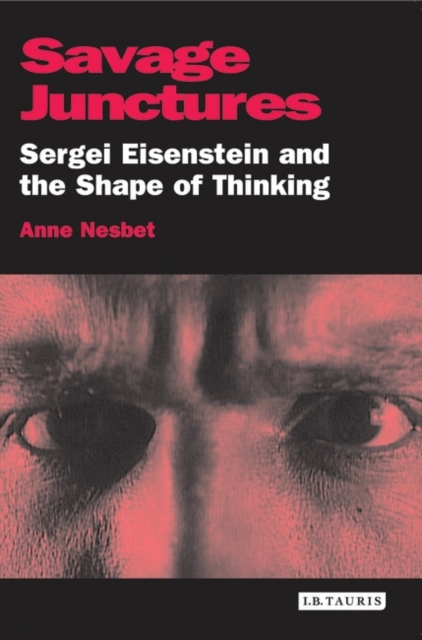
Savage Junctures : Sergei Eisenstein and the Shape of Thinking
Eisenstein delighted in unlikely juxtapositions, being apt to cite from Stalin and Disney in one breath. The heterogeneity underlying his work is breathtaking and his lack of decorum and refusal to be categorised tend to make critics uneasy but not Anne Nesbet. Based on extensive research in the Eisenstein archives, her book is an original, beautifully written exploration of Eisenstein's omnivorous consumption of high and low culture and his wide-ranging experiments in 'thinking in pictures'. Savage Junctures provides fresh insights into Eisenstein's films and writings. It examines the multiple contexts within which his films evolved and Eisenstein's appropriation of all of world culture as his source. Like Eisenstein himself, Anne Nesbet is particularly interested in the possibilities of visual image making and each chapter addresses the problem of his image-based thinking from a different perspective. Each chapter also offers a fundamentally new interpretation of the films and writings that make up his oeuvre. This is a major new contribution to studies in Soviet cinema and culture and to the field of film studies.
eBook

This thing of darkness : Eisenstein's Ivan the Terrible in Stalin's Russia
\"Eisenstein's diaries and production notebooks show that he carefully planned Ivan the Terrible to be a devastating critique of Stalinism, a profound study of the tragedy of absolute power, and a wildly innovative use of montage, all wrapped inside a narrative that would receive Stalin's approval\"-- Provided by publisher.
BOOK

Dance of Values
Sergei Eisenstein's cinematic adaptation of Karl Marx's Capital was never realized, yet it has haunted the imagination of many filmmakers, historians, and philosophers to the present day.
eBook