
Catalogue Search | MBRL


Are you sure you want to remove the book from the shelf?

{{itemTitle}}
25
result(s) for
"Ekokritik."
Sort by:


The Cambridge Introduction to Literature and the Environment
The degrading environment of the planet is something that touches everyone. This 2011 book offers an introductory overview of literary and cultural criticism that concerns environmental crisis in some form. Both as a way of reading texts and as a theoretical approach to culture more generally, 'ecocriticism' is a varied and fast-changing set of practices which challenges inherited thinking and practice in the reading of literature and culture. This introduction defines what ecocriticism is, its methods, arguments and concepts, and will enable students to look at texts in a wholly new way. Boxed sections explain key critical terms and contemporary debates in the field with 'hands-on' examples and comparisons. Timothy Clark's thoughtful approach makes this an ideal first encounter with environmental readings of literature.
eBook

Rethinking the Theatre of the Absurd
Rethinking the Theatre of the Absurd is an innovative collection of essays, written by leading scholars in the fields of theatre, performance and eco-criticism, which reconfigures absurdist theatre through the optics of ecology and environment. As well as offering strikingly new interpretations of the work of canonical playwrights such as Beckett, Genet, Ionesco, Adamov, Albee, Kafka, Pinter, Shephard and Churchill, the book playfully mimics the structure of Martin Esslin's classic text The Theatre of the Absurd, which is commonly recognised as one of the most important scholarly publications of the 20th century. By reading absurdist drama, for the first time, as an emergent form of ecological theatre, Rethinking the Theatre of the Absurd interrogates afresh the very meaning of absurdism for 21st-century audiences, while at the same time making a significant contribution to the development of theatre and performance studies as a whole. The collection's interdisciplinary approach, accessibility, and ecological focus will appeal to students and academics in a number of different fields, including theatre, performance, English, French, geography and philosophy. It will also have a major impact on the new cross disciplinary paradigm of eco-criticism.
eBook

Ecocriticism on the edge : the anthropocene as a threshold concept
The twenty-first century has seen an increased awareness of the forms of environmental destruction that cannot immediately be seen, localised or, by some, even acknowledged. Ecocriticism on the Edge explores the possibility of a new mode of critical practice, one fully engaged with the destructive force of the planetary environmental crisis. Timothy Clark argues that, in literary and cultural criticism, the \"Anthropocene\", which names the epoch in which human impacts on the planet's ecological systems reach a dangerous limit, also represents a threshold at which modes of interpretation that once seemed sufficient or progressive become, in this new counterintuitive context, inadequate or even latently destructive. The book includes analyses of literary works, including texts by Paule Marshall, Gary Snyder, Ben Okri, Henry Lawson, Lorrie Moore and Raymond Carver.
eBook
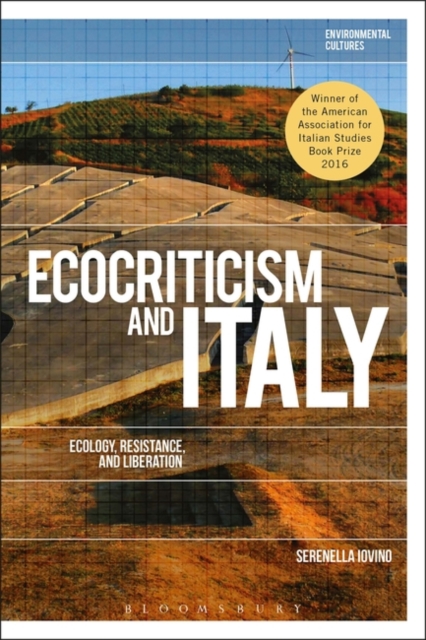
Ecocriticism and Italy
Winner of the MLA Aldo and Jeanne Scaglione Prize for Italian Studies 2016 Winner of the American Association for Italian Studies Book Prize 2016 This book is available as open access through the Bloomsbury Open Access programme and is available on www.bloomsburycollections.com. Written by one of Europe’s leading critics, Ecocriticism and Italy reads the diverse landscapes of Italy in the cultural imagination. From death in Venice as a literary trope and petrochemical curse, through the volcanoes of Naples to wine, food and environmental violence in Piedmont, Serenella Iovino explores Italy as a text where ecology and imagination meet. Examining cases where justice, society and politics interlace with stories of land and life, pollution and redemption, the book argues that literature, art and criticism are able to transform the unexpressed voices of these suffering worlds into stories of resistance and practices of liberation.
eBook

Material Ecocriticism
Material Ecocriticism offers new ways to analyze language and reality, human and nonhuman life, mind and matter, without falling into well-worn paths of thinking. Bringing ecocriticism closer to the material turn, the contributions to this landmark volume focus on material forces and substances, the agency of things, processes, narratives and stories, and making meaning out of the world. This broad-ranging reflection on contemporary human experience and expression provokes new understandings of the planet to which we are intimately connected.
eBook

Anthropocene Reading
Few terms have garnered more attention recently in the sciences,
humanities, and public sphere than the Anthropocene, the proposed
epoch in which a human \"signature\" appears in the
lithostratigraphic record. Anthropocene Reading considers
the implications of this concept for literary history and critical
method.
Entering into conversation with geologists and geographers, this
volume reinterprets the cultural past in relation to the
anthropogenic transformation of the Earth system while showcasing
how literary analysis may help us conceptualize this geohistorical
event. The contributors examine how a range of literary texts, from
The Tempest to contemporary dystopian novels to the poetry
of Emily Dickinson, mediate the convergence of the social
institutions, energy regimes, and planetary systems that support
the reproduction of life. They explore the long-standing dialogue
between imaginative literature and the earth sciences and show how
scientists, novelists, and poets represent intersections of
geological and human timescales, the deep past and a posthuman
future, political exigency and the carbon cycle.
Accessibly written and representing a range of methodological
perspectives, the essays in this volume consider what it means to
read literary history in the Anthropocene.
Contributors include Juliana Chow, Jeffrey Jerome Cohen, Thomas
H. Ford, Anne-Lise François, Noah Heringman, Matt Hooley, Stephanie
LeMenager, Dana Luciano, Steve Mentz, Benjamin Morgan, Justin
Neuman, Jennifer Wenzel, and Derek Woods.
eBook

Ecocritical explorations in literary and cultural studies
In Ecocritical Explorations, Patrick D. Murphy explores environmental literature and environmental cultural issues through both theoretical and applied criticism. He engages with the concepts of referentiality, simplicity, the nation state, and virtual reality in the first section of the book, and then goes on to interrogate these issues in contemporary environmental literature, both American and international. He concludes his argument with a discussion of the larger frames of family dynamics and un-natural disasters, such as hurricanes and global warming, ending with a chapter on the integration of scholarship and pedagogy in the classroom, with reference to his own teaching experiences. Murphy's study provides a wide ranging discussion of contemporary literature and cultural phenomena through the lens of ecological literary criticism, giving attention to both theoretical issues and applied critiques. In particular, he looks at popular literary genres, such as mystery and science fiction, as well as actual disasters and disaster scenarios. Ecocritical Explorations in Literary and Cultural Studies is a timely contribution to ecological literary criticism and an insightful look into how we represent our relationship with the environment.
eBook

Animal, Vegetable, Digital
Winner of the Elizabeth Agee Prize in American Literature
In Animal, Vegetable, Digital , Elizabeth Swanstrom makes a confident and spirited argument for the use of digital art in support of ameliorating human engagement with the environment and suggests a four-part framework for analyzing and discussing such applications.
Through close readings of a panoply of texts, artworks, and cultural artifacts, Swanstrom demonstrates that the division popular culture has for decades observed between nature and technology is artificial. Not only is digital technology not necessarily a brick in the road to a dystopian future of environmental disaster, but digital art forms can be a revivifying bridge that returns people to a more immediate relationship to nature as well as their own embodied selves.
To analyze and understand the intersection of digital art and nature, Animal, Vegetable, Digital explores four aesthetic techniques: coding, collapsing, corresponding, and conserving. “Coding” denotes the way artists use operational computer code to blur distinctions between the reader and text, and, hence, the world. Inviting a fluid conception of the boundary between human and technology, “collapsing” voids simplistic assumptions about the human body’s innate perimeter. The process of translation between natural and human-readable signs that enables communication is described as “corresponding.” “Conserving” is the application of digital art by artists to democratize large- and small-scale preservation efforts.
A fascinating synthesis of literary criticism, communications and journalism, science and technology, and rhetoric that draws on such disparate phenomena as simulated environments, video games, and popular culture, Animal, Vegetable, Digital posits that partnerships between digital aesthetics and environmental criticism are possible that reconnect humankind to nature and reaffirm its kinship with other living and nonliving things.
eBook

A Place for Humility
Emily Dickinson and Walt Whitman are widely acknowledged as two of America's foremost nature poets, primarily due to their explorations of natural phenomena as evocative symbols for cultural developments, individual experiences, and poetry itself. Yet for all their metaphorical suggestiveness, Dickinson's and Whitman's poems about the natural world neither preclude nor erase nature's relevance as an actual living environment. In their respective poetic projects, the earth matters both figuratively, as a realm of the imagination, and also as the physical ground that is profoundly affected by human action. This double perspective, and the ways in which it intersects with their formal innovations, points beyond their traditional status as curiously disparate icons of American nature poetry. That both of them not only approach nature as an important subject in its own right, but also address human-nature relationships in ethical terms, invests their work with important environmental overtones.Dickinson and Whitman developed their environmentally suggestive poetics at roughly the same historical moment, at a time when a major shift was occurring in American culture's view and understanding of the natural world. Just as they were achieving poetic maturity, the dominant view of wilderness was beginning to shift from obstacle or exploitable resource to an endangered treasure in need of conservation and preservation.A Place for Humilityexamines Dickinson's and Whitman's poetry in conjunction with this important change in American environmental perception, exploring the links between their poetic projects within the context of developing nineteenth-century environmental thought. Christine Gerhardt argues that each author's poetry participates in this shift in different but related ways, and that their involvement with their culture's growing environmental sensibilities constitutes an important connection between their disparate poetic projects. There may be few direct links between Dickinson's \"letter to the World\" and Whitman's \"language experiment,\" but via a web of environmentally-oriented discourses, their poetry engages in a cultural conversation about the natural world and the possibilities and limitations of writing about it-a conversation in which their thematic and formal choices meet on a surprising number of levels.
eBook