
Catalogue Search | MBRL


Are you sure you want to remove the book from the shelf?

{{itemTitle}}
13,545
result(s) for
"Election law -- United States"
Sort by:


The Supreme Court and election law : judging equality from Baker v. Carr to Bush v. Gore
In the first comprehensive study of election law since the Supreme Court decided Bush v. Gore , Richard L. Hasen rethinks the Court’s role in regulating elections. Drawing on the case files of the Warren, Burger, and Rehnquist courts, Hasen roots the Court’s intervention in political process cases to the landmark 1962 case, Baker v. Carr. The case opened the courts to a variety of election law disputes, to the point that the courts now control and direct major aspects of the American electoral process.
The Supreme Court does have a crucial role to play in protecting a socially constructed “core” of political equality principles, contends Hasen, but it should leave contested questions of political equality to the political process itself. Under this standard, many of the Court’s most important election law cases from Baker to Bush have been wrongly decided.
eBook

Ballot battles : the history of disputed elections in the United States
\"The 2000 presidential election, with its problems in Florida, was not the first major vote-counting controversy in the nation's history--nor the last. Ballot Battles traces the evolution of America's experience with these disputes, from 1776 to now, explaining why they have proved persistently troublesome and offering an institutional solution\"-- Provided by publisher.
Book

Drawing the Lines
Radical redistricting plans, such as that pushed through by Texas governor Rick Perry in 2003, are frequently used for partisan purposes. Perry's plan sent twenty-one Republicans (and only eleven Democrats) to Congress in the 2004 elections. Such heavy-handed tactics strike many as contrary to basic democratic principles. InDrawing the Lines, Nicholas R. Seabrook uses a combination of political science methods and legal studies insights to investigate the effects of redistricting on U.S. House elections. He concludes that partisan gerrymandering poses far less of a threat to democratic accountability than conventional wisdom would suggest.
Building on a large data set of the demographics of redrawn districts and subsequent congressional elections, Seabrook looks less at the who and how of gerrymandering and considers more closely the practical effects of partisan redistricting plans. He finds that the redrawing of districts often results in no detrimental effect for district-level competition. Short-term benefits in terms of capturing seats are sometimes achieved but long-term results are uncertain. By focusing on the end results rather than on the motivations of political actors, Seabrook seeks to recast the political debate about the importance of partisanship. He supports institutionalizing metrics for competitiveness that would prove more threatening to all incumbents no matter their party affiliation.
eBook

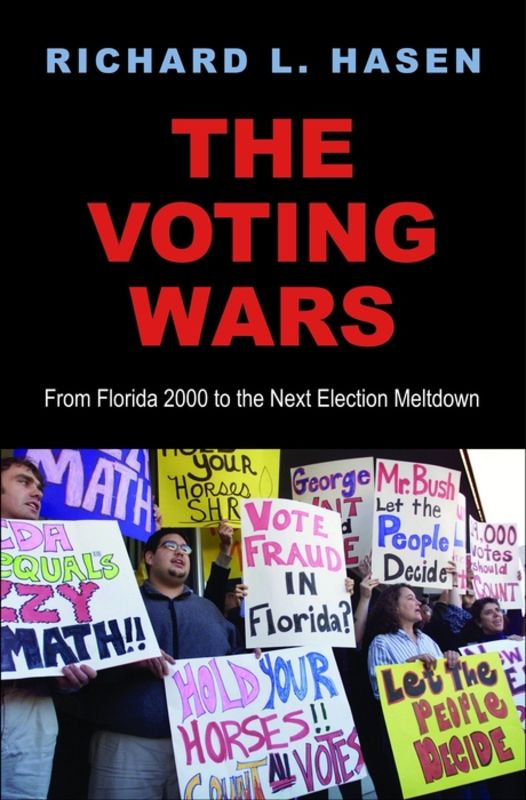
The voting wars : from Florida 2000 to the next election meltdown
In 2000, just a few hundred votes out of millions cast in the state of Florida separated Republican presidential candidate George W. Bush from his Democratic opponent, Al Gore. The outcome of the election rested on Florida's 25 electoral votes, and legal wrangling continued for 36 days. Then, abruptly, one of the most controversial Supreme Court decisions in U.S. history, Bush v. Gore, cut short the battle. Since the Florida debacle we have witnessed a partisan war over election rules. Election litigation has skyrocketed, and election time brings out inevitable accusations by political partisans of voter fraud and voter suppression. These allegations have shaken public confidence, as campaigns deploy \"armies of lawyers\" and the partisan press revs up when elections are expected to be close and the stakes are high.Richard L. Hasen, a respected authority on election law, chronicles and analyzes the battles over election rules from 2000 to the present. From a nonpartisan standpoint he explores the rising number of election-related lawsuits and charges of voter fraud as well as the decline of public confidence in fair results. He explains why future election disputes will be worse than previous ones-more acrimonious, more distorted by unsubstantiated allegations, and amplified by social media. No reader will fail to conclude with Hasen that election reform is an urgent priority, one that demands the attention of conscientious citizens and their elected representatives.Also available: The Fraudulent Fraud Squad, an e-excerpt from The Voting WarsReleased February 2012 9780300187489 $1.99
eBook

Red fighting blue : how geography and electoral rules polarize American politics
\"The national electoral map has split into warring regional bastions of Republican red and Democratic blue, producing a deep and enduring partisan divide in American politics. In Red Fighting Blue, David A. Hopkins places the current partisan and electoral era in historical context, explains how the increased salience of social issues since the 1980s has redefined the parties' geographic bases of support, and reveals the critical role that American political institutions play in intermediating between the behavior of citizens and the outcome of public policy-making. The widening geographic gap in voters' partisan preferences, as magnified further by winner-take-all electoral rules, has rendered most of the nation safe territory for either Democratic or Republican candidates in both presidential and congressional elections - with significant consequences for party competition, candidate strategy, and the operation of government\"-- Provided by publisher.
Book
The political battle over congressional redistricting
John Engler, former Governor of Michigan, once claimed that redistricting is one of the purest actions a legislative body can take. Academicians and political leaders alike, however, have regularly debated the ideal way by to redistrict national and state legislatures. Rather than being the pure process that Governor Engler envisioned, redistricting has led to repeated court battles waged on such traditional democratic values as one person, one vote, and minority rights. Instead of being an opportunity to help ensure maximum representation for the citizens, the process has become a cat and mouse game in many states with citizen representation seemingly the farthest idea from anyone’s mind. From a purely political perspective, those in power in the state legislature at the time of redistricting largely act like they have unilateral authority to do as they please. In this volume, contributors discuss why such an assumption is concerning in the modern political environment.
eBook

State voting laws in America : historical statutes and their modern implications
\"State Voting Laws in America documents changing views on voting rights, emphasizing court rulings that shaped our understanding of what constitutes a legitimate right to vote.\"--Back cover.
Book
Representation and Inequality in Late Nineteenth-Century America
This book demonstrates that apportionment, although long overlooked by scholars, dominated state politics in late nineteenth-century America, setting the boundaries not only for legislative districts but for the nature of representative democracy. The book examines the fierce struggles over apportionment in the Midwest, where a distinctive constitutional and electoral context shaped their course with momentous consequences. As the major parties alternated in effectively disenfranchising their opponents through gerrymanders, growing tensions challenged established patterns of political behaviour and precipitated intense and even dangerous disputes. Unprecedented judicial intervention overturned gerrymanders in stunning decisions that electrified the public but intensified rather than resolved political conflict and uncertainty. Ultimately, America's political ideal of representative democracy was frustrated by its own political institutions, including the courts, because their decisions against gerrymandering in the 1890s helped parties and legislatures entrench the practice as a basic and profoundly undemocratic feature of American politics in the twentieth century.
eBook