
Catalogue Search | MBRL


Are you sure you want to remove the book from the shelf?

{{itemTitle}}
65
result(s) for
"Elections -- Corrupt practices -- United States"
Sort by:

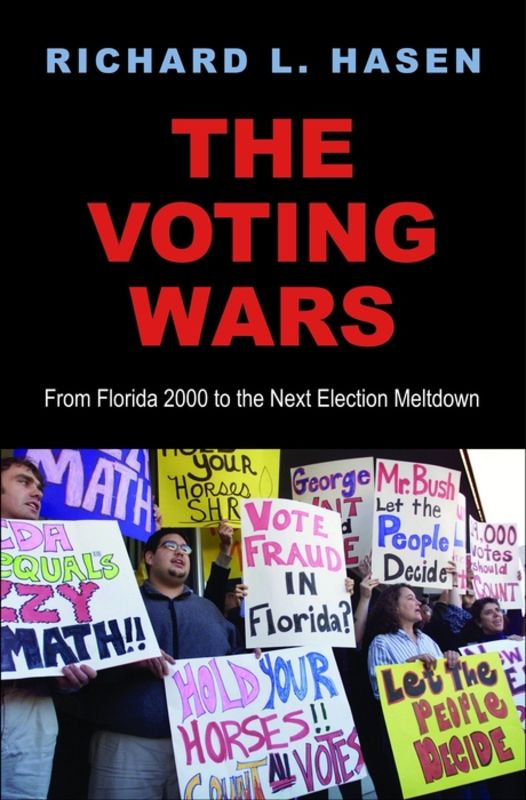
The voting wars : from Florida 2000 to the next election meltdown
In 2000, just a few hundred votes out of millions cast in the state of Florida separated Republican presidential candidate George W. Bush from his Democratic opponent, Al Gore. The outcome of the election rested on Florida's 25 electoral votes, and legal wrangling continued for 36 days. Then, abruptly, one of the most controversial Supreme Court decisions in U.S. history, Bush v. Gore, cut short the battle. Since the Florida debacle we have witnessed a partisan war over election rules. Election litigation has skyrocketed, and election time brings out inevitable accusations by political partisans of voter fraud and voter suppression. These allegations have shaken public confidence, as campaigns deploy \"armies of lawyers\" and the partisan press revs up when elections are expected to be close and the stakes are high.Richard L. Hasen, a respected authority on election law, chronicles and analyzes the battles over election rules from 2000 to the present. From a nonpartisan standpoint he explores the rising number of election-related lawsuits and charges of voter fraud as well as the decline of public confidence in fair results. He explains why future election disputes will be worse than previous ones-more acrimonious, more distorted by unsubstantiated allegations, and amplified by social media. No reader will fail to conclude with Hasen that election reform is an urgent priority, one that demands the attention of conscientious citizens and their elected representatives.Also available: The Fraudulent Fraud Squad, an e-excerpt from The Voting WarsReleased February 2012 9780300187489 $1.99
eBook

Down for the count : dirty elections and the rotten history of democracy in America
\"Down for the Count explores in an accessible, engaging style the tawdry continuing history of votes bought, stolen, suppressed, lost, miscounted, thrown into rivers, and litigated up to the Supreme Court in the world's most powerful democracy. First published to great acclaim and controversy in 2005 as Steal this Vote, this thoroughly revised edition lifts the lid off the largely undiscussed corruption at the core of our democracy-elections so poorly regulated and administered they fall short of standards the United States routinely imposes on emerging democracies. The problem has only grown worse in the last decade, as campaign spending has gone hog wild, partisan battles rage over voter ID, and a key provision of the Voting Rights Act has been shredded. As award-winning journalist Andrew Gumbel shows, we need proper oversight and regulation of elections, reliable voting machines, and a keener understanding of where private interests infringe on the public good. Now that Citizens United, super PACs, and the Koch brothers have turned the electoral process into an increasingly squalid lottery for billionaires, there is no better time for Gumbel's revision of his acclaimed book\"-- Provided by publisher.
Book

Ballot battles : the history of disputed elections in the United States
Perhaps the truest test of a nation's ability govern itself democratically is its ability to count ballots fairly and accurately in competitive, high-stakes elections. Yet from the founding on, America's adherence to this ideal has been distinctly uneven. Edward Foley's Ballot Battles is a sweeping synthesis of the subject, tracing how election controversies evolved over time, from the 1780s to the present.
eBook

Electoral integrity in America : securing democracy
\"Concern about the integrity of American elections did not start with Trump's election, by any means; flaws in procedures have gradually grown during recent decades, initially amplifying with the 2000 Bush v. Gore Florida count. But, several major structural weaknesses clearly worsened by the 2016 campaign and its aftermath, thereby deepening party polarization over the rules of the game and corroding American trust in the electoral process. Disputes over elections have proliferated on all sides in Trump's America with heated debate about the key problems - whether the risks of electoral fraud, fake news, voter suppression, or Russian interference -and with no consensus about the right solutions. This book illuminates several major challenges observed during the 2016 U.S. elections, focusing upon concern about both the security and inclusiveness of the voter registration process in America. Given the importance of striking the right balance between security and inclusiveness in voter registration, this volume brings together legal scholars, political scientists, and electoral assistance practitioners to provide new evidence-based insights and policy-relevant recommendations\"-- Provided by publisher.
Book

Election Fraud: Detecting and Deterring Electoral Manipulation
Brings together experts on election law, election administration, and U.S. and comparative politics to examine the U.S. understanding of election fraud. With survey data, incident reports, and state-collected fraud allegations, measures the extent and nature of election fraud in U.S. Analyzes techniques for detecting and potentially deterring fraud.
eBook


The Politics of Voter Suppression
The Politics of Voter Suppressionarrives in time to assess actual practices at the polls this fall and to reengage with debates about voter suppression tactics such as requiring specific forms of identification. Tova Andrea Wang examines the history of how U.S. election reforms have been manipulated for partisan advantage and establishes a new framework for analyzing current laws and policies. The tactics that have been employed to suppress voting in recent elections are not novel, she finds, but rather build upon the strategies used by a variety of actors going back nearly a century and a half. This continuity, along with the shift to a Republican domination of voter suppression efforts for the past fifty years, should inform what we think about reform policy today.
Wang argues that activities that suppress voting are almost always illegitimate, while reforms that increase participation are nearly always legitimate. In short, use and abuse of election laws and policies to suppress votes has obvious detrimental impacts on democracy itself. Such activities are also harmful because of their direct impacts on actual election outcomes. Wang regards as beneficial any legal effort to increase the number of Americans involved in the electoral system. This includes efforts that are focused on improving voter turnout among certain populations typically regarded as supporting one party, as long as the methods and means for boosting participation are open to all. Wang identifies and describes a number of specific legitimate and positive reforms that will increase voter turnout.
eBook

Democracy in danger : how hackers and activists exposed fatal flaws in the election system
\"When cybersecurity expert Jake Braun challenged hackers at DEFCON, the largest hacking conference in the world, to breach the security of an American voting machine, a hacker in Europe conquered the task in less than 2 minutes. From hacking into voting machines to more mundane, but no less serious problems, our democracy faces unprecedented tests from without and within. In Democracy In Danger, Braun, a veteran of 3 presidential campaigns and former White House Liaison to the Department of Homeland Security, reveals what the national security apparatus, local election administrators, and political parties have gotten wrong about election security and what America needs to do to protect the ballot box in 2020 and beyond.\" -- Provided by publisher.
Book

The Myth of Voter Fraud
Allegations that widespread voter fraud is threatening to the integrity of American elections and American democracy itself have intensified since the disputed 2000 presidential election. The claim that elections are being stolen by illegal immigrants and unscrupulous voter registration activists and vote buyers has been used to persuade the public that voter malfeasance is of greater concern than structural inequities in the ways votes are gathered and tallied, justifying ever tighter restrictions on access to the polls. Yet, that claim is a myth.
InThe Myth of Voter Fraud, Lorraine C. Minnite presents the results of her meticulous search for evidence of voter fraud. She concludes that while voting irregularities produced by the fragmented and complex nature of the electoral process in the United States are common, incidents of deliberate voter fraud are actually quite rare. Based on painstaking research aggregating and sifting through data from a variety of sources, including public records requests to all fifty state governments and the U.S. Justice Department, Minnite contends that voter fraud is in reality a politically constructed myth intended to further complicate the voting process and reduce voter turnout.
She refutes several high-profile charges of alleged voter fraud, such as the assertion that eight of the 9/11 hijackers were registered to vote, and makes the question of voter fraud more precise by distinguishing fraud from the manifold ways in which electoral democracy can be distorted. Effectively disentangling misunderstandings and deliberate distortions from reality,The Myth of Voter Fraudprovides rigorous empirical evidence for those fighting to make the electoral process more efficient, more equitable, and more democratic.
eBook