
Catalogue Search | MBRL


Are you sure you want to remove the book from the shelf?

{{itemTitle}}
13,329
result(s) for
"Electric circuit analysis"
Sort by:

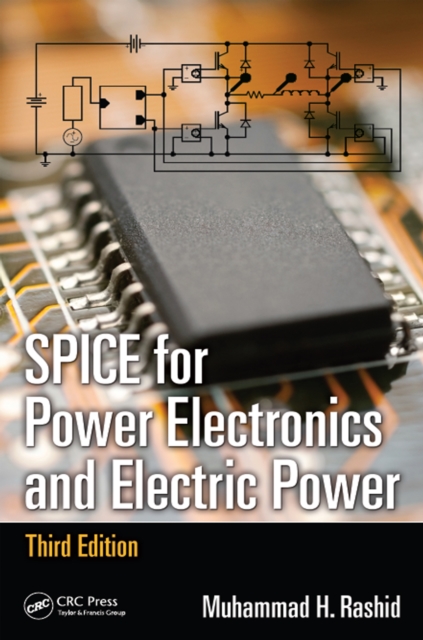
SPICE for Power Electronics and Electric Power
This third edition illustrates the integration of the industry standard software as a tool for design verification and as a theoretical laboratory bench. The book presents examples of all types of power converters as well as circuits with linear and nonlinear inductors. A new chapter covers multi-level converters. Assuming no prior knowledge of SPICE or PSPICE simulation, the text provides detailed step-by-step instructions on how to draw a schematic of a circuit, execute simulations, and view or plot the output results. It also includes suggestions for laboratory experiments and design problems that can be used for student homework assignments.
eBook

Introduction to linear circuit analysis and modelling : from DC to RF
Luis Moura and Izzat Darwazeh introduce linear circuit modelling and analysis applied to both electrical and electronic circuits, starting with DC and progressing up to RF, considering noise analysis along the way.Avoiding the tendency of current textbooks to focus either on the basic electrical circuit analysis theory (DC and low frequency AC frequency range), on RF circuit analysis theory, or on noise analysis, the authors combine these subjects into the one volume to provide a comprehensive set of the main techniques for the analysis of electric circuits in these areas.Taking the subject from a modelling angle, this text brings together the most common and traditional circuit analysis techniques (e.g. phasor analysis) with system and signal theory (e.g. the concept of system and transfer function), so students can apply the theory for analysis, as well as modelling of noise, in a broad range of electronic circuits.A highly student-focused text, each chapter contains exercises, worked examples and end of chapter problems, with an additional glossary and bibliography for reference. A balance between concepts and applications is maintained throughout.The book is also supported by a companion website, featuring a full solutions manual, additional equations, graphs and illustrations for Lecturers to download when preparing teaching aids, as well as numerous case studies, worked examples and exercises using MATLAB to aid student learning.Luis Moura is a Lecturer in Electronics at the University of Algarve. Izzat Darwazeh is Senior Lecturer in Telecommunications at University College, London, previously at UMIST. · An innovative approach fully integrates the topics of electrical and RF circuits, and noise analysis, with circuit modelling · Highly student-focused, the text includes exercises and worked examples throughout, along with end of chapter problems to put theory into practice· The companion website for the book features additional exercises and a full solutions manual to aid student learning
eBook

Mathematical foundations for linear circuits and systems in engineering
Extensive coverage of mathematical techniques used in engineering with an emphasis on applications in linear circuits and systems
Mathematical Foundations for Linear Circuits and Systems in Engineering provides an integrated approach to learning the necessary mathematics specifically used to describe and analyze linear circuits and systems. The chapters develop and examine several mathematical models consisting of one or more equations used in engineering to represent various physical systems. The techniques are discussed in-depth so that the reader has a better understanding of how and why these methods work. Specific topics covered include complex variables, linear equations and matrices, various types of signals, solutions of differential equations, convolution, filter designs, and the widely used Laplace and Fourier transforms. The book also presents a discussion of some mechanical systems that mathematically exhibit the same dynamic properties as electrical circuits. Extensive summaries of important functions and their transforms, set theory, series expansions, various identities, and the Lambert W-function are provided in the appendices.
The book has the following features:
* Compares linear circuits and mechanical systems that are modeled by similar ordinary differential equations, in order to provide an intuitive understanding of different types of linear time-invariant systems.
* Introduces the theory of generalized functions, which are defined by their behavior under an integral, and describes several properties including derivatives and their Laplace and Fourier transforms.
* Contains numerous tables and figures that summarize useful mathematical expressions and example results for specific circuits and systems, which reinforce the material and illustrate subtle points.
* Provides access to a companion website that includes a solutions manual with MATLAB code for the end-of-chapter problems.
Mathematical Foundations for Linear Circuits and Systems in Engineering is written for upper undergraduate and first-year graduate students in the fields of electrical and mechanical engineering. This book is also a reference for electrical, mechanical, and computer engineers as well as applied mathematicians.
John J. Shynk, PhD, is Professor of Electrical and Computer Engineering at the University of California, Santa Barbara. He was a Member of Technical Staff at Bell Laboratories, and received degrees in systems engineering, electrical engineering, and statistics from Boston University and Stanford University.
eBook

Circuit analysis for dummies
Get clear-cut information about the topics covered in a typical circuit analysis course. This hands-on guide is the perfect aid for making sense of the topics, from understanding the lingo to using phasor and Laplace techniques to convert a calculus-based problem into one requiring only algebra.
Book
Base electronics. 8, Basic circuit analysis
A description of basic circuit analysis with Arduino.
Streaming Video
Base electronics. 10, Series circuits
A description of basic series circuit analysis with Arduino.
Streaming Video