
Catalogue Search | MBRL


Are you sure you want to remove the book from the shelf?

{{itemTitle}}
121
result(s) for
"Electronic data processing Psychological aspects"
Sort by:
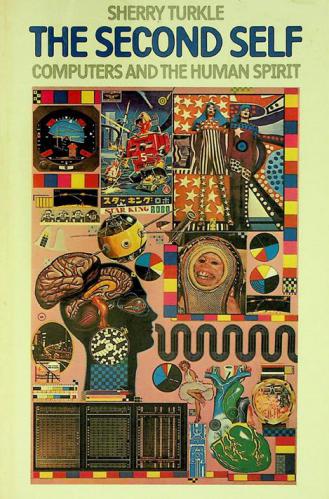

The Second Self
In The Second Self, Sherry Turkle looks at the computer not as a \"tool,\" but as part of our social and psychological lives; she looks beyond how we use computer games and spreadsheets to explore how the computer affects our awareness of ourselves, of one another, and of our relationship with the world. \"Technology,\" she writes, \"catalyzes changes not only in what we do but in how we think.\" First published in 1984, The Second Self is still essential reading as a primer in the psychology of computation. This twentieth anniversary edition allows us to reconsider two decades of computer culture--to (re)experience what was and is most novel in our new media culture and to view our own contemporary relationship with technology with fresh eyes. Turkle frames this classic work with a new introduction, a new epilogue, and extensive notes added to the original text.Turkle talks to children, college students, engineers, AI scientists, hackers, and personal computer owners--people confronting machines that seem to think and at the same time suggest a new way for us to think--about human thought, emotion, memory, and understanding. Her interviews reveal that we experience computers as being on the border between inanimate and animate, as both an extension of the self and part of the external world. Their special place betwixt and between traditional categories is part of what makes them compelling and evocative. (In the introduction to this edition, Turkle quotes a PDA user as saying, \"When my Palm crashed, it was like a death. I thought I had lost my mind.\") Why we think of the workings of a machine in psychological terms--how this happens, and what it means for all of us--is the ever more timely subject of The Second Self.
eBook

Information visualization : perception for design
Most designers know that yellow text presented against a blue background reads clearly and easily, but how many can explain why, and what really are the best ways to help others and ourselves clearly see key patterns in a bunch of data? When we use software, access a website, or view business or scientific graphics, our understanding is greatly enhanced or impeded by the way the information is presented. This book explores the art and science of why we see objects the way we do. Based on the science of perception and vision, the author presents the key principles at work for a wide range of applications--resulting in visualization of improved clarity, utility, and persuasiveness. The book offers practical guidelines that can be applied by anyone: interaction designers, graphic designers of all kinds (including web designers), data miners, and financial analysts. Complete update of the recognized source in industry, research, and academic for applicable guidance on information visualizing. Includes the latest research and state of the art information on multimedia presentation. More than 160 explicit design guidelines based on vision science. A new final chapter that explains the process of visual thinking and how visualizations help us to think about problems. Packed with over 400 informative full color illustrations, which are key to understanding of the subject.
eBook

Serious Games
Serious Games provides a thorough exploration of the claim that playing games can provide learning that is deep, sustained and transferable to the real world. \"Serious games\" is defined herein as any form of interactive computer-based game software for one or multiple players to be used on any platform and that has been developed to provide more than entertainment to players. With this volume, the editors address the gap in exisiting scholarship on gaming, providing an academic overview on the mechanisms and effects of serious games. Contributors investigate the psychological mechanisms that take place not only during gaming, but also in game selection, persistent play, and gaming impact.
The work in this collection focuses on the desirable outcomes of digital game play. The editors distinguish between three possible effects -- learning, development, and change -- covering a broad range of serious games’ potential impact. Contributions from internationally recognized scholars focus on five objectives:
Define the area of serious games
Elaborate on the underlying theories that explain suggested psychological mechanisms elicited through serious game play, addressing cognitive, affective and social processes
Summarize the empirical evidence on the effectiveness of serious games,
Introduce innovative research methods as a response to methodological challenges imposed through interactive media
Discuss the possibilities and limitations of selected applications for educational purposes.
Anchored primarily in social science research, the reader will be introduced to approaches that focus on the gaming process and the users’ experiences. Additional perspectives will be provided in the concluding chapters, written from non-social science approaches by experts in academic game design and representatives of the gaming industry. The editors acknowledge the necessity for a broader interdisciplinary study of the phenomena and work to overcome the methodological divide in games research to look ahead to a more integrated and interdisciplinary study of digital games.
This timely and singular volume will appeal to scholars, researchers, and graduate students working in media entertainment and game studies in the areas of education, media, communication, and psychology.
Ute Ritterfeld , Professor for Media Psychology, received her education in the Health Sciences (Academy of Rehabilitation in Heidelberg) and in Psychology (University of Heidelberg), completed her Ph.D. in Psychology (Technical University in Berlin), and habilitated at the University of Magdeburg, Germany. She was Assistant Professor at the University of Magdeburg, Adjunct Professor at the Universities of Berlin (Humboldt) and Hannover, and Associate Professor at the University of Southern California (USC) in Los Angeles, Annenberg School for Communication. At USC, Ritterfeld directed an interdisciplinary research team devoted to the studies of digital games and hosted the inaugural academic conference on serious games. In 2007, Ritterfeld joined the faculty of Psychology and Education at the VU University Amsterdam and co-founded the Center for Advanced Media Research Amsterdam (CAMeRA@VU) where she serves as director of interdisciplinary research. Ritterfeld co-edits the Journal of Media Psychology published by Hogrefe.
Michael Cody is Professor of Communication at the University of Southern California Annenberg School for Communication. He earned his Ph.D. in Communication at Michigan State University in 1978, where he focused on research methods and face to face social influence processes. He has authored or edited books in persuasion, interpersonal communication and entertainment education. He is the editor of the Journal of Communication (2009-2012).
Peter Vorderer (Ph.D., Technical University of Berlin), is Scientific Director of the Center for Advanced Media Research Amsterdam (CAMeRA) and head of the Department of Communication Science, VU University Amsterdam, The Netherlands. He specializes in media use and media effects research with a special focus on media entertainment and digital games. Together with Dolf Zillmann and Jennings Bryant, he has edited three well-recognized volumes on media entertainment and video games.
eBook

Computational paralinguistics : emotion, affect and personality in speech and language processing
This book presents the methods, tools and techniques that are currently being used to recognise (automatically) the affect, emotion, personality and everything else beyond linguistics ('paralinguistics') expressed by or embedded in human speech and language.
It is the first book to provide such a systematic survey of paralinguistics in speech and language processing. The technology described has evolved mainly from automatic speech and speaker recognition and processing, but also takes into account recent developments within speech signal processing, machine intelligence and data mining.
Moreover, the book offers a hands-on approach by integrating actual data sets, software, and open-source utilities which will make the book invaluable as a teaching tool and similarly useful for those professionals already in the field.
Key features:
* Provides an integrated presentation of basic research (in phonetics/linguistics and humanities) with state-of-the-art engineering approaches for speech signal processing and machine intelligence.
* Explains the history and state of the art of all of the sub-fields which contribute to the topic of computational paralinguistics.
* C overs the signal processing and machine learning aspects of the actual computational modelling of emotion and personality and explains the detection process from corpus collection to feature extraction and from model testing to system integration.
* Details aspects of real-world system integration including distribution, weakly supervised learning and confidence measures.
* Outlines machine learning approaches including static, dynamic and context?sensitive algorithms for classification and regression.
* Includes a tutorial on freely available toolkits, such as the open-source 'openEAR' toolkit for emotion and affect recognition co-developed by one of the authors, and a listing of standard databases and feature sets used in the field to allow for immediate experimentation enabling the reader to build an emotion detection model on an existing corpus.
eBook


Human-AI Teaming
Although artificial intelligence (AI) has many potential benefits, it has also been shown to suffer from a number of challenges for successful performance in complex real-world environments such as military operations, including brittleness, perceptual limitations, hidden biases, and lack of a model of causation important for understanding and predicting future events. These limitations mean that AI will remain inadequate for operating on its own in many complex and novel situations for the foreseeable future, and that AI will need to be carefully managed by humans to achieve their desired utility.
Human-AI Teaming: State-of-the-Art and Research Needs examines the factors that are relevant to the design and implementation of AI systems with respect to human operations. This report provides an overview of the state of research on human-AI teaming to determine gaps and future research priorities and explores critical human-systems integration issues for achieving optimal performance.
eBook

Indexing It All
In this book, Ronald Day offers a critical history of the modern tradition of documentation. Focusing on the documentary index (understood as a mode of social positioning), and drawing on the work of the French documentalist Suzanne Briet, Day explores the understanding and uses of indexicality. He examines the transition as indexes went from being explicit professional structures that mediated users and documents to being implicit infrastructural devices used in everyday information and communication acts. Doing so, he also traces three epistemic eras in the representation of individuals and groups, first in the forms of documents, then information, then data. Day investigates five cases from the modern tradition of documentation. He considers the socio-technical instrumentalism of Paul Otlet, \"the father of European documentation\" (contrasting it to the hermeneutic perspective of Martin Heidegger); the shift from documentation to information science and the accompanying transformation of persons and texts into users and information; social media's use of algorithms, further subsuming persons and texts; attempts to build android robots--to embody human agency within an information system that resembles a human being; and social \"big data\" as a technique of neoliberal governance that employs indexing and analytics for purposes of surveillance. Finally, Day considers the status of critique and judgment at a time when people and their rights of judgment are increasingly mediated, displaced, and replaced by modern documentary techniques.
eBook

Change in address in electronic health records as an early marker of homelessness
Housing stability is a key health determinant and there is a need for early screening for instability with existing electronic health record (EHR) data to improve health outcomes. We aim to establish recorded address changes as a screening variable for housing instability and homelessness and to attempt to define the threshold of high churn.
Our study is a single-center cross-sectional study of EHR data (2018-2024) conducted at a US academic center with eleven sites across Chicago. We include patients 18 years or older with at least three hospital encounters over three different years. We define address churn as the number of address changes recorded in the EHR corrected to three-year intervals. We compare demographic and clinical characteristics of individuals with varying address churn with the student T-test to look at distribution of address churn for patients with and without record of homelessness, ANOVA to evaluate the distribution of ages for different levels of churn, and the chi-square test to evaluate for association between churn and clinical diagnoses. We perform multivariable logistic regression to measure the association between people with a record of homelessness and address changes.
The study includes 1,068,311 patients with 756,222 having zero address changes, 156,911 having one address change, 137,491 with two address changes, 9,558 with three address changes, and 8,129 with four or more address changes. People with no record of homelessness in the EHR have mean address changes of 0.6 (SD 0.7) whereas people with record of homelessness have mean address changes of 1.8 (SD 1.3). Diagnostic profiles of the varying address change groups show increased prevalence of psychiatric diagnoses (65.2% in the 4 or more-address change group) compared to lower address change (27.7% in the 0-address change group). Address churn is significantly associated with homelessness with an odds ratio (OR) of 1.44 (95% CI = [1.42-1.47], P < 0.001).
Our results support a role for residential address churn in screening for housing instability in healthcare systems and reinforce the association between psychiatric disorders and housing instability. Our findings can help public health policy makers in targeting vulnerable populations at risk of homelessness with multiple health comorbidities for housing interventions.
Journal Article

The Normalization of Vaping on TikTok Using Computer Vision, Natural Language Processing, and Qualitative Thematic Analysis: Mixed Methods Study
Social media posts that portray vaping in positive social contexts shape people's perceptions and serve to normalize vaping. Despite restrictions on depicting or promoting controlled substances, vape-related content is easily accessible on TikTok. There is a need to understand strategies used in promoting vaping on TikTok, especially among susceptible youth audiences.
This study seeks to comprehensively describe direct (ie, explicit promotional efforts) and indirect (ie, subtler strategies) themes promoting vaping on TikTok using a mixture of computational and qualitative thematic analyses of social media posts. In addition, we aim to describe how these themes might play a role in normalizing vaping behavior on TikTok for youth audiences, thereby informing public health communication and regulatory policies regarding vaping endorsements on TikTok.
We collected 14,002 unique TikTok posts using 50 vape-related hashtags (eg, #vapetok and #boxmod). Using the k-means unsupervised machine learning algorithm, we identified clusters and then categorized posts qualitatively based on themes. Next, we organized all videos from the posts thematically and extracted the visual features of each theme using 3 machine learning-based model architectures: residual network (ResNet) with 50 layers (ResNet50), Visual Geometry Group model with 16 layers, and vision transformer. We chose the best-performing model, ResNet50, to thoroughly analyze the image clustering output. To assess clustering accuracy, we examined 4.01% (441/10,990) of the samples from each video cluster. Finally, we randomly selected 50 videos (5% of the total videos) from each theme, which were qualitatively coded and compared with the machine-derived classification for validation.
We successfully identified 5 major themes from the TikTok posts. Vape product marketing (1160/10,990, 8.28%) reflected direct marketing, while the other 4 themes reflected indirect marketing: TikTok influencer (3775/14,002, 26.96%), general vape (2741/14,002, 19.58%), vape brands (2042/14,002, 14.58%), and vaping cessation (1272/14,002, 9.08%). The ResNet50 model successfully classified clusters based on image features, achieving an average F
-score of 0.97, the highest among the 3 models. Qualitative content analyses indicated that vaping was depicted as a normal, routine part of daily life, with TikTok influencers subtly incorporating vaping into popular culture (eg, gaming, skateboarding, and tattooing) and social practices (eg, shopping sprees, driving, and grocery shopping).
The results from both computational and qualitative analyses of text and visual data reveal that vaping is normalized on TikTok. Our identified themes underscore how everyday conversations, promotional content, and the influence of popular figures collectively contribute to depicting vaping as a normal and accepted aspect of daily life on TikTok. Our study provides valuable insights for regulatory policies and public health initiatives aimed at tackling the normalization of vaping on social media platforms.
Journal Article