
Catalogue Search | MBRL


Are you sure you want to remove the book from the shelf?

{{itemTitle}}
1,257
result(s) for
"Electronic data processing personnel"
Sort by:

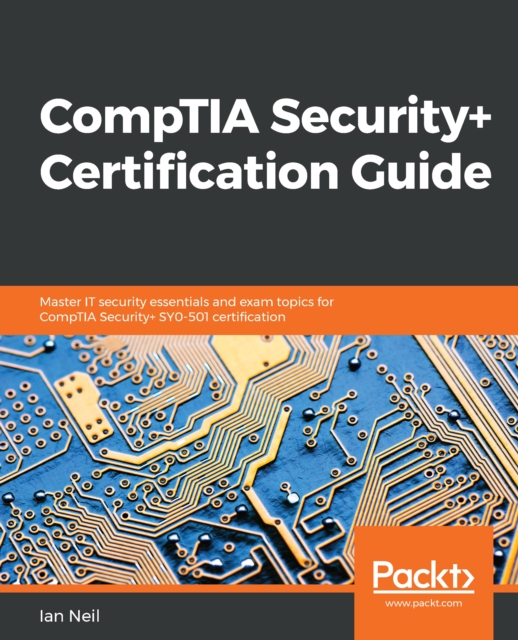
CompTIA Security+ Certification Guide
This is a practical certification guide covering all the exam topics in an easy-to-follow manner backed with mock tests and self-assesment scenarios for better preparation. Key Features * Learn cryptography and various cryptography algorithms for real-world implementations * Discover security policies, plans, and procedures to protect your security infrastructure * Written by Ian Neil, one of the world's top CompTIA Security+ (SY0-501) trainer Book Description CompTIA Security+ is a worldwide certification that establishes the fundamental knowledge required to perform core security functions and pursue an IT security career. CompTIA Security+ Certification Guide is a best-in-class exam study guide that covers all of CompTIA Security+ 501 exam objectives. It is authored by Ian Neil, who is a world-class trainer of CompTIA Security+ 501. Packed with self-assessment scenarios and realistic exam questions, this guide will help you master the core concepts to succeed in the exam the first time you take it. Using relevant examples, you will learn all the important security fundamentals from Certificates and Encryption to Identity and Access Management concepts. You will then dive into the important domains of the exam; namely, threats, attacks and vulnerabilities, technologies and tools, architecture and design, risk management, and cryptography and Public Key Infrastructure (PKI). This book comes with over 600 practice questions with detailed explanation that is at the exam level and also includes two mock exams to help you with your study plan. This guide will ensure that encryption and certificates are made easy for you. What you will learn * Get to grips with security fundamentals from Certificates and Encryption to Identity and Access Management * Secure devices and applications that are used by your company * Identify the different types of malware and virus and take appropriate actions to protect against them * Protect your environment against social engineering and advanced attacks * Implement PKI concepts * Learn about secure coding techniques, quality control, and testing * Troubleshoot common security issues Who this book is for This book is designed for anyone who is seeking to pass the CompTIA Security+ SY0-501 exam. It is a stepping stone for anyone who wants to become a security professional or move into cyber security. This certification guide assumes no prior knowledge of the product.
eBook

CompTIA Linux+ Certification Guide
Master the concepts and techniques that will help you gain the LX0-103 and LX0-104 certifications on your first attempt Key Features * Get a clear understanding of how to achieve the Linux+ certification * Explore system architecture, shell scripts, data management, and Linux security * Work through practice and mock tests to pass both LX0-103 and LX0-104 exams Book Description Linux+ certification demonstrates technical competency and provides a broad awareness of Linux operating systems. Professionals who have achieved the Linux+ certification exhibit all-important knowledge of installation, operation, administration, and troubleshooting services. The CompTIA Linux+ Certification Guide is an overview of the certification that gives you insights into the system architecture. You'll understand how to install and uninstall Linux distributions, followed by working with various package managers. Once you've grasped all this, you'll move on to manipulating files and processes at command-line interface (CLI) and creating, monitoring, killing, restarting, and modifying processes. As you progress, you'll be equipped to work with display managers and learn how to create, modify, and remove user accounts and groups, as well as understand how to automate tasks. The last set of chapters helps you configure dates and set up local and remote system logging. In addition to this, you'll explore different internet protocols, along with discovering network configuration, security administration, Shell scripting, and SQL management. By the end of this book, you'll not only have got to grips with all the modules using practice questions and mock exams, but you'll also be well prepared to pass the LX0-103 and LX0-104 certification exams. What you will learn * Understand the Linux system architecture * Install, upgrade, and manage Linux system packages * Configure devices and maintain the Linux filesystem * Manage the Shell environment, write scripts, and manage data * Set user interfaces and desktops in the Linux operating system * Automate system admin tasks and manage essential system services * Manage SQL server on Linux and log locally and remotely with rsyslogd * Administer network and local security Who this book is for The CompTIA Linux+ Certification Guide is for you if you want to gain the CompTIA Linux+ certificate. This guide is also for system administrators and rookie Linux professionals interested in enhancing their Linux and Shell scripting skills. No prior knowledge of Linux is needed, although some understanding of Shell scripting would be helpful.
eBook


ITIL 4
Intro -- Copyright Page -- Contents -- Foreword -- Acknowledgements -- About this guide -- 1 Introduction -- 2 Key terms and concepts -- 2.1 Overview of high-velocity IT -- 2.2 Key terms -- 2.3 High-velocity IT objectives -- 2.4 Key characteristics of high-velocity IT -- 2.5 Service-dominant logic -- 3 High-velocity IT across the ITIL model -- 3.1 Four dimensions of service management -- 3.2 Service value system -- 3.3 Service value chain -- 3.4 Digital product lifecycles -- 4 High-velocity IT culture -- 4.1 Key behaviour patterns -- 4.2 Models and concepts -- 5 High-velocity IT techniques -- 5.1 Techniques for valuable investments -- 5.2 ITIL practices contributing to valuable investments -- 5.3 Techniques for fast development -- 5.4 ITIL practices contributing to fast development -- 5.5 Techniques for resilient operations -- 5.6 ITIL practices contributing to resilient operations -- 5.7 Techniques for co-created value -- 5.8 ITIL practices contributing to co-created value -- 5.9 Techniques for assured conformance -- 5.10 ITIL practices contributing to assured conformance -- 6 Taking the HVIT examination -- 6.1 Purpose of the ITIL 4 HVIT qualification -- 6.2 Examination overview -- 6.3 Question type examples -- 6.4 Examination modalities -- 7 The ITIL 4 certification scheme -- 7.1 ITIL Foundation -- 7.2 ITIL Managing Professional stream -- 7.3 ITIL Strategic Leader stream -- 7.4 ITIL Master -- 7.5 ITIL and the T-shaped individual -- 8 ITIL 4: High-velocity IT syllabus -- End notes -- Further information.
eBook

Cisco Certified Design Expert : CCDE 400-007 official cert guide
Trust the best-selling Official Cert Guide series from Cisco Press to help you learn, prepare, and practice for exam success. They are built with the objective of providing assessment, review, and practice to help ensure you are fully prepared for your certification exam. Cisco Certified Design Expert (CCDE 400-007) Official Cert Guide presents you with an organized test preparation routine using proven series elements and techniques. \"Do I Know This Already?\" quizzes open each chapter and allow you to decide how much time you need to spend on each section. Exam topic lists make referencing easy. Chapter-ending Exam Preparation Tasks help you drill on key concepts you must know thoroughly.
Book

ITIL 4
Intro -- Copyright Page -- Contents -- Foreword -- Acknowledgements -- About this guide -- 1. Introduction -- 2. Customer journeys -- 2.1: Co-creating service value through customer journeys -- 2.2: Designing and improving customer journeys -- 3. Step 1: Explore - understand markets and stakeholders -- 3.1: Customer needs and impacting factors -- 3.2: Identifying service providers and value propositions -- 3.3: Market characteristics -- 3.4: Marketing activities and techniques -- 4. Step 2: Engage - foster relationships -- 4.1: Communication and collaboration -- 4.2: Service relationship types -- 4.3: Customer relationships and engagement -- 4.4: Relationship management practice -- 4.5: Supplier management practice -- 5. Step 3: Offer - shape demand and service offerings -- 5.1: Managing demand and opportunities -- 5.2: Specifying and managing customer requirements -- 5.3: Designing digital services -- 5.4: Selling and obtaining services -- 5.5: Business analysis practice -- 6. Step 4: Agree - align expectations and agree service -- 6.1: Plan for value co-creation -- 6.2: Negotiate and agree service levels -- 6.3: Service level management practice -- 7. Step 5: Onboard - get on board or leave the journey -- 7.1: Planning onboarding -- 7.2: Fostering user relationships -- 7.3: User engagement and delivery channels -- 7.4: Enabling users for service -- 7.5: Elevating mutual capabilities -- 7.6: Offboarding -- 7.7: Service catalogue management practice -- 7.8: Service desk practice -- 8. Step 6: Co-create - provide and consume -- 8.1: A service mindset -- 8.2: Provisioning user services -- 8.3: Requesting services -- 8.4: Triaging requests -- 8.5: Customer and user feedback -- 8.6: User communities -- 8.7: Service request management practice -- 9. Step 7: Realize - capture value and improve -- 9.1: Realizing service value.
eBook

ITIL 4
Intro -- Copyright Page -- Contents -- Foreword -- Acknowledgements -- About this guide -- 1 Introduction -- 2 Key terms and concepts -- 2.1 Key terms -- 2.2 Key concepts -- 3 Direction and control -- 3.1 Cascading objectives and requirements -- 3.2 Defining effective policies, controls, and guidelines -- 3.3 Decision-making at the right level -- 4 Governance, risk, and compliance -- 4.1 Role of risk management in direction, planning, and improvement -- 4.2 Governance -- 5 Continual improvement -- 5.1 Improving the SVS -- 5.2 The continual improvement model -- 5.3 Assessing for improvement -- 5.4 Prioritizing outcomes -- 5.5 Developing a business case -- 5.6 Learning from past experience -- 6 OCM and communication -- 6.1 Organizational change management -- 6.2 Communication and OCM -- 6.3 Interfaces across the value chain -- 7 Measurement and reporting -- 7.1 Basics of measurement and reporting -- 7.2 Types of measurements -- 7.3 Success factors and KPIs -- 8 Value streams and practices -- 8.1 Value stream mapping -- 8.2 Value streams, practices, and processes in the SVS -- 8.3 Methods and techniques to direct, plan, and improve value streams and practices -- 9 Taking the DPI examination -- 9.1 Purpose of the ITIL 4 DPI qualification -- 9.2 Examination overview -- 9.3 Question type examples -- 9.4 Examination modalities -- 10 The ITIL 4 certification scheme -- 10.1 ITIL Foundation -- 10.2 ITIL Managing Professional stream -- 10.3 ITIL Strategic Leader stream -- 10.4 ITIL Master -- 10.5 ITIL and the T-shaped individual -- 11 ITIL 4 Direct, Plan and Improve syllabus -- Further information.
eBook