
Catalogue Search | MBRL


Are you sure you want to remove the book from the shelf?

{{itemTitle}}
30,339
result(s) for
"Electronic games industry"
Sort by:

The story of Nintendo
This book reveals how Nintendo came into being, the entrepreneurs behind the success of the brand, the key facts about the video game industry, and Nintendo's impact in the global market.
Book

Cultural Policy and East Asian Rivalry
Hong Kong was once an established hub of creativity in Asia recognized internationally for its cinema, Bruce Lee and Kung Fu.Cantopop, its particular form of pop music, was popular throughout China and East Asia from the 1970s.
eBook

Console wars : Sega, Nintendo, and the battle that defined a generation
\"In the tradition of The Accidental Billionaires and Moneyball, a behind-the-scenes business thriller about how the small, scrappy Sega, led by one unlikely visionary, took on the juggernaut Nintendo and changed the face of entertainment\"-- Provided by publisher.
Book

Digital Play
In a marketplace that demands perpetual upgrades, the survival of interactive play ultimately depends on the adroit management of negotiations between game producers and youthful consumers of this new medium. The authors suggest a model of expansion that encompasses technological innovation, game design, and marketing practices. Their case study of video gaming exposes fundamental tensions between the opposing forces of continuity and change in the information economy: between the play culture of gaming and the spectator culture of television, the dynamism of interactive media and the increasingly homogeneous mass-mediated cultural marketplace, and emerging flexible post-Fordist management strategies and the surviving techniques of mass-mediated marketing. Digital Play suggests a future not of democratizing wired capitalism but instead of continuing tensions between \"access to\" and \"enclosure in\" technological innovation, between inertia and diversity in popular culture markets, and between commodification and free play in the cultural industries.
eBook

Blood, sweat, and pixels : the triumphant, turbulent stories behind how video games are made
\"You've got your dream job--making video games. You have a great project, great designs, and clever controls. One morning, you get a call from your producer. Turns out that wall-jumping trick won't work because the artists don't have time to design a separate animation just for the plumber to move that way. Also, your lead designer keeps micromanaging the programmers, which is driving them crazy. Your E3 demo is due in two weeks, and you know there's no way you can get it done in less than four. You'll have to cut out some of the game's biggest features just to hit your deadlines. And suddenly the investor is asking if maybe you can slash that $10 million budget down to $8 million, even if you have to fire a few people to make it happen? Welcome to video game development. In his years covering the industry, Jason Schreier has often heard developers say that any game actually released is a miracle. In Blood, Sweat, and Pixels, Schreier takes you behind the scenes of some of the biggest recent games to share never-before-told stories of the struggles and failures the development teams faced along the way. His reputation for great storytelling and fly-on-the-wall detail will provide readers with the clearest picture yet of what actually goes on behind the scenes. Each chapter will cover a different game, from major studios with nine-figure budgets to indie games with half a dozen people on their teams. The chapters will also focus on a variety of subjects in the process, from building the basics to adjusting for fan reaction post-launch. Blood, Sweat, and Pixels will give readers an unparallelled inside look at one of the biggest entertainment industries in the world\"-- Provided by publisher.
Book

Not All Fun and Games
Motivated by the goal of understanding the labour conditions of workers in the videogame industry and their participatory power to create decent work, Not All Fun and Games is a critical examination of a global entertainment juggernaut with revenues that top film, television, and music production combined. Jobs in the industry are heralded as the vanguard of the new economy, governments offer lucrative tax credits to lure game studios to their regions, and game developers often express commitment and passion for their work. Yet, the industry is also known for its toxic workplaces. To understand these disparities and gain insight into twenty-first-century labour conditions, Marie-Josée Legault and Johanna Weststar have carried out a comprehensive mixed-methods study of the North American industry over the past fifteen years. They combine detailed survey data from thousands of game developers with over one hundred qualitative interviews to systematically reveal labour issues such as precarity, lack of workforce diversity, unpredictable schedules, unpaid overtime, low unionization rates, worker burnout, and significant pay inequality. Updating the theoretical concept of citizenship at work, the authors connect these labour issues to a fundamental lack of voice and representation in the workplace. They determine that videogame workers and others in contemporary project-based work environments lack agency in regulating their work and lack fundamental protections. Not All Fun and Games comprehensively documents conditions in the North American industry and highlights ways to counter workers' lack of voice and representation in their workplaces to better create healthy, equitable, and inclusive workplaces.
eBook

The Tetris effect : the game that hypnotized the world
\"Tetris is perhaps the most instantly recognizable, popular video game ever made. Sales of authorized copies total near $1 billion to date, and that is just a fraction of the money made from knockoffs and pirated versions. Based on an obscure board game, it was designed for early computers, became a hit on TV consoles, and soared in popularity with handheld devices like the Game Boy. Today it lives on in smartphones, tablets, and laptops. All this despite the fact--or perhaps because of it--that it has no superhero to merchandise and no story to dramatize. Tetris is abstraction translated to bytes, a puzzle game in its purest form. Yet its origin story is so improbable that it's amazing that any of us ever played the game. In this surprising and entertaining book, tech reporter Dan Ackerman explains how a Soviet programmer named Alexey Pajitnov was struck with inspiration as a teenager, then meticulously worked for years to bring the game he had envisioned to life. Despite the archaic machines (outdated even for their era) that Pajitnov worked with and the fact that he had to develop the game after-hours on his own time, Tetris worked its way first through his office, and then out of it, entrancing player after player with its hypnotic shapes. It became almost a metaphor for the late Soviet era, with the kinetic energy of commerce pushing ever harder against the walls put up by the government. British, American, and Japanese moguls saw the game's potential and worked, often unscrupulously, to beat each other in the race to sell the game. Ackerman tells the story of these men and their maneuvers, and how the game made it to consumers' hands in the United States on a Game Boy screen in 1989\"-- Provided by publisher.
Book
Economist video. Why is Saudi Arabia buying up the video game industry?
Why is Saudi Arabia investing in the world's biggest gaming firms? Our Media Editor, Tom Wainwright, and Rosie Blau, co-host of The Intelligence podcast, discuss the Middle Eastern kingdom's bid to become a video game superpower.
Streaming Video

Metagaming : playing, competing, spectating, cheating, trading, making, and breaking videogames
\"The greatest trick the videogame industry ever pulled was convincing the world that videogames were games rather than a medium for making metagames. Elegantly defined as \"games about games,\" metagames implicate a diverse range of practices that stray outside the boundaries and bend the rules: from technical glitches and forbidden strategies to Renaissance painting, algorithmic trading, professional sports, and the War on Terror. In Metagaming, Stephanie Boluk and Patrick LeMieux demonstrate how games always extend beyond the screen, and how modders, mappers, streamers, spectators, analysts, and artists are changing the way we play. Metagaming uncovers these alternative histories of play by exploring the strange experiences and unexpected effects that emerge in, on, around, and through videogames. Players puzzle through the problems of perspectival rendering in Portal, perform clandestine acts of electronic espionage in EVE Online, compete and commentate in Korean StarCraft, and speedrun The Legend of Zelda in record times (with or without the use of vision). Companies like Valve attempt to capture the metagame through international e-sports and online marketplaces while the corporate history of Super Mario Bros. is undermined by the endless levels of Infinite Mario, the frustrating pranks of Asshole Mario, and even Super Mario Clouds, a ROM hack exhibited at the Whitney Museum of American Art. One of the only books to include original software alongside each chapter, Metagaming transforms videogames from packaged products into instruments, equipment, tools, and toys for intervening in the sensory and political economies of everyday life. And although videogames conflate the creativity, criticality, and craft of play with the act of consumption, we don't simply play videogames--we make metagames\"-- Provided by publisher.
Book
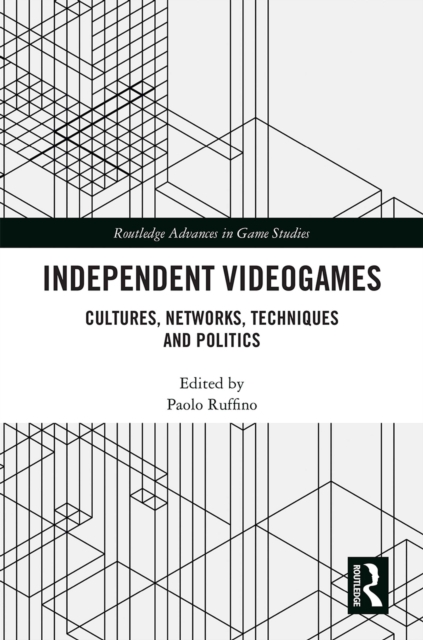
Independent Videogames
Independent Videogames investigates the social and cultural implications of contemporary forms of independent videogame development. Through a series of case studies and theoretical investigations, it evaluates the significance of such a multi-faceted phenomenon within videogame and digital cultures.
A diverse team of scholars highlights the specificities of independence within the industry and the culture of digital gaming through case studies and theoretical questions. The chapters focus on labor, gender, distribution models and technologies of production to map the current state of research on independent game development. The authors also identify how the boundaries of independence are becoming opaque in the contemporary game industry – often at the cost of the claims of autonomy, freedom, and emancipation that underlie the indie scene. The book ultimately imagines new and better narratives for a less exploitative and more inclusive videogame industry.
Systematically mapping the current directions of a phenomenon that is becoming increasingly difficult to define and limit, this book will be a crucial resource for scholars and students of game studies, media history, media industries and independent gaming.
eBook