
Catalogue Search | MBRL


Are you sure you want to remove the book from the shelf?

{{itemTitle}}
74,446
result(s) for
"Electronics History."
Sort by:


Spy Ships
Almost from the first days of seafaring, men have used ships for
\"spying\" and intelligence collection. Since early in the twentieth
century, with the technological advancements of radio and radar,
the U.S. Navy and other government agencies and many other navies
have used increasingly specialized ships and submarines to ferret
out the secrets of other nations. The United States and the Soviet
Union/Russia have been the leaders in those efforts, especially
during the forty-five years of the Cold War. But, as Norman Polmar
and Lee J. Mathers reveal, so has China, which has become a major
maritime power in the twenty-first century, with special interests
in the South China Sea and with increasing hostility toward the
United States. Through extensive, meticulous research and through
the lens of such notorious spy ship events as the Israeli attack on
the USS Liberty , the North Korean capture of the USS
Pueblo , and the U.S. Central Intelligence Agency's success
in clandestinely salvaging part of a Soviet submarine with the
Hughes Glomar Explorer , Spy Ships is a
fascinating and valuable resource for understanding maritime
intelligence collection and what we have learned from it.
eBook

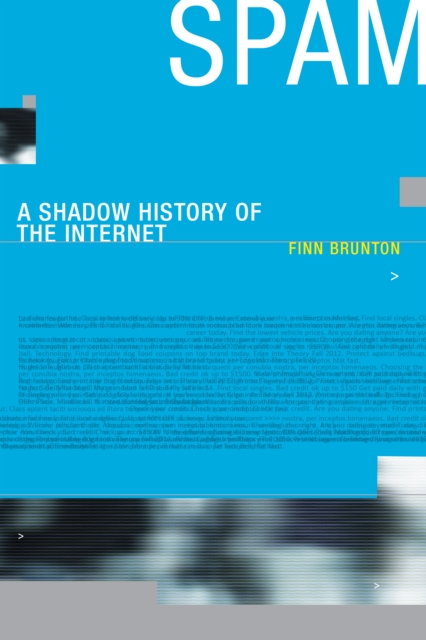
Spam
The vast majority of all email sent every day is spam, a variety of idiosyncratically spelled requests to provide account information, invitations to spend money on dubious products, and pleas to send cash overseas. Most of it is caught by filters before ever reaching an in-box. Where does it come from? As Finn Brunton explains in Spam, it is produced and shaped by many different populations around the world: programmers, con artists, bots and their botmasters, pharmaceutical merchants, marketers, identity thieves, crooked bankers and their victims, cops, lawyers, network security professionals, vigilantes, and hackers. Every time we go online, we participate in the system of spam, with choices, refusals, and purchases the consequences of which we may not understand. This is a book about what spam is, how it works, and what it means. Brunton provides a cultural history that stretches from pranks on early computer networks to the construction of a global criminal infrastructure. The history of spam, Brunton shows us, is a shadow history of the Internet itself, with spam emerging as the mirror image of the online communities it targets. Brunton traces spam through three epochs: the 1970s to 1995, and the early, noncommercial computer networks that became the Internet; 1995 to 2003, with the dot-com boom, the rise of spam's entrepreneurs, and the first efforts at regulating spam; and 2003 to the present, with the war of algorithms -- spam versus anti-spam. Spam shows us how technologies, from email to search engines, are transformed by unintended consequences and adaptations, and how online communities develop and invent governance for themselves.
eBook


Electronic and Computer Music
In this new edition of the classic text on the history and evolution of electronic music, Peter Manning extends the definitive account of the medium from its birth to include key developments from the dawn of the 21st century to the present day. After explaining the antecedents of electronic music from the turn of the 20th century to the Second World War, Manning discusses the emergence of the early ‘classical’ studios of the 1950s, and the subsequent evolution of more advanced analogue technologies during the 1960s and ‘70s, leading in turn to the birth and development of the MIDI synthesizer. Attention then turns to the characteristics of the digital revolution, from the pioneering work of Max Mathews at Bell Telephone Laboratories in the 1950s to the wealth of resources available today, facilitated by the development of the personal computer and allied digital technologies. The scope and extent of the technical and creative developments that have taken place since the late 1990s are considered in an extended series of new and updated chapters. These include topics such as the development of the digital audio workstation, laptop music, the Internet, and the emergence of new performance interfaces. Manning offers a critical perspective of the medium in terms of the philosophical and technical features that have shaped its growth. Emphasizing the functional characteristics of emerging technologies and their influence on the creative development of the medium, Manning covers key developments in both commercial and the non-commercial sectors to provide readers with the most comprehensive resource available on the evolution of this ever-expanding area of creativity.
eBook


Building better batteries
Researchers must find a sustainable way of providing the power our modern lifestyles demand.
Research Horizons
A new series begins this week. 'Horizons' are commissioned articles in which experts speculate on what will happen over the next few years in their fields. On the cover, one of Antony Gormley's figures in his
Another Place
installation sets the tone. In the first piece, Thomas Kirkwood considers the potential of systems biology to de-link disease and old age. Peter Murray-Rust writes on a new 'open' approach to chemistry. But his subtext is broader: the future of the 'semantic web', where computers can make as much use of information as humans can. M. Armand and J.-M. Tarascon show how advances in materials science can provide the batteries of the future. George Koentges tackles 'evo-devo', the marriage of fossil evidence, genomic sequencing and molecular developmental biology. And R. J. Schoelkopf and S. M. Girvin raise the prospect that circuit quantum electrodynamics could pave the way for practical quantum computing and communication. On page
643
,
Nature
editor Philip Campbell sets out the brief for these and future Horizons.
Journal Article

Great electronic gadget designs : 1900-today
Discover the most amazing gadget designs since 1900. From the Japanese Tamagotchi to the iPhone, this book charts the story of design that led to some amazing games and gadgets. We look at the needs that prompted their design, the designers responsible for breaking boundariesand the technology that made them possible.
Book

A brief history of molecular electronics
The field of molecular electronics has been around for more than 40 years, but only recently have some fundamental problems been overcome. It is now time for researchers to move beyond simple descriptions of charge transport and explore the numerous intrinsic features of molecules.
Journal Article