
Catalogue Search | MBRL


Are you sure you want to remove the book from the shelf?

{{itemTitle}}
344
result(s) for
"Electronics Problems, exercises, etc."
Sort by:
Complete Electronics Self-Teaching Guide with Projects
An all-in-one resource on everything electronics-related! For almost 30 years, this book has been a classic text for electronics enthusiasts. Now completely updated for today's technology, this latest version combines concepts, self-tests, and hands-on projects to offer you a completely repackaged and revised resource. This unique self-teaching guide features easy-to-understand explanations that are presented in a user-friendly format to help you learn the essentials you need to work with electronic circuits. All you need is a general understanding of electronics concepts such as Ohm's law and current flow, and an acquaintance with first-year algebra. The question-and-answer format, illustrative experiments, and self-tests at the end of each chapter make it easy for you to learn at your own speed. * Boasts a companion website that includes more than twenty full-color, step-by-step projects * Shares hands-on practice opportunities and conceptual background information to enhance your learning process * Targets electronics enthusiasts who already have a basic knowledge of electronics but are interested in learning more about this fascinating topic on their own * Features projects that work with the multimeter, breadboard, function generator, oscilloscope, bandpass filter, transistor amplifier, oscillator, rectifier, and more You're sure to get a charge out of the vast coverage included in Complete Electronics Self-Teaching Guide with Projects!
eBook
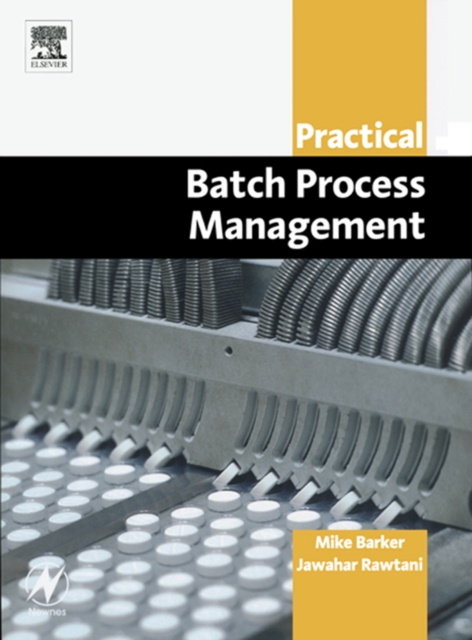
Practical Batch Process Management
Historically batch control systems were designed individually to match a specific arrangement of plant equipment. They lacked the ability to convert to new products without having to modify the control systems, and did not lend themselves to integration with manufacturing management systems. Practical Batch Management Systems explains how to utilize the building blocks and arrange the structures of modern batch management systems to produce flexible schemes suitable for automated batch management, with the capability to be reconfigured to use the same plant equipment in different combinations. It introduces current best practice in the automation of batch processes, including the drive for integration with MES (Manufacturing Execution System) and ERP (Enterprise Resource Planning) products from major IT vendors. References and examples are drawn from DCS / PLC batch control products currently on the market. - Implement modern batch management systems that are flexible and easily reconfigured - Integrate batch management with other manufacturing systems including MES and ERP - Increase productivity through industry best practice
eBook

Make : family projects for smart objects : tabletop projects that respond to your world
\"'The Internet of Things' is the new buzzphrase, but what is it? A toaster that texts? The fitness band on your wrist? The camera in an infant's room? Sure, it's all of those things. But it's also your phone: an ultra-sophisticated sensor and communications system in your pocket or purse--capable of tracking your steps, capturing an image, or calling an Uber. And it is actually not hard or expensive to make a sensing, communicating object yourself. Doing so can be rewarding, fun, and even useful. This book teaches the basics of building sensors and communicating objects through a series of practical, demonstrative, and fun activities\"--Amazon.com.
Book

Sintering - Densification, Grain Growth, and Microstructure
Sintering is the process of forming materials and components from a powder under the action of thermal energy. It is a key materials science subject; most ceramic materials and many specialist metal powder products for use in key industries such as electronics, automotive and aerospace are formed this way. Written by one of the leading experts in the field, this book offers an unrivalled introduction to sintering and sintering processes for students of materials science and engineering, and practicing engineers in industry. The book is unique in providing a complete grounding in the principles of sintering and equal coverage of the three key sintering processes: densification, grain growth and microstructure. Students and professional engineers alike will be attracted by the emphasis on developing a detailed understanding of the theory and practical processes of sintering, the balanced coverage of ceramic and metal sintering, and the accompanying examination questions with selected solutions.
eBook

Programmable Logic Controllers (4th Edition)
This is the introduction to PLCs for which baffled students, technicians and managers have been waiting. In this straightforward, easy-to-read guide, Bill Bolton has kept the jargon to a minimum, considered all the programming methods in the standard IEC 1131-3 - in particular ladder programming, and presented the subject in a way that is not device specific to ensure maximum applicability to courses in electronics and control systems. Now in its fourth edition, this best-selling text has been expanded with increased coverage of industrial systems and PLCs and more consideration has been given to IEC 1131-3 and all the programming methods in the standard. The new edition brings the book fully up to date with the current developments in PLCs, describing new and important applications such as PLC use in communications (e.g. Ethernet - an extremely popular system), and safety - in particular proprietary emergency stop relays (now appearing in practically every PLC based system).
eBook

Investing in Financial Research
Every day, people around the world make financial decisions. They choose to invest in a stock, sell their holdings in a mutual fund or buy a condominium. These decisions are complex and financially tricky-even for financial professionals. But the literature available on financial research is dated and narrowly focused without any real practical application. Until now there's been a gap in the literature: a book that shows you how to conduct a step by step comprehensive financial investigation that ends in a decision.
This book gives you that how.
Investing In Financial Research is a guidebook for conducting financial investigations and lays out Cheryl Strauss Einhorn's AREA Method-a research and decision-making system that uniquely controls for bias, focuses on the incentives of others and expands knowledge while improving judgement-and applies it to investigating financial situations. AREA is applicable to all sorts of financial sleuthing, whether for investment analysis or investigative journalism. It allows you to be the expert in your own life.
The AREA Method provides you with:
-Defined tasks that guide and focus your research on your vision of success;
-A structure that isolates your sources, giving you insight into their perspectives, biases and incentives;
-Investigative resources, tips and techniques to upgrade your research and analysis beyond document-based sources;
-Exercises to foster creativity and originality in your thinking;
-A sequence and framework that brings your disparate pieces of research together to build your confidence and conviction about your financial decision.
eBook
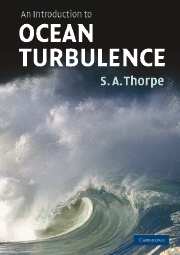
An Introduction to Ocean Turbulence
This textbook provides an introduction to turbulent motion occurring naturally in the ocean on scales ranging from millimetres to hundreds of kilometres. It describes turbulence in the mixed boundary layers at the sea surface and seabed, turbulent motion in the density-stratified water between, and the energy sources that support and sustain ocean mixing. Little prior knowledge of physical oceanography is assumed. The text is supported by numerous figures, extensive further reading lists, and more than 50 exercises that are graded in difficulty. Detailed solutions to the exercises are available to instructors online at www.cambridge.org/9780521859486. This textbook is intended for undergraduate courses in physical oceanography, and all students interested in multidisciplinary aspects of how the ocean works, from the shoreline to the deep abyssal plains. It also forms a useful lead-in to the author's more advanced graduate textbook, The Turbulent Ocean (Cambridge University Press, 2005).
eBook
How to Pass Professional Level Psychometric Tests
How to Pass Professional Level Psychometric Tests contains a wealth of practice questions to help prepare you for exactly the type of tests you will face in recruitment assessments for professional careers. A staggering 650 questions and answers, consisting of 20 timed practice tests reflect real life exams favoured by the most popular organisations. It is particularly useful for those facing aggressive psychometric tests, particularly candidates for careers in IT, management and finance. Also including practice questions for common verbal reasoning and numerical tests, How to Pass Professional Level Psychometric Tests provides essential help and preparation to improve your score and gain the competitive edge over the competition.
eBook