
Catalogue Search | MBRL


Are you sure you want to remove the book from the shelf?

{{itemTitle}}
4,324
result(s) for
"Electronics Textbooks"
Sort by:

Practical electronics for inventors
Spark your creativity and gain the electronics skills required to transform your innovative ideas into functioning gadgets. This hands-on, updated guide outlines electrical principles and provides thorough, easy-to-follow instructions, schematics, and illustrations. Find out how to select components, safely assemble circuits, perform error tests, and build plug-and-play prototypes.
Book
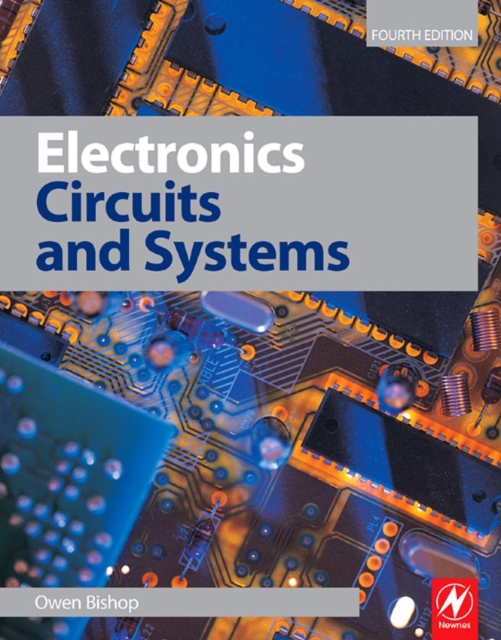
Electronics - Circuits and Systems
This cutting-edge textbook with coverage matching the electronics units of many vocational engineering courses is organized with a logical learning progression, making it ideal for a wide range of electronics courses. The approach is student-centred and includes numerous examples and activities, web research topics, self test features, highlighted key facts, formulae and definitions. A companion website with interactive exercises and illustrations is included.
eBook

Electronics fundamentals : circuits, devices, and applications
This text provides optional computer analysis exercises in selected examples, troubleshooting sections, & applications assignments. It gives comprehensive coverage & limits maths to what's needed for understanding electric circuits fundamentals.
Book


College Students’ Usage of and Preferences for Print and Electronic Textbooks
Although print textbooks have been central for schooling for more than two centuries, electronic textbooks (e-textbooks) are steadily growing in popu-larity among students at all levels of education. This sharp growth has esca-lated the need for further research to enable a better understanding of the changing patterns of students’ usage of print and electronic media. The study explores college students’ usage of and preference for print and elec-tronic textbooks in Bahrain Teachers’ College, in Bahrain. The sample of the study consisted of 271 undergraduate students selected from courses that utilized both formats of textbook as clearly indicated in their syllabi. De-scriptive analyses were used to analyze data collected. Results indicate that regardless of textbook format, the highest percentage of students use their textbooks only when their instructors require them to do so. For print text-books, results show that the highest percentage of students spend between 1 to 3 hours a week on reading. However, for e-textbooks, the highest per-centage of students spend only less than 1 hour per week on reading. An in-teresting finding for this study is that compared to print textbooks, e-textbooks gain a higher percentage of students’ usage when it comes to spending higher numbers of hours of reading per week. The study affirms that students are in general positive to the use of electronic format but still show a preference for print format as the best medium for academic study. Lastly, the study uncovers reasonable findings as to why students prefer one textbook format over the other.
Journal Article

Photovoltaic laboratory : safety, code-compliance, and commercial off-the-shelf equipment
\"This textbook is comprised of twelve chapters, each one representing a well-defined sequence of measurements and analyses. The laboratory textbook is designed to be a companion to photovoltaics lecture sequence covering the sun as a resource, photovoltaic components, systems, and applications\"-- Provided by publisher.
Book

Optimization of computer ontologies for e-courses in information and communication technologies
A methodology is proposed for modifying computer ontologies (CO) for electronic courses (EC) in the field of information and communication technologies (ICT) for universities, schools, extracurricular institutions, as well as for the professional retraining of specialists. The methodology includes the modification of CO by representing the formal ontograph of CO in the form of a graph and using techniques for working with the graph to find optimal paths on the graph using applied software (SW). A genetic algorithm (GA) is involved in the search for the optimal CO. This will lead to the division of the ontograph into branches and the ability to calculate the best trajectory in a certain sense through the EC educational material, taking into account the syllabus. An example is considered for the ICT course syllabus in terms of a specific topic covering the design and use of databases. It is concluded that for the full implementation of this methodology, a tool is needed that automates this procedure for developing EC and/or electronic textbooks. An algorithm and a prototype of software tools are also proposed, integrating machine methods of working with CO and graphs.
Journal Article

Design and research potential of interactive textbooks: the case of fractions
The transition from classical to electronic textbooks seems to be a logical step in the digitization advancing worldwide. However, developing an e-book ought to be more than digitizing text: key features of computer-based learning environments such as interactive exercises, adaptive demands, or automatic feedback should be integrated to take advantage of the digitization. The “ALICE:fractions” project aims at designing and evaluating an interactive mathematics textbook for introducing fractions in the classroom. It is based on research in mathematics education and includes the elements just mentioned. This paper describes the electronic textbook’s implementation and its theoretical background. Moreover, it introduces aspects that allow further information on learning processes to be gleaned. As an example, time on task is regarded in a study with 6th graders who used the electronic textbook in the classroom. Linear mixed models revealed a negative effect of time on task on task success. The effect was moderated by exercise difficulty and slightly by student competence: the effect was less pronounced in difficult exercises and for low-achieving students, whereas for high-achieving students or in easier exercises, the effect intensified.
Journal Article

Optimization of computer ontologies for e-courses in information and communication technologies
A methodology is proposed for modifying computer ontologies (CO) for electronic courses (EC) in the field of information and communication technologies (ICT) for universities, schools, extracurricular institutions, as well as for the professional retraining of specialists. The methodology includes the modification of CO by representing the formal ontograph of CO in the form of a graph and using techniques for working with the graph to find optimal paths on the graph using applied software (SW). A genetic algorithm (GA) is involved in the search for the optimal CO. This will lead to the division of the ontograph into branches and the ability to calculate the best trajectory in a certain sense through the EC educational material, taking into account the syllabus. An example is considered for the ICT course syllabus in terms of a specific topic covering the design and use of databases. It is concluded that for the full implementation of this methodology, a tool is needed that automates this procedure for developing EC and/or electronic textbooks. An algorithm and a prototype of software tools are also proposed, integrating machine methods of working with CO and graphs.
Journal Article