
Catalogue Search | MBRL


Are you sure you want to remove the book from the shelf?

{{itemTitle}}
357
result(s) for
"Eliot, T. S. (Thomas Stearns), 1888-1965 -- Criticism and interpretation"
Sort by:

The Great War and the language of modernism
In The Great War and the Language of Modernism, Vincent Sherry reopens long unanswered questions regarding the influence of the 1914 war on the verbal experiments of modernist poetry and fiction. Sherry recovers the political discourses of the British campaign and establishes the language to which literary modernism responds with its boldest initiatives. In its wholly new reading of Woolf, Eliot, and Pound, this book restores the historical content and depth of this literature and reveals its most daring import.
eBook

Becoming T. S. Eliot
Focusing on the period from 1909 to 1915, this incisive portrait of Eliot as a budding writer is as much a study of Eliot himself as it is a study of how a writer hones his voice.
eBook

The Edinburgh Companion to T. S. Eliot and the Arts
Explores Eliot’s many-sided engagements with painting, sculpture, architecture, music, drama, music hall and cinema, recorded sound, and dance, drawing on newly available sources, archival material, and interart connections.
eBook

Power, Plain English, and the Rise of Modern Poetry
In this engaging book David Rosen offers a radically new account of Modern poetry and revises our understanding of its relation to Romanticism. British poets from Wordsworth to Auden attempted to present themselves simultaneously as persons of power and as moral voices in their communities. The modern lyric derives its characteristic complexities-psychological, ethical, formal-from the extraordinary difficulty of this effort.The low register of our language-a register of short, concrete, native words arranged in simple syntax-is deeply implicated in this story. Rosen shows how the peculiar reputation of \"plain English\" for truthfulness is employed by Modern poets to conceal the rift between their (probably irreconcilable) ambitions for themselves.With a deep appreciation for poetic accomplishment and a wonderful iconoclasm, Rosen sheds new light on the innovative as well as the self-deceptive aspects of Modern poetry. This book alters our understanding of the history of poetry in the English language.
eBook

True Friendship
True Friendshiplooks closely at three outstanding poets of the past half-century-Geoffrey Hill, Anthony Hecht, and Robert Lowell-through the lens of their relation to their two predecessors in genius, T. S. Eliot and Ezra Pound. The critical attention then finds itself reciprocated, with Eliot and Pound being in their turn contemplated anew through the lenses of their successors. Hill, Hecht, and Lowell are among the most generously alert and discriminating readers, as is borne out not only by their critical prose but (best of all) by their acts of new creation, those poems of theirs that are thanks to Eliot and Pound.
\"Opposition is true Friendship.\" So William Blake believed, or at any rate hoped. Hill, Hecht, and Lowell demonstrate many kinds of friendship with Eliot and Pound: adversarial, artistic, personal. In their creative assent and dissent, the imaginative literary allusions-like other, wider forms of influence-are shown to constitute the most magnanimous of welcomes and of tributes.
eBook

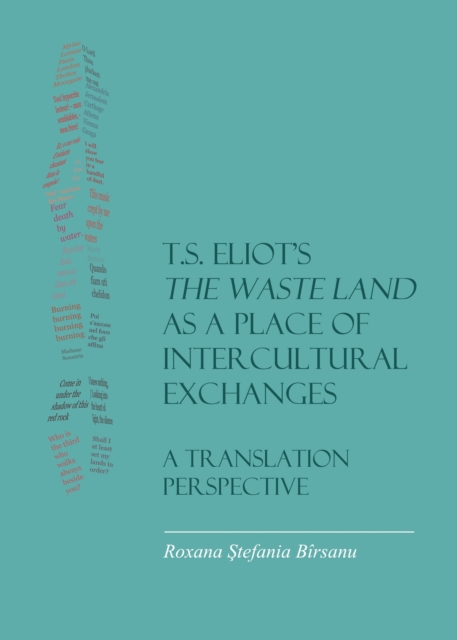
T.S. Eliot’s The Waste Land as a Place of Intercultural Exchanges
The focal point of this study is one of the masterpieces of Anglo-American poetry, T.S. Eliots The Waste Land, tackled from the perspective of translation. In this particular case, translation is deemed to be not only an intra- and inter-linguistic transfer, but also a form of intercultural contact. The book centres on a comparative study of the poem with five of its Romanian translations within the framework of Romanian letters. Thus, it also presents a thorough analysis of the target liter.
eBook
T.S. Eliot, Poetry, and Earth
T. S. Eliot enjoyed a profound relationship with Earth. Criticism of his work does not suggest that this exists in his poetic oeuvre. Writing into this gap, Etienne Terblanche demonstrates that Eliot presents Earth as a process in which humans immerse themselves. The Waste Land and Four Quartets in particular re-locate the modern reader towards mindfulness of Earth's continuation and one's radical becoming within that process. But what are the potential implications for ecocriticism? Based on its careful reading of the poems from a new material perspective, this book shows how vital it has become for ecocriticism to be skeptical about the extent of its skepticism, to follow instead the twentieth century's
most important poet who, at the end of searing skepticism, finds affirmation of Earth, art, and real presence.
eBook
A Companion to T. S. Eliot
Reflecting the surge of critical interest in Eliot renewed in recent years, A Companion to T.S. Eliot introduces the 'new' Eliot to readers and educators by examining the full body of his works and career. Leading scholars in the field provide a fresh and fully comprehensive collection of contextual and critical essays on his life and achievement.
* It compiles the most comprehensive and up-to-date treatment available of Eliot's work and career
* It explores the powerful forces that shaped Eliot as a writer and thinker, analyzing his body of work and assessing his oeuvre in a variety of contexts: historical, cultural, social, and philosophical
* It charts the surge in critical interest in T.S. Eliot since the early 1990s
* It provides an illuminating insight into a poet, writer, and critic who continues to define the literary landscape of the last century
eBook