
Catalogue Search | MBRL


Are you sure you want to remove the book from the shelf?

{{itemTitle}}
1,101
result(s) for
"Elite (Social sciences) United States."
Sort by:


No longer separate, not yet equal
Against the backdrop of today's increasingly multicultural society, are America's elite colleges admitting and successfully educating a diverse student body? No Longer Separate, Not Yet Equal pulls back the curtain on the selective college experience and takes a rigorous and comprehensive look at how race and social class impact each stage--from application and admission, to enrollment and student life on campus. Arguing that elite higher education contributes to both social mobility and inequality, the authors investigate such areas as admission advantages for minorities, academic achievement gaps tied to race and class, unequal burdens in paying for tuition, and satisfaction with college experiences. The book's analysis is based on data provided by the National Survey of College Experience, collected from more than nine thousand students who applied to one of ten selective colleges between the early 1980s and late 1990s. The authors explore the composition of applicant pools, factoring in background and \"selective admission enhancement strategies\"--including AP classes, test-prep courses, and extracurriculars--to assess how these strengthen applications. On campus, the authors examine roommate choices, friendship circles, and degrees of social interaction, and discover that while students from different racial and class circumstances are not separate in college, they do not mix as much as one might expect. The book encourages greater interaction among student groups and calls on educational institutions to improve access for students of lower socioeconomic status.
eBook


Class and Campus Life
In 2015, theNew York Timesreported, \"The bright children of janitors and nail salon workers, bus drivers and fast-food cooks may not have grown up with the edifying vacations, museum excursions, daily doses of NPR and prep schools that groom Ivy applicants, but they are coveted candidates for elite campuses.\" What happens to academically talented but economically challenged \"first-gen\" students when they arrive on campus? Class markers aren't always visible from a distance, but socioeconomic differences permeate campus life-and the inner experiences of students-in real and sometimes unexpected ways. InClass and Campus Life, Elizabeth M. Lee shows how class differences are enacted and negotiated by students, faculty, and administrators at an elite liberal arts college for women located in the Northeast.
Using material from two years of fieldwork and more than 140 interviews with students, faculty, administrators, and alumnae at the pseudonymous Linden College, Lee adds depth to our understanding of inequality in higher education. An essential part of her analysis is to illuminate the ways in which the students' and the college's practices interact, rather than evaluating them separately, as seemingly unrelated spheres. She also analyzes underlying moral judgments brought to light through cultural connotations of merit, hard work by individuals, and making it on your own that permeate American higher education. Using students' own descriptions and understandings of their experiences to illustrate the complexity of these issues, Lee shows how the lived experience of socioeconomic difference is often defined in moral, as well as economic, terms, and that tensions, often unspoken, undermine students' senses of belonging.
eBook


Culture and Liberty in the Age of the American Revolution
In his new book, Michal Jan Rozbicki undertakes to bridge the gap between the political and the cultural histories of the American Revolution. Through a careful examination of liberty as both the ideological axis and the central metaphor of the age, he is able to offer a fresh model for interpreting the Revolution. By establishing systemic linkages between the histories of the free and the unfree, and between the factual and the symbolic, this framework points to a fundamental reassessment of the ways we think about the American Founding.
Rozbicki moves beyond the two dominant interpretations of Revolutionary liberty-one assuming the Founders invested it with a modern meaning that has in essence continued to the present day, the other highlighting its apparent betrayal by their commitment to inequality. Through a consistent focus on the interplay between culture and power, Rozbicki demonstrates that liberty existed as an intricate fusion of political practices and symbolic forms. His deeply historicized reconstruction of its contemporary meanings makes it clear that liberty was still understood as a set of privileges distributed according to social rank rather than a universal right. In fact, it was because the Founders considered this assumption self-evident that they felt confident in publicizing a highly liberal, symbolic narrative of equal liberty to represent the Revolutionary endeavor. The uncontainable success of this narrative went far beyond the circumstances that gave birth to it because it put new cultural capital-a conceptual arsenal of rights and freedoms-at the disposal of ordinary people as well as political factions competing for their support, providing priceless legitimacy to all those who would insist that its nominal inclusiveness include them in fact.
eBook
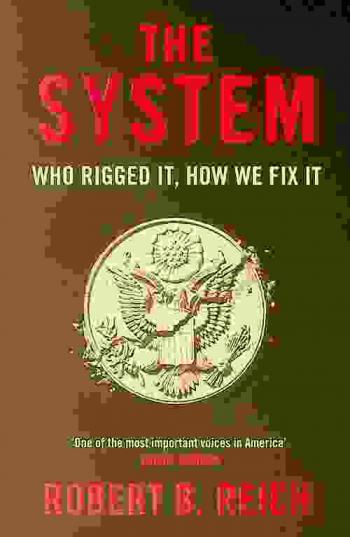
The system : who rigged it, how we fix it
Millions of Americans have lost confidence in our political and economic system. After years of stagnant wages, volatile job markets, and an unwillingness to deal with profound threats such as climate change, there is a mounting sense that the system is fixed, serving only those select few with enough money to secure a controlling stake. With the characteristic clarity and passion that has made him a central civil voice, Robert B. Reich shows how wealth and power have interacted to install an elite oligarchy, eviscerate the middle class, and undermine democracy.

Dream Hoarders
America is becoming a class-based society.It's now conventional wisdom to focus on the excesses of the top 1% - especially the top 0.01% - and how the ultra-rich are hoarding income and wealth while incomes for most other Americans are stagnant. But the more important, and widening, gap in American society is between the upper middle class and everyone else.Reeves defines the upper middle class as those whose incomes are in the top 20 percent of American society. Income isn't the only way to measure a society, but in a market economy it is crucial because access to money generally determines who gets the best quality education, housing, health care, and other necessary goods and services.As Reeves shows, the growing separation between the upper middle class and everyone else can be seen in family structure, neighborhoods, attitudes, and lifestyle. Those at the top of the income ladder are becoming more effective at passing on their status to their children, reducing overall social mobility. The result is a fracturing of American society along class lines, not just an economic divide. Upper-middle-class children become upper-middle-class adults.These trends matter because the separation and perpetuation of the upper middle class corrode prospects for more progressive approaches to policy. Various forms of \"opportunity hoarding\" among the upper middle class make it harder for others to rise up to the top rung. Examples include zoning laws and schooling, occupational licensing, college application procedures, and the allocation of internships. Upper middle class opportunity hoarding, Reeves argues, results in a less competitive economy as well as a less open society.Inequality is inevitable and can even be good, within limits. But Reeves argues that society can take effective action to reduce opportunity hoarding and thus promote broader opportunity. This fascinating book shows how American society has become the very class-defined society that earlier Americans rebelled against - and what can be done to restore a more equitable society.
eBook

Conspiracies of the ruling class : how to break their grip forever
\"An audacious and desperately needed primer on how America's Ruling Class have upended the Constitution and taken over our country--and how we must unite to regain control of our liberty. A Ruling Class have emerged in America against the hopes and designs of our Founding Fathers. Over the last hundred years, they have rejected the Constitution and expanded their own power, slowly at first and now rapidly. These people believe their actions are justified because they think they are smarter than the rest of us--so smart they can run our lives better than we can. But for all the power and resources at their command, they have failed. Miserably. Society has become increasingly unequal, even as we're promised \"equality.\" Our government finances are out of control, our basic infrastructure is broken, and education is unaffordable and mediocre. And yet the Ruling Class think the solution is for us to grant them ever more control. We can stop this--but to do so we must unite. In Conspiracies of the Ruling Class, Lawrence Lindsey lays out his plan for how we can use common sense to change the way our country is run. Finally, here is the truth from a Washington insider about how to reawaken the spirit upon which America was founded, with liberty for every person to pursue his or her own dreams\"-- Provided by publisher.
Book

The scholar denied
In this groundbreaking book, Aldon D. Morris's ambition is truly monumental: to help rewrite the history of sociology and to acknowledge the primacy of W. E. B. Du Bois's work in the founding of the discipline. Calling into question the prevailing narrative of how sociology developed, Morris, a major scholar of social movements, probes the way in which the history of the discipline has traditionally given credit to Robert E. Park at the University of Chicago, who worked with the conservative black leader Booker T. Washington to render Du Bois invisible. Morris uncovers the seminal theoretical work of Du Bois in developing a \"scientific\" sociology through a variety of methodologies and examines how the leading scholars of the day disparaged and ignored Du Bois's work.The Scholar Deniedis based on extensive, rigorous primary source research; the book is the result of a decade of research, writing, and revision. In exposing the economic and political factors that marginalized the contributions of Du Bois and enabled Park and his colleagues to be recognized as the \"fathers\" of the discipline, Morris delivers a wholly new narrative of American intellectual and social history that places one of America's key intellectuals, W. E. B. Du Bois, at its center.The Scholar Deniedis a must-read for anyone interested in American history, racial inequality, and the academy. In challenging our understanding of the past, the book promises to engender debate and discussion.
eBook