
Catalogue Search | MBRL


Are you sure you want to remove the book from the shelf?

{{itemTitle}}
817
result(s) for
"Elocution"
Sort by:

The dramatic text workbook and video : practical tools for actors and directors
\"Drama begins with the word. Characters, plot, conflict, genre - all are created through language. An ability to understand how language works is invaluable: actors need to learn not only how to use their voice, but how to use voice and language together. The Dramatic Text Workbook is a textbook which explores the expressive potential of language, and how you as an actor can develop your verbal skills to release that potential. Written by acclaimed voice teachers David Carey and Rebecca Clark Carey (Oregon Shakespeare Festival, RADA) this book provides practical approaches to each aspect of verbal expression with the aid of classical and modern scenes and speeches. Chapters include: ¨ Sound: speech sounds and how to use them more expressively ¨ Image: bring life and specificity to images when you speak ¨ Sense: focus on the most significant words and phrases in a speech or scene ¨ Rhythm: how rhythm is created and used in both verse and prose ¨ Argument: the structure or logic of language A follow-up to The Dramatic Text Workbook, and now including a revised introduction, updated reading lists and a comprehensive revision of the major exercises within the book, it is supported by over 90 minutes of online video workshops, exploring the key techniques and tactics explored in the book\"-- Provided by publisher.
Book
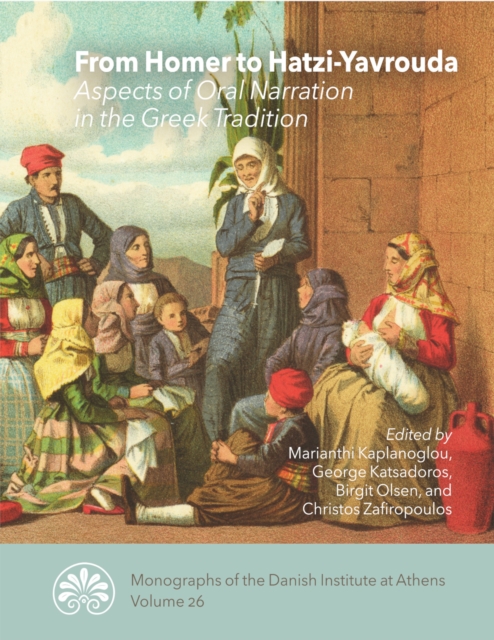
From Homer to Hatzi-Yavrouda
\"From Homer to Hatzi-Yavrouda - Aspects of Oral Narration in the Greek Tradition\" provides a multidisciplinary discussion of the concept of orality in the framework of Greek narrative tradition, from Antiquity to the 21st century.Orality is a prominent concept in contemporary folkloristics, philology, and other related fields and a basic concept.
eBook


Heart Beats
Heart Beats is a step-by-step guide which equips music therapists with foundational components necessary to apply Amplified Cardiopulmonary Recordings (ACPR) to their practice. This manual includes the theoretical underpinnings of clinical approaches, legal and logistic considerations, and two complete technology photo user-guides for music recording software and equipment basics. With a growing demand for one of the newest, formally established interventions in music therapy, this clinical resource is a timely, accessible tool for students and interdisciplinary team members alike across a variety of healthcare settings. Heart Beats inspires clinicians to think deeply about how to harness the rhythm of the heart in music and for healing across the lifespan.
eBook


Neurocomputational Poetics
This book introduces a new thrilling field- neuro computational poetics, the scientific 'marriage' between cognitive poetics, data science and neuroscience - that aims at uncovering the secrets of verbal art reception.
eBook


The science of reading : a handbook
Provides an overview of state-of-the-art research on the science of reading, revised and updated throughout The Science of Reading presents the most recent advances in the study of reading and related skills. Bringing together contributions from a multidisciplinary team of experts, this comprehensive volume reviews theoretical approaches, stage models of reading, cross-linguistic studies of reading, reading instruction, the neurobiology of reading, and more. Divided into six parts, the book explores word recognition processes in skilled reading, learning to read and spell, reading comprehension and its development, reading and writing in different languages, developmental and acquired reading disorders, and the social, biological, and environmental factors of literacy. The second edition of The Science of Reading is extensively revised to reflect contemporary theoretical insights and methodological advances. Two entirely new chapters on co-occurrence and complexity are accompanied by reviews of recent findings and discussion of future trends and research directions. Updated chapters cover the development of reading and language in preschools, the social correlates of reading, experimental research on sentence processing, learning to read in alphabetic orthographies, comorbidities that occur frequently with dyslexia, and other central topics. * Demonstrates how different knowledge sources underpin reading processes using a wide range of methodologies * Presents critical appraisals of theoretical and computational models of word recognition and evidence-based research on reading intervention * Reviews evidence on skilled visual word recognition, the role of phonology, methods for identifying dyslexia, and the molecular genetics of reading and language * Highlights the importance of language as a foundation for literacy and as a risk factor for developmental dyslexia and other reading disorders * Discusses learning to read in different types of writing systems, with a language impairment, and in variations of the home literacy environment * Describes the role of contemporary analytical tools such as dominance analysis and quantile regression in modelling the development of reading and comprehension Part of the acclaimed Wiley Blackwell Handbooks of Developmental Psychology series, the second edition of The Science of Reading: A Handbook remains an invaluable resource for advanced students, researchers, and specialist educators looking for an up-to-date overview of the field.
eBook

Rhetoric and the Writing of History, 400–1500
This book provides an analytical overview of the vast range of historiography which was produced in western Europe over a thousand-year period between c.400 and c.1500. Concentrating on the general principles of classical rhetoric central to the language of this writing, alongside the more familiar traditions of ancient history, biblical exegesis and patristic theology, this survey introduces the conceptual sophistication and semantic rigour with which medieval authors could approach their narratives of past and present events, and the diversity of ends to which this history could then be put. By providing a close reading of some of the historians who put these linguistic principles and strategies into practice (from Augustine and Orosius through Otto of Freising and William of Malmesbury to Machiavelli and Guicciardini), it traces and questions some of the key methodological changes that characterise the function and purpose of the western historiographical tradition in this formative period of its development.
eBook

Continuity in Peirce's Lesson in Elocution: A Performance-based Approach
Peirce's \"Lesson in Elocution\" (written ca. 1892) provides insight into his ideas on continuity and community through his knowledge of performance cultures such as theatre, elocution, rhetoric, and declamation. This unpublished manuscript constitutes the extant part of an application Peirce drafted to the Episcopal Church's General Theological Seminary for the position of elocution instructor. Continuing Henry C. Johnson, Jr.'s account (published in Transactions [2006] vol. 42, no. 4) of the Lesson as evidence of Peirce's religious practices, this article explores the Lesson as demonstration of his performance knowledge and experience. What would Peirce have brought as philosopher and scientist to the teaching of elocution? Conversely, what did his performance knowledge bring to his work on continuity and community? Outlining significant differences between Peirce's semiotic approach and that of the Seminary's then-current instructor, Francis Thayer Russell, the article argues, employing selected performance theory concepts, that performance often operates in semiosis itself, as Peirce defined it.
Journal Article