
Catalogue Search | MBRL


Are you sure you want to remove the book from the shelf?

{{itemTitle}}
1,468
result(s) for
"Emergency number"
Sort by:

The Spatio-Temporal Distribution of Suicide-related Emergency Calls in a European City: Age and Gender Patterns, and Neighborhood Influences
The aim of this study was to conduct a comprehensive spatio-temporal analysis of suicide-related emergency calls in the city of Valencia (Spain) over a six-year period. To this end we first examined age and gender patterns and, second, the influence of neighborhood characteristics on general and gender-specific spatio-temporal patterns of suicide-related emergency calls.
Geocoded data on suicide-related emergency calls between 2017 and 2022 (
= 10,030) were collected from the 112 emergency service in Valencia. Data were aggregated at the census block group level, used as a proxy for neighborhoods, and trimesters were considered as the temporal unit. Two set of analyses were performed: (1) demographic (age and gender) and temporal descriptive analyses and (2) general and gender-specific Bayesian spatio-temporal autoregressive models.
Descriptive analyses revealed a higher incidence of suicide-related emergency calls among females and an increase in calls among the 18-23 age group from 2020 onwards. The general spatio-temporal model showed higher levels of suicide-related emergency calls in neighborhoods characterized by lower education levels and population density, and higher residential mobility, aging population, and immigrant concentration. Relevant gender differences were also observed. A seasonal effect was noted, with a peak in calls during spring for females and summer for males.
These findings highlight the need for comprehensive mental health targeted interventions and preventive strategies that account for gender-specific disparities, age-related vulnerabilities, and the specific characteristics of neighborhoods.
Journal Article

The Danish prehospital emergency healthcare system and research possibilities
The emergency medical healthcare system outside hospital varies greatly across the globe - even within the western world. Within the last ten years, the demand for emergency medical service systems has increased, and the Danish emergency medical service system has undergone major changes.
Therefore, we aimed to provide an updated description of the current Danish prehospital medical healthcare system.
Since 2007, Denmark has been divided into five regions each responsible for health services, including the prehospital services. Each region may contract their own ambulance service providers. The Danish emergency medical services in general include ambulances, rapid response vehicles, mobile emergency care units and helicopter emergency medical services. All calls to the national emergency number, 1-1-2, are answered by the police, or the Copenhagen fire brigade, and since 2011 forwarded to an Emergency Medical Coordination Centre when the call relates to medical issues. At the Emergency Medical Coordination Centre, healthcare personnel assess the situation guided by the Danish Index for Emergency Care and determine the level of urgency of the situation, while technical personnel dispatch the appropriate medical emergency vehicles. In Denmark, all healthcare services, including emergency medical services are publicly funded and free of charge. In addition to emergency calls, other medical services are available for less urgent health problems around the clock. Prehospital personnel have since 2015 utilized a nationwide electronic prehospital medical record. The use of this prehospital medical record combined with Denmark’s extensive registries, linkable by the unique civil registration number, enables new and unique possibilities to do high quality prehospital research, with complete patient follow-up.
Journal Article

Academic College of Emergency Experts in India's INDO-US Joint Working Group (JWG) White Paper on the Integrated Emergency Communication Response Service in India: Much more than just a number
The proposal for an integrated national emergency number for India is garnering a lot of enthusiasm and stimulating debate. This ambitious project has a two-part paradigm shift to set in; the first being the integration into a single number and the infrastructure required for setting up and operating this number such that a call can be received and identified. The second is the submerged part of the iceberg: That of the ability to respond to a call and deliver the appropriate emergency service. The first part is more technical and has potential precedents like the 911 phone hotline, for example, to emulate. The main premise of this paper is that the second part is a rather subjective exercise largely determined by the realities of existing public infrastructure in a specific geographical area with respect to emergency services management, especially medical care. Consequently, we highlight the key areas of both precall preparedness and postcall execution that need to be reviewed prior to going live with an integrated number on a national scale.
Journal Article
Academic College of Emergency Experts in India′s INDO-US Joint Working Group (JWG) White Paper on the Integrated Emergency Communication Response Service in India: Much more than just a number
The proposal for an integrated national emergency number for India is garnering a lot of enthusiasm and stimulating debate. This ambitious project has a two-part paradigm shift to set in; the first being the integration into a single number and the infrastructure required for setting up and operating this number such that a call can be received and identified. The second is the submerged part of the iceberg: That of the ability to respond to a call and deliver the appropriate emergency service. The first part is more technical and has potential precedents like the 911 phone hotline, for example, to emulate. The main premise of this paper is that the second part is a rather subjective exercise largely determined by the realities of existing public infrastructure in a specific geographical area with respect to emergency services management, especially medical care. Consequently, we highlight the key areas of both precall preparedness and postcall execution that need to be reviewed prior to going live with an integrated number on a national scale.
Journal Article

Temporal trends in suicide related emergency calls by age group and gender from 2014 to 2023
Gender-age differences in suicide behavior are well-documented. This study aims to analyze the temporal trends in suicide-related calls by gender and age groups and assess the impact of the COVID-19 pandemic. Monthly suicide-related calls to the 112-emergency number in the Valencian Community (Spain) from 2014 to 2023 (
N
= 66,881) were used. Calls were categorized by gender (male/female) and age group: youth (< 21), young adults (21–40), middle-aged adults (41–65), and elderly (> 65). Descriptive time series and LOESS regression modeling identified long-term and seasonal trends for each gender-age combination. Additionally, the pandemic’s impact was assessed using interrupted time series analysis (ITSA) with March 2020 as the intervention point. A rising trend in suicide-related calls was observed, particularly among females. However, the trend differed depending on the age group. Seasonal patterns indicated a general summer peak, also with variations across gender and age groups. Finally, ITSA analysis revealed that the COVID-19 pandemic had an impact on the temporal trends affecting young adult males and all female groups except elderly. The results suggest that suicide behavior trends could be significantly influenced by gender and age dynamics, and the COVID-19 pandemic could have exacerbated these trends in females.
Journal Article
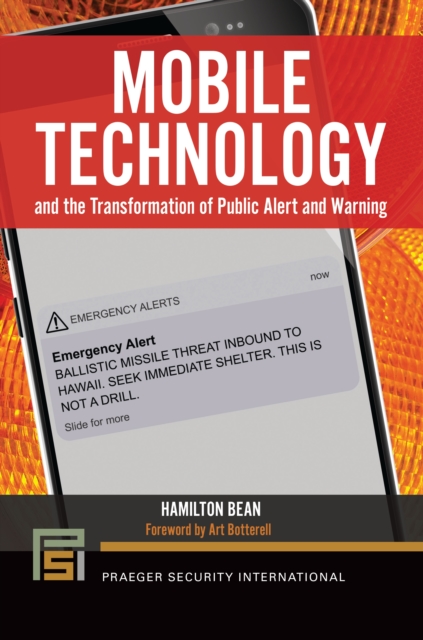
Mobile Technology and the Transformation of Public Alert and Warning
This timely book provides the inside story of the development of mobile public alert and warning technology in the United States and addresses similar systems being used in Australia, Canada, Japan, and the Netherlands. This book provides a comprehensive account of how mobile-smartphone systems are transforming the practice of public alert and warning in the United States. Recent events have vaulted mobile alert and warning technology to the forefront of public debates concerning the hazards of the digital age. False alarms of ballistic missile attacks on Hawaii and Japan, the non-use of mobile alerts during the Northern California wildfires, and the role this technology plays in supporting police manhunts and counterterrorism efforts have prompted reconsideration of how these systems are used. Drawing upon interviews with officials, executives, experts, and citizens, the book provides an in-depth analysis of the events and contexts influencing the trajectory of mobile public alert and warning and charts a course for its improvement. The book first introduces readers to the high stakes involved in the transformation of public alert and warning, explaining how new research is revealing the benefits, limitations, and risks of mobile technology in the disaster communication context. Three case studies then illustrate issues of risk, trust, and appropriateness in mobile public alert and warning.
eBook
Impact of an emergency medical dispatch system on survival from out-of-hospital cardiac arrest
Background
In countries where a single public emergency telephone number is not in operation, different emergency telephone numbers corresponding to multiple dispatch centres (police, fire, emergency medical service) may create confusion for the population about the most appropriate service to call. In particular, out-of-hospital cardiac arrest (OHCA) requires a prompt and effective response. We compare two different dispatch systems on OHCA patient survival at 30 days in a national system with multiple emergency telephone numbers.
Methods
We conducted an observational retrospective study of 6871 patients aged 18 years or older with presumed OHCA of cardiac origin between 2005 and 2013 in three counties of the Northern French Alps region. One county had a single dispatch centre combining medical and fire emergencies, and two had multiple dispatch centres. Propensity score matching analyses were performed to compare patient survival at 30 days.
Results
A total of 2257 emergency calls for OHCA were managed by a single dispatch centre and 4614 by a multiple dispatch centre. A single dispatch centre was associated with an increase in survival (adjusted odds ratio [OR] for all patients: 1.7; 95 % confidence interval [CI] = 1.3–2.2;
p
<0.001; adjusted OR for propensity-matched patients: 2.0; 95 % CI = 1.2–3.4;
p
= 0.012).
Conclusions
A single dispatch centre was associated with a markedly improved increase of survival among OHCA patients at 30 days in a system with several emergency telephone numbers.
Journal Article
Telephone triage protocols for nurses
Performing triage requires the ability to make quick, evidence-based decisions based on limited information.Nurses are often required to preform triage either over the phone, in urgent care settings, in the emergency department, and even in office settings.This reference provides over 200 triage protocols for evaluating a person's symptoms.
eBook

International university students' pre-travel preparation, knowledge and practices towards travel health in Thailand: A nationwide cross-sectional study
International university students are vulnerable travellers due to their unpredictable schedules and lifestyles. As Thailand continues to see an increase in international students, evaluating their pre-travel preparation and preventive behaviours is crucial to identify areas for improvement. For this purpose, an online survey focusing on pre-travel preparation, knowledge and preventive practices related to travel health was distributed to 324 eligible international students from 14 Thai universities, with the majority being from Asia and Oceania (79.0%; 'n' = 256). The results showed that half of the respondents (53.7%; 'n' = 175) received professional pre-travel advice, mainly because of the mandatory health examination and vaccination requirements of the host university. The study also revealed inadequate knowledge about infectious and non-infectious health risks, with only one-third being aware that Japanese encephalitis is transmitted by mosquito bites, and less than half of the students recognising Thailand's emergency services number. Poor preventive practices were also observed, with less than half of those with new sexual partners consistently using condoms and less than half of those riding motorcycles always wearing helmets. These findings highlight the need for a new strategy to improve the standard of travel health preparation among this group of young adult travellers, particularly those from resource-limited countries.
Journal Article

Have the implementation of a new specialised emergency medical service influenced the pattern of general practitioners involvement in pre-hospital medical emergencies? A study of geographic variations in alerting, dispatch, and response
Objectives: Emergency medical service systems in Norway are based on equity and equality. A toll free number (113) and criteria based dispatch are crucial components. The establishment of an emergency medical system (EMS) manned by an air and ground emergency physician (EP) has challenged the role of the general practitioner (GP) in emergency medical care. We investigated whether there were any geographical differences in the use of 113, alerts to GPs by the emergency medical dispatch centres (EMDCs), and of the presence of GPs on scene in medical emergencies leading to a turnout of the EP manned EMS. Methods: This was a prospective, observational cohort study of 385 000 inhabitants covered by the two EMDCs of Rogaland county, Norway, including 1035 on scene missions of the EP manned EMS during the period 1998–99. Results: The proportion of emergency calls routed through 113 was significantly lower, the proportion of alerts to GPs significantly higher, and the proportions of GPs on scene significantly higher in rural than urban areas. Conclusion: We found geographical differences in the involvement of GPs in pre-hospital emergency medical situations, probably caused by a specialised emergency medical service system including an EMDC and an air and ground EP manned EMS. There were geographical differences in public use of the toll free 113, and alerts to GPs by the EMDCs, which is likely to result from geographical conditions and proximity to medical resources. Future organisation of the EMS has to reflect this to prevent unplanned and unwanted autonomously emerging EMS systems.
Journal Article