
Catalogue Search | MBRL


Are you sure you want to remove the book from the shelf?

{{itemTitle}}
17
result(s) for
"Emil Brunner"
Sort by:
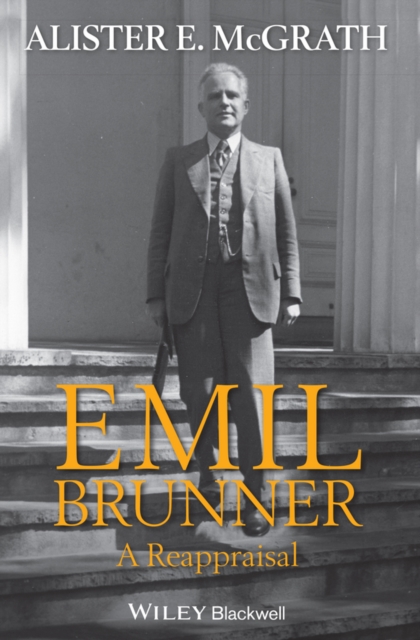
Emil Brunner
In Emil Brunner: A Reappraisal, renowned theologian Alister E. McGrath presents a comprehensive intellectual history of Emil Brunner, the highly influential Swiss theologian who was instrumental in shaping modern Protestant theology. Explores Brunner’s theological development and offers a critical engagement of his theology Examines the role that Brunner played in shaping the characteristics of dialectical theology Reveals the complex and shifting personal and professional relationship between Brunner and Barth Delves into the reasons for Brunner’s contemporary neglect in theological scholarship Represents the only book-length study of Brunner’s works and significance in the English language
eBook


EMIL BRUNNER REVISITED: ON THE COGNITIVE SCIENCE OF RELIGION, THE IMAGO DEI, AND REVELATION
This article aims at a constructive and argumentative engagement between the cognitive science of religion (CSR) and philosophical and theological reflection on the imago Dei. The Swiss theologian Emil Brunner argued that the theological notion that humans were created in the image of God entails that there is a “point of contact” for revelation to occur. This article argues that Brunner's notion resonates quite strongly with the findings of the CSR. The first part will give a short overview of the CSR. The second part deals with Brunner's idea of the imago Dei and the “point of contact.” The third and final part of the article outlines a model of revelation that is in line with Brunner's thought and the CSR. The aim of this article is to show how the naturalistic methodology of the CSR provides a fertile new perspective on several theological issues and thereby enriches theological reflection.
Journal Article

Christianity and History
In Part I of Christianity and History, the author asks whether the committed Christian should be more conscious than the uncommitted of some meaning in history. In answering this he offers a critique of Arnold Toynbee and makes some penetrating observations on the teaching of history. Part II is concerned with the author's special field-the Protestant Reformation and its origins. Calvinism, with its dynamic sense of the historical process, receives special treatment, and there is a brilliant essay on Machiavelli and Thomas More. Three of the essays included in this new book appear here for the first time.
Originally published in 1964.
The Princeton Legacy Library uses the latest print-on-demand technology to again make available previously out-of-print books from the distinguished backlist of Princeton University Press. These editions preserve the original texts of these important books while presenting them in durable paperback and hardcover editions. The goal of the Princeton Legacy Library is to vastly increase access to the rich scholarly heritage found in the thousands of books published by Princeton University Press since its founding in 1905.
eBook
A NATURAL LAW THEORY OF MARRIAGE
For the past two decades, I have been developing an integrative Christian marriage theory, based in part on a grounding concept of natural law and an overarching theory of covenant. The natural law part of this theory starts with an account of the natural facts, conditions, interests, needs, and qualities of human life, interaction, and generation—what I call the “premoral” goods or realities of life. It then identifies the natural inclinations of humans to form enduring and exclusive monogamous marriages and to preserve these units as the central site for intimacy, procreation, and nurture of children. In this paper, I first summarize this natural law theory of marriage and then compare it to the formulations of other modern Christian thinkers. I also defend this theory against various modern critics of natural law—in part by reinterpreting some traditional natural law teachings that in my view have been misunderstood, in part by looking at the interesting convergences between the insights into sex, marriage, and family life offered by contemporary Christian theological ethicists and by evolutionary biologists and biological anthropologists.
Journal Article

Emil Brunner (1889–1966)
The theology of Emil Brunner, one of the most influential theologians of the twentieth century, was marked by the desire to do justice to the twin poles of God and humanity. Brunner's early interest in religious epistemology, his self‐proclaimed attempt to find a “third way” between liberalism and orthodoxy, and his concern to articulate the Christian faith to the modern world produced his most distinctive contribution to modern theology: “truth as encounter”. Brunner considered theological anthropology the “cardinal point of his theology”. His concern with the doctrine of humanity was connected to his concern to do justice to the existential pole of the revelational event. It was this concern that also fueled his interest in “eristics” and social ethics. In The Divine Imperative, Brunner developed theological ethics that sought to integrate the dynamic “ethics of divine command” of Barth with the more traditional categories of “the orders of creation.”
Book Chapter
Natural Theology: Some Concerns and Challenges
Natural theology is an example of a discredited ontotheology, a preconceived metaphysics of the kind criticized by Martin Heidegger. The Scottish philosopher David Hume's ideas are historically and culturally situated, reflecting the perceived inadequacies of a specific form of Deist natural theology which gained the cultural ascendancy in the early eighteenth century. The philosopher Charles Taylor's analysis is intended to hold up a mirror to our present, discerns its regnant implicit narrative, the immanent frame, and this can be understood as both closed and open. This chapter considers the famous 1934 debate between Barth and Emil Brunner, in which natural theology was a significant element in a broader, essentially anthropological discussion about the relation of nature and grace. In recent Protestant discussions, the term fideism has often been deployed as a criticism of postliberal theologies which were held to rest on a Wittgensteinian fideism.
Book Chapter
Developer plans to build 149 homes in Terrace Heights
\"We must meet the future as it comes. The vital matter is that the Church should make a fresh surrender of itself to the realities in which it believes.
Newspaper Article
New Testament about love
For us to begin to understand what this means we must look at the usual meaning of love. The Greek word that was primarily used for love was \"eros.\" This is the word that we get erotic from and is often associated with sexual love. However, this was just one aspect of its use in Greek thinking. Plato explained \"eros\" in his Symposium -- Emil Brunner summarizes it here: \"Eros is the desire for that which we do not possess, but which we ought to have, or would like to have\" (Emil Brunner, The Doctrine of God). \"Agape\" is the Greek word the Bible uses for God's love. This \"agape\" is completely different from \"eros.\" \"Agape\" does not \"seek value, but it creates value or gives value\" (Emil Brunner). This kind of love is given where it is not deserved. Love, like holiness, is God's nature and is His desire to give of Himself.
Newspaper Article