
Catalogue Search | MBRL


Are you sure you want to remove the book from the shelf?

{{itemTitle}}
1,138
result(s) for
"Emperors Rome."
Sort by:

Imagining the Roman emperor : perceptions of rulers in the high empire
How was the Roman emperor viewed by his subjects? How strongly did their perception of his role shape his behaviour? Adopting a fresh approach, Panayiotis Christoforou focuses on the emperor from the perspective of his subjects across the Roman Empire. Stress lies on the imagination: the emperor was who he seemed, or was imagined, to be. Through various vignettes employing a wide range of sources, he analyses the emperor through the concerns and expectations of his subjects, which range from intercessory justice to fears of the monstrosities associated with absolute power. The book posits that mythical and fictional stories about the Roman emperor form the substance of what people thought about him, which underlines their importance for the historical and political discourse that formed around him as a figure.
BOOK
Constantine
Drawing on recent scholarly advances and new evidence, Timothy Barnes offers a fresh and exciting study of Constantine and his life.First study of Constantine to make use of Kevin Wilkinson's re-dating of the poet Palladas to the reign of Constantine, disproving the predominant scholarly belief that Constantine remained tolerant in matters of.
eBook


Greece and the Augustan Cultural Revolution
This book examines the impact of the Roman cultural revolution under Augustus on the Roman province of Greece. It argues that the transformation of Roman Greece into a classicizing 'museum' was a specific response of the provincial Greek elites to the cultural politics of the Roman imperial monarchy. Against a background of Roman debates about Greek culture and Roman decadence, Augustus promoted the ideal of a Roman debt to a 'classical' Greece rooted in Europe and morally opposed to a stereotyped Asia. In Greece the regime signalled its admiration for Athens, Sparta, Olympia and Plataea as symbols of these past Greek glories. Cued by the Augustan monarchy, provincial Greek notables expressed their Roman orientation by competitive cultural work (revival of ritual; restoration of buildings) aimed at further emphasising Greece's 'classical' legacy. Reprised by Hadrian, the Augustan construction of 'classical' Greece helped to promote the archaism typifying Greek culture under the principate.
eBook


Constantine and the Cities
Over the course of the fourth century, Christianity rose from a religion actively persecuted by the authority of the Roman empire to become the religion of state-a feat largely credited to Constantine the Great. Constantine succeeded in propelling this minority religion to imperial status using the traditional tools of governance, yet his proclamation of his new religious orientation was by no means unambiguous. His coins and inscriptions, public monuments, and pronouncements sent unmistakable signals to his non-Christian subjects that he was willing not only to accept their beliefs about the nature of the divine but also to incorporate traditional forms of religious expression into his own self-presentation. InConstantine and the Cities, Noel Lenski attempts to reconcile these apparent contradictions by examining the dialogic nature of Constantine's power and how his rule was built in the space between his ambitions for the empire and his subjects' efforts to further their own understandings of religious truth.
Focusing on cities and the texts and images produced by their citizens for and about the emperor,Constantine and the Citiesuncovers the interplay of signals between ruler and subject, mapping out the terrain within which Constantine nudged his subjects in the direction of conversion. Reading inscriptions, coins, legal texts, letters, orations, and histories, Lenski demonstrates how Constantine and his subjects used the instruments of government in a struggle for authority over the religion of the empire.
eBook

Representing Rome's emperors : historical and cultural perspectives through time
'Representing Rome's Emperors' brings together an international team of experts to examine the literary and artistic representations of Roman emperors across more than two thousand years of history, breaking down traditional disciplinary boundaries that have separated the study of emperors in antiquity from their representation in later periods.
BOOK
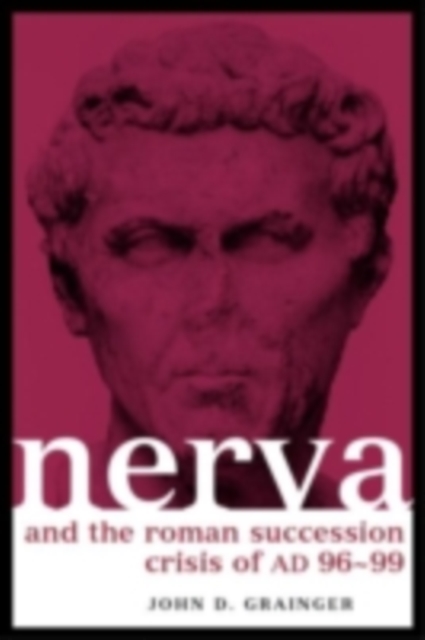
Nerva and the Roman Succession Crisis of ad 96-99
The imperial succession at Rome was notoriously uncertain, and where possible hereditary succession was preferred.
John Grainger's detailed study looks at aperiod of intrigue and conspiracy. He explores how, why and by whom Domitian was killed, the rule of Nerva, chosen to succeed him, and finally Nerva's own choice of successor, Trajan, who became a strong and respected emperor against the odds.
Perhaps most significantly Grainger investigates the effects of this dynastic uncertainty both inside and outside the ruling group in Rome, asking why civil war did not occur in this time of political upheaval.
The last time a dynasty had failed, in AD 68, a damaging military conflict had resulted; at the next failure in AD 192, another war broke out; by the third century civil war was institutionalized, and was one of the main reasons for the eventual downfall of the entire imperial structure. Grainger argues that though AD 96-98 stands out as the civil war that did not happen, it was a perilously close-run thing.
eBook


Marcus Aurelius' Rain Miracle and the Marcomannic Wars
The rain and lightning miracles are the best-known events of Marcus Aurelius' northern wars. Several pagan and Christian versions existed in Antiquity. The author studies and publishes for the first time all the sources and the development of the legend from Antiquity to the 14th century.
eBook