
Catalogue Search | MBRL


Are you sure you want to remove the book from the shelf?

{{itemTitle}}
56,818
result(s) for
"Empires"
Sort by:

Rebellion's fury
\"Damian Ward thought he was done fighting. But the retired veteran and war hero is now leading the revolution against the oppressive Federal America--a bloody battle for the future of his adopted planet that will cost brave rebel lives. But failure means living under the yoke of tyranny--a price Ward and the people of Haven refuse to pay. Federal America cannot allow Haven to break away. If rebellion is successful on one colony, it will spread, and threaten the flow of wealth and raw materials the government needs. With its superior troops and weaponry, it will crush the traitorous rebellion, and retain the empire's standing and power. The colonists have won the first battle, and driven the government forces from the planet. But the Federals are by no means defeated. For just months after the brutal Colonel Semmes and his defeated troops return to Earth, a new force is gathering, larger, better-equipped, and augmented with front line units, veterans of the last war, ready to take back the planet and end the threat of rebellion once and for all\"--From back cover.
Book

Non-Muslims in the Early Islamic Empire
The Muslim conquest of the East in the seventh century entailed the subjugation of Christians, Jews, Zoroastrians and others. Although much has been written about the status of non-Muslims in the Islamic empire, no previous works have examined how the rules applying to minorities were formulated. Milka Levy-Rubin's remarkable book traces the emergence of these regulations from the first surrender agreements in the immediate aftermath of conquest to the formation of the canonic document called the Pact of 'Umar, which was formalized under the early 'Abbasids, in the first half of the ninth century. The study reveals that the conquered peoples themselves played a major role in the creation of these policies and that they were based on long-standing traditions, customs and institutions from earlier pre-Islamic cultures that originated in the worlds of both the conquerors and the conquered. In its connections to Roman, Byzantine and Sasanian traditions, the book will appeal to historians of Europe as well as Arabia and Persia.
eBook

Writing Self, Writing Empire
Writing Self, Writing Empireexamines the life, career, and writings of the Mughal state secretary, or munshi, Chandar Bhan \"Brahman\" (d. c.1670), one of the great Indo-Persian poets and prose stylists of early modern South Asia. Chandar Bhan's life spanned the reigns of four different emperors, Akbar (1556-1605), Jahangir (1605-1627), Shah Jahan (1628-1658), and Aurangzeb Alamgir (1658-1707), the last of the Great Mughals whose courts dominated the culture and politics of the subcontinent at the height of the empire's power, territorial reach, and global influence. As a high-caste Hindu who worked for a series of Muslim monarchs and other officials, forming powerful friendships along the way, Chandar Bhan's experience bears vivid testimony to the pluralistic atmosphere of the Mughal court, particularly during the reign of Shah Jahan, the celebrated builder of the Taj Mahal. But his widely circulated and emulated works also touch on a range of topics central to our understanding of the court's literary, mystical, administrative, and ethical cultures, while his letters and autobiographical writings provide tantalizing examples of early modern Indo-Persian modes of self-fashioning. Chandar Bhan's oeuvre is a valuable window onto a crucial, though surprisingly neglected, period of Mughal cultural and political history.
eBook

The Brush of Insight
Over the course of the sixteenth and early seventeenth
centuries, Mughal court painters evolved from illustrators of
manuscripts and albums to active mediators of imperial visionary
experience, cultivating their patrons' earthly and spiritual
authority. Featuring over 80 color illustrations, The Brush of
Insight traces this shift, demonstrating how royal artists
created a new visual economy that featured highly naturalistic
royal portraits and depictions of the emperors' dreams. These
images, in turn, shaped the perception of the Mughal emperors'
preeminence in all domains-temporal and spiritual-from the reign of
Akbar to that of his son and successor, Jahangir. In analyzing a
wide range of visual materials including manuscripts, albums, and
coins, art historian Yael Rice documents how manuscript painters
and paintings challenged the status of writing as the primary
medium for the transmission of knowledge and experience. With
compelling material and original arguments, The Brush of
Insight probes how pictures and illustrated books became
central to imperial modes of seeing and being in early modern
Mughal South Asia.
eBook


Court ceremonies and rituals of power in Byzantium and the medieval Mediterranean : comparative perspectives
Comparative approaches to political rituals and ceremonies in Byzantium and other court cultures of the Mediterranean basin form the subject of this collective volume, which examines related topics from the viewpoint of transformation, succession, appropriation, and representation in art and literature.
eBook

Parable and politics in early islamic history
The story of the succession to the Prophet Muhammad and the rise of the Rashidun Caliphate (632-661 AD) is familiar to historians from the political histories of medieval Islam, which treat it as a factual account. The story also informs the competing perspectives of Sunni and Shi'i Islam, which read into it the legitimacy of their claims. Yet while descriptive and varied, these approaches have long excluded a third reading, which views the conflict over the succession to the Prophet as a parable. From this vantage point, the motives, sayings, and actions of the protagonists reveal profound links to previous texts, not to mention a surprising irony regarding political and religious issues.
In a controversial break from previous historiography, Tayeb El-Hibri privileges the literary and artistic triumphs of the medieval Islamic chronicles and maps the origins of Islamic political and religious orthodoxy. Considering the patterns and themes of these unified narratives, including the problem of measuring personal qualification according to religious merit, nobility, and skills in government, El-Hibri offers an insightful critique of both early and contemporary Islam and the concerns of legitimacy shadowing various rulers. In building an argument for reading the texts as parabolic commentary, he also highlights the Islamic reinterpretation of biblical traditions, both by Qur'anic exegesis and historical composition.
eBook
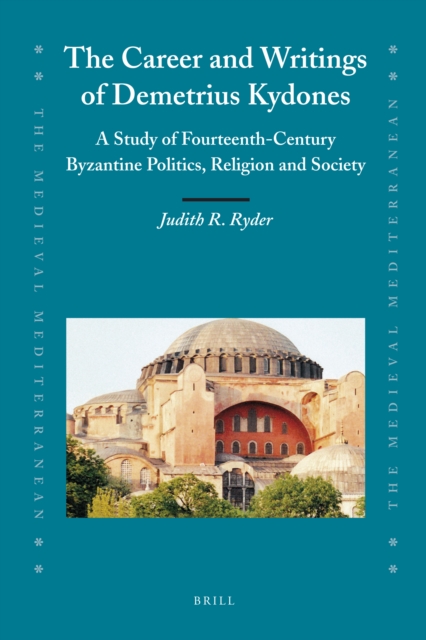
The Career and Writings of Demetrius Kydones
Demetrius Kydones was a leading political and intellectual figure in fourteenth-century Byzantium, know especially for his translations of Aquinas and pro-western attitudes. This book examines Kydones' career and writings in order to see what light they shed on Byzantine political and cultural developments in the period.
eBook

Military Saints in Byzantium and Rus, 900–1200
The rulers of the Byzantine Empire and its commonwealth were protected both by their own soldiers and by a heavenly army: the military saints. The transformation of Saints George, Demetrios, Theodore and others into the patrons of imperial armies was one of the defining developments of religious life under the Macedonian emperors. This book provides a comprehensive study of military sainthood and its roots in late antiquity. The emergence of the cults is situated within a broader social context, in which mortal soldiers were equated with martyrs and martyrs of the early Church recruited to protect them on the battlefield. Dr White then traces the fate of these saints in early Rus, drawing on unpublished manuscripts and other under-utilised sources to discuss their veneration within the princely clan and their influence on the first native saints of Rus, Boris and Gleb, who eventually joined the ranks of their ancient counterparts.
eBook

Arabic literary salons in the Islamic Middle Ages : poetry, public performance, and the presentation of the past
Arabic literary salons emerged in ninth-century Iraq and, by the tenth, were flourishing in Baghdad and other urban centers. In an age before broadcast media and classroom education, salons were the primary source of entertainment and escape for middle- and upper-rank members of society, serving also as a space and means for educating the young. Although salons relied on a culture of oral performance from memory, scholars of Arabic literature have focused almost exclusively on the written dimensions of the tradition. That emphasis, argues Samer Ali, has neglected the interplay of oral and written, as well as of religious and secular knowledge in salon society, and the surprising ways in which these seemingly discrete categories blurred in the lived experience of participants. Looking at the period from 500 to 1250, and using methods from European medieval studies, folklore, and cultural anthropology, Ali interprets Arabic manuscripts in order to answer fundamental questions about literary salons as a social institution. He identifies salons not only as sites for socializing and educating, but as loci for performing literature and oral history; for creating and transmitting cultural identity; and for continually reinterpreting the past. A fascinating recovery of a key element of humanistic culture, Ali’s work will encourage a recasting of our understanding of verbal art, cultural memory, and daily life in medieval Arab culture.
eBook