
Catalogue Search | MBRL


Are you sure you want to remove the book from the shelf?

{{itemTitle}}
2,038
result(s) for
"Employment interviewing"
Sort by:
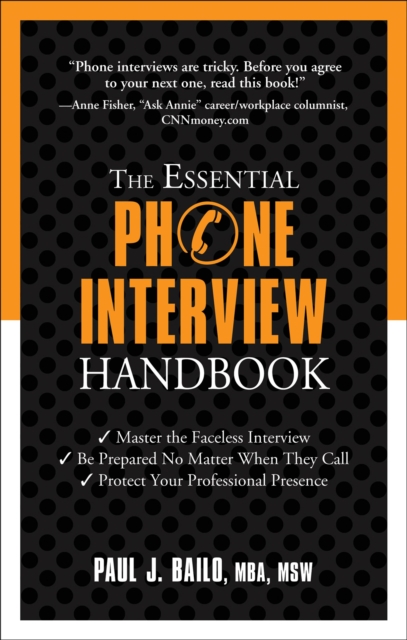
The Essential Phone Interview Handbook
Today more than ever, job candidates make initial contact with prospective employers via the telephone. Phone interviews are often the most unexpected facet of job interviewing, yet they are fast becoming the standard for employers when narrowing the pool of applicants and determining who will be invited for in-person interviews.The Essential Phone Interview Handbook covers:How to prepare, what to say, and when to say itHow to establish your professional presence over the phoneHow to get to the next step
eBook

CV & interview 101 : how to apply and interview for jobs
Writing your CV or getting ready to interview for a job? Chances are you have lots of questions. Should I? What if? How can I? Help! This book gives highly practical and instantly actionable advice on the 101 issues, questions and scenarios most frequently encountered by people when applying and interviewing for jobs. When you don't have your own personal CV and Interview coach on speed dial this book is the next best thing - and costs a lot less.
Book

Ace Your Teacher Interview
\"ACE YOUR TEACHER INTERVIEW\" -- \"Title Page\" -- \"Copyright\" -- \"Dedication\" -- \"Contents\" -- \"Preface to the Revised and Expanded Edition\" -- \"Acknowledgements\" -- \"Introduction\" -- \"Part I Before the Interview\" -- \"Chapter 1 What You Need to Know About Interviews\" -- \"Chapter 2 Preparing for the Interview: 10 How Toâs\" -- \"Chapter 3 Interview Formats and Types\" -- \"Chapter 4 Donât Mess Up! 43 Mistakes You Canât Afford to Make\" -- \"Part II During the Interview\" -- \"Chapter 5 Put Your Best Foot Forward (the Nonverbal Edge)\" -- \"Chapter 6 The Single-Most Important Question You Must Always Answer!\" -- \"Chapter 7 123 Basic Interview Questions (+ 123 Fantastic Responses)\" -- \"Chapter 8 25 Zingers! (And 25 Dynamite Answers)\" -- \"Chapter 9 Hypothetical and Situational Scenarios\" -- \"Chapter 10 Questions You Should Ask (and Questions You Shouldnât)\" -- \"Chapter 11 Illegal Questions\" -- \"Part III After the Interview\" -- \"Chapter 12 32 Questions to Ask Yourself\" -- \"Chapter 13 Follow-Up and Follow-Through\" -- \"Chapter 14 Reality Check \" -- \"Appendix A Non-Traditional Candidates: What You Need to Know\" -- \"Appendix B Your Personal Checklist For Interview Success\" -- \"Appendix C Your Questions Answered\" -- \"Appendix D Web Resources\" -- \"Appendix E Resources for Teachers (and Teachers-to-be)\" -- \"Index
eBook

101 great answers to the toughest interview questions
\"No matter how good you look, how much research you've done, or how perfectly your qualifications match the job description, if you're not prepared with great answers to the toughest interview questions, you won't get the job. [Here] is a manual that will help you home in on exactly what the interviewer is trying to learn--with each and every question he or she asks\"--Amazon.com.
Book

Embracing, Passing, Revealing, and the Ideal Worker Image: How People Navigate Expected and Experienced Professional Identities
This paper examines how people navigate organizational pressures to embrace a professional identity that—like the ideal worker image—centers on devotion to work. My field study of a consulting firm demonstrated that although some people easily embrace this expected identity, for others, it conflicts with their experienced professional identity. I found that people cope with this conflict by straying from the expected identity while passing as having embraced it or revealing their deviance. Analyzing 115 interviews, performance evaluations, and turnover data, I trace how and why people manage their deviance differently across audiences within the organization, show the interdependence of these efforts, and illuminate consequences for how they are perceived and evaluated. In the firm I studied, although both men and women strayed, men were more likely than women to pass. Together, these findings highlight the importance of deviance and its management to people’s professional identities, offer new insights regarding the ideal worker image’s relationship to gender inequality, and enrich theory on passing and revealing.
Journal Article


Virtual Interview Training Among BIPOC Autistic Transition-Age Youth: A Secondary Analysis of an Initial Effectiveness RCT
Black, Indigenous, and Persons of Color (BIPOC) autistic transition-aged youth (TAY) report lower rates of competitive employment compared to White autistic TAY and even greater deficits with social skills associated with positive job interviewing. A virtual job interviewing program was adapted to support and improve the job interviewing skills of autistic TAY. The current study evaluates the effectiveness of an efficacious virtual interview training program on the job interview skills, interview anxiety, and likeliness to be hired, for a subsample of 32 BIPOC autistic TAY, ages 17–26 years old from a previous randomized control trial of the program. Bivariate analyses were used to evaluate between-group differences at pre-test related to background characteristics, and whether Virtual Interview Training for Transition-Age Youth (VIT-TAY) was associated with changes between pre-test and post-test measures of job interview skills. Additionally, a Firth logistic regression was conducted to examine the relationship between VIT-TAY and competitive integrative employment at 6 months, covarying for fluid cognition, having ever had a job interview, and baseline employment status. Participants receiving pre-employment services (Pre-ETS) and virtual interview training had better job interview skills (F = 12.7,
ρ
< .01;
η
ρ
2
= .32), lower job interview anxiety (F = .3.96,
ρ
< .05;
η
ρ
2
= .12), and a higher likeliness of receiving employment (F = 4.34,
ρ
< .05;
η
ρ
2
= .13 at the 6-month follow up compared to participants that only had Pre-ETS. Findings from this study suggest that virtual interview training for TAY is effective for BIPOC autistic TAY in improving their interview skills to gain competitive employment and lower their job interview anxiety.
Journal Article

101 job interview questions you'll never fear again
\"You can't prepare an answer for every interview question. So, of the thousands of questions a potential employer might ask, which ones will they ask? And what should you say?\"--Amazon.com.
Book
Brief Report: Improving Employment Interview Self-efficacy Among Adults with Autism and Other Developmental Disabilities Using Virtual Interactive Training Agents (ViTA)
This study evaluated the measurable impact of the use of virtual interactive training agents (ViTA) as a way to practice interviewing and gain confidence in responding to questions asked during job interviews. Of the total participants (n = 153), the majority were male (72.55%) with an average age of 21.71 years old (SD = 3.14 years). Autism spectrum disorders (ASDs; 64.71%) and intellectual disability (40%) were the most frequently reported diagnoses. Using a within-subjects repeated measures design, the repeated measures linear regression analysis found that the average self-efficacy score increased by 0.31 (
p
= 0.002), and statistically significant increases were found in all three subscales. Further development of virtual reality interventions like ViTA, that improve outcomes for adults with ASDs and other developmental disabilities, is warranted.
Journal Article