
Catalogue Search | MBRL


Are you sure you want to remove the book from the shelf?

{{itemTitle}}
10,905
result(s) for
"Energy development Economic aspects."
Sort by:


Renewable Energy Sources and Climate Change Mitigation
This Intergovernmental Panel on Climate Change Special Report (IPCC-SRREN) assesses the potential role of renewable energy in the mitigation of climate change. It covers the six most important renewable energy sources – bioenergy, solar, geothermal, hydropower, ocean and wind energy – as well as their integration into present and future energy systems. It considers the environmental and social consequences associated with the deployment of these technologies and presents strategies to overcome technical as well as non-technical obstacles to their application and diffusion. SRREN brings a broad spectrum of technology-specific experts together with scientists studying energy systems as a whole. Prepared following strict IPCC procedures, it presents an impartial assessment of the current state of knowledge: it is policy relevant but not policy prescriptive. SRREN is an invaluable assessment of the potential role of renewable energy for the mitigation of climate change for policymakers, the private sector and academic researchers.
eBook

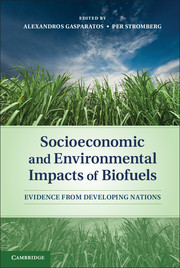
Socioeconomic and Environmental Impacts of Biofuels
Biofuels are currently in the middle of a heated academic and public policy debate. Biofuel production has increased fivefold in the past decade and is expected to further double by 2020. Most of this expansion will happen in developing nations. This volume is the first of its kind, providing a comprehensive overview of the biofuel debate in developing countries. The chapters are written by a multidisciplinary team of experts, exposing the key drivers and impacts of biofuel production and use. The book covers impacts as diverse as air pollution, biodiversity loss, deforestation, energy security, food security, greenhouse gas emissions, land use change, rural development, water consumption and other socioeconomic issues. Its wide focus accommodates examples from countries in Africa, America and Asia. As such, this book will become an indispensable companion to academics, practitioners and policy makers who wish to know more about biofuel issues in the developing world.
eBook

Fully automated luxury communism : a manifesto
\"In his first book, leading political commentator Aaron Bastani conjures a new politics: a vision of a world of unimaginable hope, highlighting how we might move to energy abundance, feed a world of 9 billion, overcome work, transcend the limits of biology and build meaningful freedom for everyone. Rather than a final destination, such a society heralds the beginning of history\"-- Provided by publisher.
Book

Hydrogen Energy
Hydrogen could be a significant fuel of the future, with the potential to make a major contribution to the resolution of pressing social and environmental problems such as carbon emissions, energy security and local air pollution.
This book, based on four years of detailed research, subjects the promise and potential of hydrogen to searching, in-depth socio-economic analysis. It discusses the different technologies for the production, distribution, storage and use of hydrogen, and analyses the economics of these technologies and their current market prospects. It also describes various experiences with aspects of a hydrogen economy in two parts of the world - the UK and Canada - and then assesses the nature of different hydrogen futures that might develop depending on how the technology, economics, social acceptance and policy frameworks play out in different contexts. The book ends by setting out the policy drivers and levers which could stimulate a virtuous circle of research and development, innovation and investment that might ultimately generate a sustainable hydrogen economy.
This is essential reading for economists, engineers, business leaders, investors, policy makers, researchers and students who are interested in the future of the energy system and the part that hydrogen might play in it.
eBook


Hydrogen energy
Hydrogen could be a significant fuel of the future, with the potential to make a major contribution to the resolution of pressing social and environmental problems such as carbon emissions, energy security and local air pollution. This book, based on four years of detailed research, subjects the promise and potential of hydrogen to searching, in-depth socio-economic analysis. It discusses the different technologies for the production, distribution, storage and use of hydrogen, and analyses the economics of these technologies and their current market prospects. It also describes various experie
Book

