
Catalogue Search | MBRL


Are you sure you want to remove the book from the shelf?

{{itemTitle}}
30,825
result(s) for
"Engineering Statistical methods"
Sort by:


Bayesian methods for structural dynamics and civil engineering
Bayesian methods are a powerful tool in many areas of science and engineering, especially statistical physics, medical sciences, electrical engineering, and information sciences. They are also ideal for civil engineering applications, given the numerous types of modeling and parametric uncertainty in civil engineering problems. For example, earthquake ground motion cannot be predetermined at the structural design stage. Complete wind pressure profiles are difficult to measure under operating conditions. Material properties can be difficult to determine to a very precise level – especially concrete, rock, and soil. For air quality prediction, it is difficult to measure the hourly/daily pollutants generated by cars and factories within the area of concern. It is also difficult to obtain the updated air quality information of the surrounding cities. Furthermore, the meteorological conditions of the day for prediction are also uncertain. These are just some of the civil engineering examples to which Bayesian probabilistic methods are applicable.
* Familiarizes readers with the latest developments in the field
* Includes identification problems for both dynamic and static systems
* Addresses challenging civil engineering problems such as modal/model updating
* Presents methods applicable to mechanical and aerospace engineering
* Gives engineers and engineering students a concrete sense of implementation
* Covers real-world case studies in civil engineering and beyond, such as:
* structural health monitoring
* seismic attenuation
* finite-element model updating
* hydraulic jump
* artificial neural network for damage detection
* air quality prediction
* Includes other insightful daily-life examples
* Companion website with MATLAB code downloads for independent practice
* Written by a leading expert in the use of Bayesian methods for civil engineering problems
This book is ideal for researchers and graduate students in civil and mechanical engineering or applied probability and statistics. Practicing engineers interested in the application of statistical methods to solve engineering problems will also find this to be a valuable text.
MATLAB code and lecture materials for instructors available at www.wiley.com/go/yuen
eBook

Quantitative methods of data analysis for the physical sciences and engineering
\"This book provides a thorough and comprehensive coverage of most of the new and important quantitative methods of data analysis for graduate students and practitioners. In recent years, data analysis methods have exploded alongside advanced computing power, and it is critical to understand such methods to get the most out of data, and to extract signal from noise. The book excels in explaining difficult concepts through simple explanations and detailed explanatory illustrations. Most unique is the focus on confidence limits for power spectra and their proper interpretation, something rare or completely missing in other books. Likewise, there is a thorough discussion of how to assess uncertainty via use of Expectancy, and the easy to apply and understand Bootstrap method. The book is written so that descriptions of each method are as self-contained as possible\"-- Provided by publisher.
Book

Data analysis and statistics for geography, environmental science, and engineering
This practical, classroom-tested textbook helps readers learn quantitative methodology, including how to implement advanced analysis methods using an open-source software platform. Based on the author's many years of teaching undergraduate and graduate students in several countries, the book brings together principles of statistics and probability, multivariate analysis, and spatial analysis methods applied to a variety of geographical and environmental models. Theory is accompanied by practical hands-on computer exercises, progressing from easy to difficult. The text also presents a review of mathematical methods, making the book self-contained.
eBook
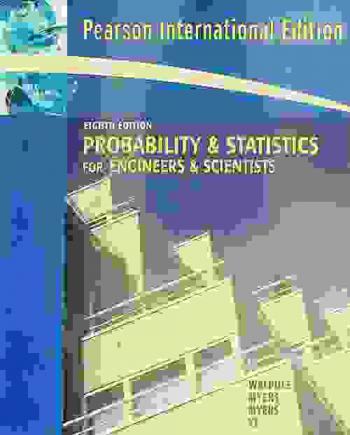
Probability & statistics for engineers & scientists
This classic text provides a rigorous introduction to basic probability theory and statistical inference, illustrated by relevant applications. It assumes a background in calculus and offers a balance of theory and methodology.
Book

The stochastic perturbation method for computational mechanics
\"Probabilistic analysis is increasing in popularity and importance within engineering and the applied sciences. However, the stochastic perturbation technique is a fairly recent development and therefore remains as yet unknown to many students, researchers and engineers. Fields in which the methodology can be applied are widespread, including various branches of engineering, heat transfer and statistical mechanics, reliability assessment and also financial investments or economical prognosis in analytical and computational contexts.Stochastic Perturbation Method in Applied Sciences and Engineering is devoted to the theoretical aspects and computational implementation of the generalized stochastic perturbation technique. It is based on any order Taylor expansions of random variables and enables for determination of up to fourth order probabilistic moments and characteristics of the physical system response.Key features: Provides a grounding in the basic elements of statistics and probability and reliability engineering Describes the Stochastic Finite, Boundary Element and Finite Difference Methods, formulated according to the perturbation method Demonstrates dual computational implementation of the perturbation method with the use of Direct Differentiation Method and the Response Function Method Accompanied by a website (www.wiley.com/go/kaminski) with supporting stochastic numerical software Covers the computational implementation of the homogenization method for periodic composites with random and stochastic material properties Features case studies, numerical examples and practical applications Stochastic Perturbation Method in Applied Sciences and Engineering is a comprehensive reference for researchers and engineers, and is an ideal introduction to the subject for postgraduate and graduate students\"--
eBook
Nonparametric statistics with applications to science and engineering with R
NONPARAMETRIC STATISTICS WITH APPLICATIONS TO SCIENCE AND ENGINEERING WITH R
Introduction to the methods and techniques of traditional and modern nonparametric statistics, incorporating R code
Nonparametric Statistics with Applications to Science and Engineering with R presents modern nonparametric statistics from a practical point of view, with the newly revised edition including custom R functions implementing nonparametric methods to explain how to compute them and make them more comprehensible.
Relevant built-in functions and packages on CRAN are also provided with a sample code. R codes in the new edition not only enable readers to perform nonparametric analysis easily, but also to visualize and explore data using R's powerful graphic systems, such as ggplot2 package and R base graphic system.
The new edition includes useful tables at the end of each chapter that help the reader find data sets, files, functions, and packages that are used and relevant to the respective chapter. New examples and exercises that enable readers to gain a deeper insight into nonparametric statistics and increase their comprehension are also included.
Some of the sample topics discussed in Nonparametric Statistics with Applications to Science and Engineering with R include:
* Basics of probability, statistics, Bayesian statistics, order statistics, Kolmogorov–Smirnov test statistics, rank tests, and designed experiments
* Categorical data, estimating distribution functions, density estimation, least squares regression, curve fitting techniques, wavelets, and bootstrap sampling
* EM algorithms, statistical learning, nonparametric Bayes, WinBUGS, properties of ranks, and Spearman coefficient of rank correlation
* Chi-square and goodness-of-fit, contingency tables, Fisher exact test, MC Nemar test, Cochran's test, Mantel–Haenszel test, and Empirical Likelihood
Nonparametric Statistics with Applications to Science and Engineering with R is a highly valuable resource for graduate students in engineering and the physical and mathematical sciences, as well as researchers who need a more comprehensive, but succinct understanding of modern nonparametric statistical methods.
eBook


Design of experiments for reliability achievement
ENABLES READERS TO UNDERSTAND THE METHODS OF EXPERIMENTAL DESIGN TO SUCCESSFULLY CONDUCT LIFE TESTING TO IMPROVE PRODUCT RELIABILITY This book illustrates how experimental design and life testing can be used to understand product reliability in order to enable reliability improvements.The book is divided into four sections.
eBook