
Catalogue Search | MBRL


Are you sure you want to remove the book from the shelf?

{{itemTitle}}
67,289
result(s) for
"Engineering law"
Sort by:

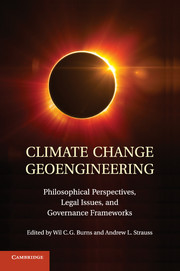
Climate Change Geoengineering
The international community is not taking the action necessary to avert dangerous increases in greenhouse gases. Facing a potentially bleak future, the question that confronts humanity is whether the best of bad alternatives may be to counter global warming through human-engineered climate interventions. In this book, eleven prominent authorities on climate change consider the legal, policy and philosophical issues presented by geoengineering. The book asks: when, if ever, are decisions to embark on potentially risky climate modification projects justified? If such decisions can be justified, in a world without a central governing authority, who should authorize such projects and by what moral and legal right? If states or private actors undertake geoengineering ventures absent the blessing of the international community, what recourse do the rest of us have?
eBook

Stem cell century : law and policy for a breakthrough technology
Korobkin's and Munzer's description of complex problems coupled with logical and well-balanced policy conclusions makes this volume essential reading for scholars and general readers concerned with the success of stem cell research and the future of regenerative medicine.
Book

Genetic Data and the Law
Research using genetic data raises various concerns relating to privacy protection. Many of these concerns can also apply to research that uses other personal data, but not with the same implications for failure. The norms of exclusivity associated with a private life go beyond the current legal concept of personal data to include genetic data that relates to multiple identifiable individuals simultaneously and anonymous data that could be associated with any number of individuals in different, but reasonably foreseeable, contexts. It is the possibilities and implications of association that are significant, and these possibilities can only be assessed if one considers the interpretive potential of data. They are missed if one fixates upon its interpretive pedigree or misunderstands the meaning and significance of identification. This book demonstrates how the public interest in research using genetic data might be reconciled with the public interest in proper privacy protection.
eBook

Bioethics, medicine, and the criminal law. Volume 1, The criminal law and bioethical conflict : walking the tightrope
\"Who should define what constitutes ethical and lawful medical practice? Judges? Doctors? Scientists? Or someone else entirely? This volume analyses how effectively criminal law operates as a forum for resolving ethical conflict in the delivery of health care. It addresses key questions such as: how does criminal law regulate controversial bioethical areas? What effect, positive or negative, does the use of criminal law have when regulating bioethical conflict? And can the law accommodate moral controversy? By exploring criminal law in theory and in practice and examining the broad field of bioethics as opposed to the narrower terrain of medical ethics, it offers balanced arguments that will help readers form reasoned views on the ethical legitimacy of the invocation and use of criminal law to regulate medical and scientific practice and bioethical issues\"-- Provided by publisher.
Book

Bioethics, Medicine and the Criminal Law
This collection of essays presents a fresh analysis of the increasing intervention of criminal law into medical practice, using evidence from previous cases alongside empirical data from a number of jurisdictions. It will be of interest to, among others, academics, healthcare practitioners and criminal lawyers.
eBook

Climate engineering and the law : regulation and liability for solar radiation management and carbon dioxide removal
\"Climate change is increasingly recognized as a global threat, and is already contributing to record-breaking hurricanes and heat waves. To prevent the worst impacts, attention is now turning to climate engineering - the intentional large-scale modification of the environment to reduce the impact of climate change. The two principal methods involve removing some carbon dioxide from the atmosphere (which could consume huge amounts of land and money, and take a long period of time), and reducing the amount of solar radiation reaching the earth's surface, perhaps by spraying aerosols into the upper atmosphere from airplanes (which could be done quickly but is risky and highly controversial). This is the first book to focus on the legal aspects of these technologies: what government approvals would be needed; how liability would be assessed and compensation provided if something goes wrong; and how a governance system could be structured and agreed internationally\"-- Unnumbered page preceeding title page.
Book
Law and Human Genetics
As developments in human genetics proceed apace,the regulation of genetic research and its applications is set to represent one of the major legal challenges of the next century. At every turn – in the fields of medicine and commerce, in insurance and employment, in the family and even in the criminal justice system – advances in human genetics threaten to transform our understanding of ourselves and the basis upon which we relate to one another. This special issue of the Modern Law Review addresses a range of key issues – conceptual, ethical, political and practical – arising from the regulatory challenge confronting the law in the face of the genetic revolution.
eBook

Nuclear law : the global debate
This open access book traces the journey of nuclear law: its origins, how it has developed, where it is now, and where it is headed. As a discipline, this highly specialized body of law makes it possible for us to benefit from the life-saving applications of nuclear science and technology, including diagnosing cancer as well as avoiding and mitigating the effects of climate change. This book seeks to give readers a glimpse into the future of nuclear law, science and technology. It intends to provoke thought and discussion about how we can maximize the benefits and minimize the risks inherent in nuclear science and technology. This compilation of essays presents a global view in discipline as well as in geography. The book is aimed at representatives of governments - including regulators, policymakers and lawmakers - as well representatives of international organizations and the legal and insurance sectors. It will be of interest to all those keen to better understand the role of law in enabling the safe, secure, and peaceful use of nuclear technology around the world. The contributions in this book are written by leading experts, including the IAEA's Director General, and discuss the four branches of nuclear law - safety, security, safeguards and nuclear liability - and the interaction of nuclear law with other fields of national and international law.
BOOK

Genetic Privacy
The phenomenon of the New Genetics raises complex social problems, particularly those of privacy. This book offers ethical and legal perspectives on the questions of a right to know and not to know genetic information from the standpoint of individuals, their relatives, employers, insurers and the state. Graeme Laurie provides a unique definition of privacy, including a concept of property rights in the person, and argues for stronger legal protection of privacy in the shadow of developments in human genetics. He challenges the role and the limits of established principles in medical law and ethics, including respect for patient autonomy and confidentiality. This book will interest lawyers, philosophers and doctors concerned both with genetic information and issues of privacy; it will also interest genetic counsellors, researchers, and policy makers worldwide for its practical stance on dilemmas in modern genetic medicine.
eBook