
Catalogue Search | MBRL


Are you sure you want to remove the book from the shelf?

{{itemTitle}}
53
result(s) for
"England -- Intellectual life -- 18th century"
Sort by:

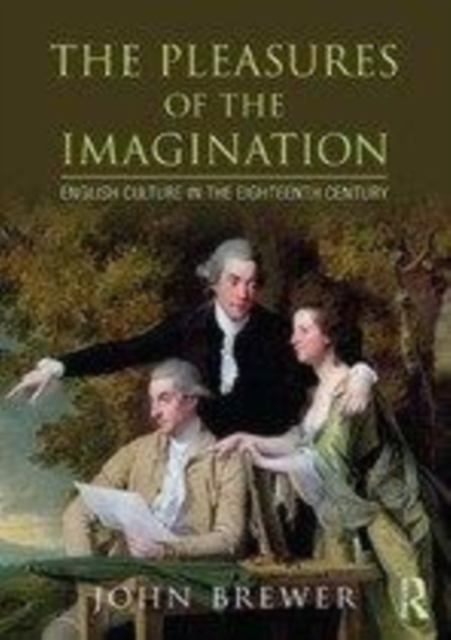
The Pleasures of the Imagination
The Pleasures of the Imagination examines the birth and development of English \"high culture\" in the eighteenth century. It charts the growth of a literary and artistic world fostered by publishers, theatrical and musical impresarios, picture dealers and auctioneers, and presented to th public in coffee-houses, concert halls, libraries, theatres and pleasure gardens. In 1660, there were few professional authors, musicians and painters, no public concert series, galleries, newspaper critics or reviews. By the dawn of the nineteenth century they were all aprt of the cultural life of the nation.
John Brewer's enthralling book explains how this happened and recreates the world in which the great works of English eighteenth-century art were made. Its purpose is to show how literature, painting, music and the theatre were communicated to a public increasingly avid for them. It explores the alleys and garrets of Grub Street, rummages the shelves of bookshops and libraries, peers through printsellers' shop windows and into artists' studios, and slips behind the scenes at Drury Lane and Covent Garden. It takes us out of Gay and Boswell's London to visit the debating clubs, poetry circles, ballrooms, concert halls, music festivals, theatres and assemblies that made the culture of English provincial towns, and shows us how the national landscape became one of Britain's greatest cultural treasures. It reveals to us a picture of English artistic and literary life in the eighteenth century less familiar, but more suprising, more various and more convincing than any we have seen before.
Preface. Introduction. Part 1. Contexts Part 2. Print Part 3. Paint Part 4. Performance Part 6. Province and Nation Part 7. Britain. Conclusion. Bibliography. Sources of Illustration. Index.
\"[T]his history book is now, for me, the last word on how British literary culture changed between the last days of the early modern period and the Victorian age ... give this book as a present to your favourite amateur historian: they will love you for it.\" - Kate Macdonald, Vulpes Libris
\" Pleasures of the Imagination paints a kaleidoscopic picture of eighteenth-century culture that is both erudite and accessible.\" - Heather Mcpherson, University of Alabama at Birmingham
\"If you want to understand how British culture reinvented itself in the eighteenth century, read The Pleasures of the Imagination ... Like all really original achievements it makes us sharply rethink things we supposed we knew well, but it does so with humour and humanity, and through the text runs Brewer's remarkable intellect: forceful, lucid and penetrating.\" - Simon Schama
\" The Pleasures of the Imagination is a splendid cornucopia of a book. It describes the contortions of the eighteenth century as it developed a culture... It is full of pure delight... The marvel of this book is that in writing in exuberant detail about the past, Brewer succeeds in illuminating the present... This book wears its massive scholarship lightly. I hope some of our new political masters have time to read it, for it is a history that teaches us many lessons.\" - Peter Hall, The Observer
\"Brewer ranges over almost every corner of the English mind with sharp, darting observation... Brewer is perceptive, amusing and thorough wherever he strays. This is by far the most complete and up-to-date account of the evolving Georgian arts... We are shown round a society aiming at Rome but often hitting Babylon, with the combined attitutes of fin-de siecle Paris and of Las Vegas. This is a book to treasure as it treasures a past we thought we had lost.\" - Pat Rogers, Sunday Telegraph
\"A model of the new cultural history... In Britons, Linda Colley highlighted the new political, patriotic and religious tides which flowed in the Georgian age, creating a fresh confidence and sense of national identity... The Pleasures of the Imagination confirms this view of the main of the public mind. It shows how the English came to feel not just strong but civilized too, polite as well as powerful. God's chosen people, of the age of Cromwell, were reinventing themselves as Shakespeare's heirs.\" - Roy Porter, The Independent
eBook


The Mind Is a Collection
John Locke described the mind as a cabinet; Robert Hooke called it a repository; Joseph Addison imagined a drawer of medals. Each of these philosophers was an avid collector and curator of books, coins, and cultural artifacts. It is therefore no coincidence that when they wrote about the mental work of reason and imagination, they modeled their powers of intellect in terms of collecting, cataloging, and classification.
The Mind Is a Collectionapproaches seventeenth- and eighteenth-century metaphors of the mind from a material point of view. Each of the book's six chapters is organized as a series of linked exhibits that speak to a single aspect of Enlightenment philosophies of mind. From his first chapter, on metaphor, to the last one, on dispossession, Sean Silver looks at ways that abstract theories referred to cognitive ecologies-systems crafted to enable certain kinds of thinking, such as libraries, workshops, notebooks, collections, and gardens. In doing so, he demonstrates the crossings-over of material into ideal, ideal into material, and the ways in which an idea might repeatedly turn up in an object, or a range of objects might repeatedly stand for an idea. A brief conclusion examines the afterlife of the metaphor of mind as collection, as it turns up in present-day cognitive studies. Modern cognitive theory has been applied to the microcomputer, and while the object is new, the habit is as old as the Enlightenment.
By examining lived environments and embodied habits from 1660 to 1800, Silver demonstrates that the philosophical dualism that separated mind from body and idea from thing was inextricably established through active engagement with crafted ecologies.
eBook


Intellectual Politics and Cultural Conflict in the Romantic Period
Intellectual Politics and Cultural Conflict in the Romantic Period maps the intellectual formation of English plebeian radicalism and Scottish philosophic Whiggism over the long eighteenth century and examines their associated strategies of critical engagement with the cultural, social and political crises of the early nineteenth century. It is a story of the making of a wider British public sphere out of the agendas and discourses of the radical and liberal publics that both shaped and responded to them. When juxtaposed, these competing intellectual formations illustrate two important expressions of cultural politics in the Romantic period, as well as the peculiar overlapping of national cultural histories that contributed to the ideological conflict over the public meaning of Britain's industrial modernity. Alex Benchimol's study provides an original contribution to recent scholarship in Romantic period studies centred around the public sphere, recovering the contemporary debates and national cultural histories that together made up a significant part of the ideological landscape of the British public sphere in the early nineteenth century.
eBook

The Club : Johnson, Boswell, and the friends who shaped an age
\"In 1763, the painter Joshua Reynolds proposed to his friend Samuel Johnson that they invite a few friends to join them every Friday at the Turk's Head Tavern in London to dine, drink, and talk until midnight. Eventually the group came to include among its members Edmund Burke, Adam Smith, Edward Gibbon, and James Boswell. It was known simply as \"the Club.\" In this captivating book, Leo Damrosch brings alive a brilliant, competitive, and eccentric cast of characters. With the friendship of the \"odd couple\" Samuel Johnson and James Boswell at the heart of his narrative, Damrosch conjures up the precarious, exciting, and often brutal world of late eighteenth-century Britain. This is the story of an extraordinary group of people whose ideas helped to shape their age, and our own.\"-- Publisher's description.
Book

Samuel Johnson and the life of reading
The surprising influence of one of the greatest readers in English literature. If readers of the twentieth century feel overwhelmed by the proliferation of writing and information, they can find in Samuel Johnson a sympathetic companion. Johnson's career coincided with the rapid expansion of publishing in England—not only in English, but in Latin and Greek; not only in books, but in reviews, journals, broadsides, pamphlets, and books about books. In 1753 Johnson imagined a time when \"writers will, perhaps, be multiplied, till no readers will be found.\" Three years later, he wrote that England had become \"a nation of authors\" in which \"every man must be content to read his book to himself.\" In Samuel Johnson and the Life of Reading, Robert DeMaria considers the surprising influence of one of the greatest readers in English literature. Johnson's relationship to books not only reveals much about his life and times, DeMaria contends, but also provides a dramatic counterpoint to modern reading habits. As a superior practitioner of the craft, Johnson provides a compelling model for how to read—indeed, he provides different models for different kinds of reading. DeMaria shows how Johnson recognized early that not all reading was alike—some requiring intense concentration, some suited for cursory glances, some requiring silence, some best appreciated amid the chatter of a coffeehouse. Considering the remarkable range of Johnson's reading, DeMaria discovers in one extraordinary career a synoptic view of the subject of reading.
eBook

The fortunes of Francis Barber : the true story of the Jamaican slave who became Samuel Johnson's heir
\"This compelling book chronicles a young boy's journey from the horrors of Jamaican slavery to the heart of London's literary world, and reveals the unlikely friendship that changed his life. Francis Barber, born in Jamaica, was brought to London by his owner in 1750 and became a servant in the household of the renowned Dr. Samuel Johnson. Although Barber left London for a time and served in the British navy during the Seven Years' War, he later returned to Johnson's employ. A fascinating reversal took place in the relationship between the two men as Johnson's health declined and the older man came to rely more and more upon his now educated and devoted companion. When Johnson died he left the bulk of his estate to Barber, a generous (and at the time scandalous) legacy, and a testament to the depth of their friendship. There were thousands of black Britons in the eighteenth century, but few accounts of their lives exist. In uncovering Francis Barber's story, this book not only provides insights into his life and Samuel Johnson's but also opens a window onto London when slaves had yet to win their freedom\"-- Provided by publisher.
BOOK

Anna Seward and the end of the eighteenth century
After nearly two hundred years of critical neglect, Seward is attracting renewed attention, and with this book Kairoff makes a strong and convincing case for including Anna Seward's remarkable literary achievements among the most important of the late eighteenth century.
eBook