
Catalogue Search | MBRL


Are you sure you want to remove the book from the shelf?

{{itemTitle}}
13
result(s) for
"England Social life and customs To 1066"
Sort by:

Medieval domesticity : home, housing and household in medieval England
This volume explores the concept of domesticity and addresses its many cultural, material and ideological dimensions. It sheds light on the diverse representations and multiple meanings of domesticity in texts, images, objects, and architecture.
Book

Lost Letters of Medieval Life
Everyday life in early thirteenth-century England is revealed in vivid detail in this riveting collection of correspondence of people from all classes, from peasants and shopkeepers to bishops and earls. The documents presented here include letters between masters and servants, husbands and wives, neighbors and enemies, and cover a wide range of topics: politics and war, going to fairs and going to law, attending tournaments and stocking a game park, borrowing cash and doing favors for friends, investigating adultery and building a windmill.
While letters by celebrated people have long been known, the correspondence of ordinary people has not survived and has generally been assumed never to have existed in the first place. Martha Carlin and David Crouch, however, have discovered numerous examples of such correspondence hiding in plain sight. The letters can be found in manuscripts called formularies-the collections of form letters and other model documents that for centuries were used to teach the arts of letter-writing and keeping accounts.
The writing-masters and their students who produced these books compiled examples of all the kinds of correspondence that people of means, members of the clergy, and those who handled their affairs might expect to encounter in their business and personal lives. Tucked among the sample letters from popes to bishops and from kings to sheriffs are examples of a much more casual, ephemeral kind of correspondence. These are the low-level letters that evidently were widely exchanged, but were often discarded because they were not considered to be of lasting importance. Two manuscripts, one in the British Library and the other in the Bodleian Library, are especially rich in such documents, and it is from these collections that Carlin and Crouch have drawn the documents in this volume. They are presented here in their first printed edition, both in the original Latin and in English translation, each document splendidly contextualized in an accompanying essay.
eBook

Voices of Medieval England, Scotland, Ireland, and Wales : Contemporary Accounts of Daily Life
\"Voices of Medieval England, Scotland, Ireland, and Wales : Contemporary Accounts of Daily Life provides a broad selection of primary documents that are appropriate in level and content for a variety of readers. It includes dozens of primary document excerpts that illustrate important elements of daily life during the medieval period. Each document is accompanied by an introduction that supplies relevant historical background, context points to help readers evaluate the document, a description of the results and consequences of the document, and a 'Further Information' section listing important print and electronic resources as well as any relevant films or television programs. Covering an important curricular topic, this book provides extensive contextual material along with guidance to help students read documents. Additionally, it serves to support Common Core State Standards by helping students develop critical thinking skills through document analysis. Features: Provides tools and techniques for effectively evaluating the meaning and importance of the documents; Enables students to effectively incorporate information from primary documents into various school and personal research projects; Includes an 'Ask Yourself' section of questions about the document and the source era as well as a 'Topics to Consider' section that suggests themes to explore in an essay, online project, or class presentation\"--From publisher's website.
Book

Beharrungsvermögen und Verdrängung
Untersucht wird das Zusammenleben von Polytheisten und Christen in den angelsächsischen Reichen des 7.Jahrhunderts.Dabei wird untersucht, wie es in den jeweiligen Reichen zu einer religiös gemischten Situation kommen konnte, wie sich diese Situation besonders für die Polytheisten gestaltete und zuletzt wie lange das religiöse Nebeneinander.
eBook
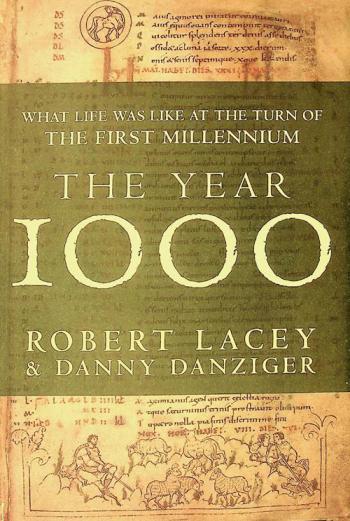
The year 1000 : what life was like at the turn of the first millennium : an Englishman's world
Presents what life was like in the year 1000 for an Englishman.
Book

The World of \Piers Plowman\
Next to Chaucer'sCanterbury Tales, William Langland'sPiers Plowmanis perhaps the best-known literary picture of fourteenth-century England. Langland's work, more socially concerned and critical than Chaucer's, reflected an age of religious controversy, social upheaval, and political unrest.The World of Piers Plowmanputs the reader in touch with the sources that helped shape Langland's somber vision. The representative documents included in this book, often cited in connection with the poem yet difficult to come by, disclose the background ofPiers Plowmanin social and economic history as well as folklore, art, theology, homilies, religious tractates, and chronicles. The seven sections into which the readings are divided illustrate ideas concerning (1) the heavens, the universal Church, England, and London; (2) material and spiritual abuses; (3) the most influential literary genres of the period; (4) exempla, moral tales from hagiography, sermon literature, and tracts on moral theology; (5) types of practical instruction available to the devout layperson; (6) the multiple meanings in many literary works; and (7) the moment of death, the judgments on the soul, and the torments and rewards of the afterlife.
eBook


Gold and Gilt, Pots and Pins
In this highly illustrated book, David Hinton looks at what possessions meant to people at every level of society in Britain in the middle ages, from elaborate gold jewellery to clay pots, and provides a fascinating window into the society of the middle ages. Gold and Gilt, Pots and Pins is about things worn and used in Britain throughout the M.
eBook

Master-servant childhood : a history of the idea of childhood in medieval English culture
\"Master-Servant Childhood\" offers a new understanding of childhood in the Middle Ages as a form of master-servant relation embedded in an ancient sense of time as a correspondence between earthly change and eternal order. It challenges the misnomer that children were 'little adults' in the Middle Ages and corrects the prevalent misconceptions that childhood was unimportant, unrecognized or disregarded. The book argues for the value of studying childhood as a structure of thought and feeling and as an important avenue for exploring large scale historical changes in our sense of what it is to be and become human.
Book

Cultural Transition in the Chilterns and Essex Region, 350 AD to 650 AD
This book compares the archaeological evidence from the fourth to seventh centuries AD in the Chilterns and Essex region with the considerable body of place-name data from the same area. Included in the study are the counties of Hertfordshire, Middlesex and Essex, and parts of Buckinghamshire, Bedfordshire and Cambridgeshire. Though it is difficult to demonstrate unbroken occupation of Romano-British sites throughout the period, the continued existence of British communities in most of the region has been shown by topographical evidence and by the existence of place-names demonstrative of Old English contact with pre-English communities. The distribution and density of Germanic archaeological remains vary considerably within the region, such that it is unlikely that there was only one predominant process by which Germanic culture was introduced to it. This highlights the danger of making generalised statements on the nature of interaction between people of British and Germanic culture in this period. The transition from Romano-British to Anglo-Saxon material culture is likely to have been the result of a combination of different processes. The distribution of supposedly early Old English place-name elements suggests that, contrary to orthodox opinion, they are not particularly useful indicators of early Germanic influence in a detailed study of this kind. Moreover, some elements traditionally thought to be relatively unimportant may belong to an earlier stratum of place-name formation, and some revision of theories on place-name chronology is necessary.
eBook