
Catalogue Search | MBRL


Are you sure you want to remove the book from the shelf?

{{itemTitle}}
19,760
result(s) for
"English Law"
Sort by:

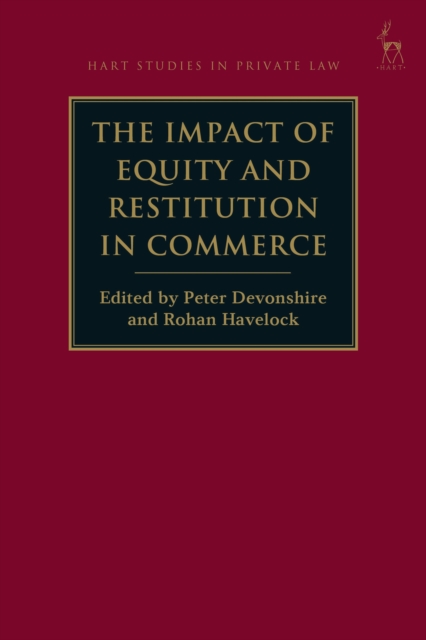
The Impact of Equity and Restitution in Commerce
Commercial relationships give rise to diverse forms of legal obligation in private law, including contract, tort, agency, company law and partnership. More controversially, equity and the law of restitution have a less defined and somewhat ambulatory role in regulating the affairs of commercial parties. Nevertheless, their impact is manifest in the commercial arena through the distinct types of liability they engender and the remedies that are imposed. This collection draws together the views of leading international scholars and judges to explore the nature and extent of this impact from two perspectives. Five chapters primarily address this impact at a macro-level, focusing on the roles of equity and the law of restitution in terms of legal taxonomy, doctrine and policy. In contrast, the remaining five chapters primarily address this impact at a micro-level, focusing on selected liabilities and remedies within equity and the law of restitution in the context of commerce. This bifocal approach enables a holistic appreciation of some important ways in which equity and the law of restitution affect or may affect commerce, with a view to fostering further debate over the fundamental issues at stake.
eBook


Private International Law in Commonwealth Africa
This book provides a comprehensive and comparative examination of private international law in Commonwealth Africa. It offers an unrivalled breadth of coverage in its examination of the law in Botswana, the Gambia, Ghana, Kenya, Lesotho, Malawi, Namibia, Nigeria, Sierra Leone, South Africa, Swaziland, Tanzania, Uganda, Zambia and Zimbabwe. The book is clearly and logically structured - it is organised around broad themes or issues, with country reports and accompanied by detailed commentaries. Drawing on nearly 1500 cases decided by courts in these countries and numerous national statutes, this book covers the four cornerstones of private international law: jurisdiction, choice of law, foreign judgements and arbitral awards enforcement, and international civil procedure. The author also provides an extensive bibliography of the literature on African private international law. Scholars and practitioners alike will find Private International Law in Commonwealth Africa invaluable and illuminating.
eBook


REVIEW OF EXECUTIVE ACTION ABROAD: THE UK SUPREME COURT IN THE INTERNATIONAL LEGAL ORDER
In January 2017, the UK Supreme Court handed down landmark judgments in three cases arising out of the UK government's conduct abroad. In Serdar Mohammed v Ministry of Defence, the Court considered whether detention in non-international armed conflicts was compatible with the right of liberty in Article 5 of the European Convention on Human Rights. The second case, Belhaj v Straw, involved an examination of the nature and scope of the foreign act of State doctrine, and its applicability as a defence to tort claims arising out of the alleged complicity of the UK Government in human rights abuses abroad. Finally, Rahmatullah v Ministry of Defence saw the Court examining the nature and scope of the Crown act of State doctrine, and its use as a defence to tort claims alleging unlawful detention and maltreatment. All three cases raise important doctrinal issues and have significant consequences for government accountability and access to a judicial remedy. At the heart of each decision is the relationship between international law and English law, including the ways in which international norms influence the development of English law and public policy, and how different interpretations of domestic law affect how judges resolve questions of international law. These cases also see the judges grapple with the role of the English court in the UK constitutional and international legal orders.
Journal Article

A BIDIRECTIONAL ANGLO-GERMAN COMPARISON OF CONSIDERATION IN CONTRACT LAW
This article explores the concept of consideration in contract law from a comparative perspective, looking at how English law and German law distinguish bargains from gifts. Contrary to the orthodoxy that consideration is unique to Common Law and absent from Civil Law, the bidirectional analysis in this article shows how English law and German law can be understood to fulfil a comparable function and can thus inform and benefit each other. The sophisticated English doctrine can be used to refine the rather imprecise German definition of gifts, whilst the understanding of English authorities can profit from reflecting inversely on the criterion of gratuitousness in German law.
Journal Article


Artificial intelligence and deep learning: considerations for financial institutions for compliance with the regulatory burden in the United Kingdom
Purpose
Artificial intelligence (AI), machine learning (ML) and deep learning (DL) are having a major impact on banking (FinTech), health (HealthTech), law (RegTech) and other sectors such as charitable fundraising (CharityTech). The pace of technological innovation and the ability of AI systems to think like human beings (simulate human intelligence), perform tasks independently, develop intelligence based on its own experiences and process layers of information to learn ever-complex representations of data (ML/DL) means that improvements in the rates at which this technology can undertake complex, technical and time-consuming tasks, identify people, objects, voices, patterns, etc., screen for ‘problems’ earlier, and provide solutions, provide astounding benefit in economic, political and social terms. The purpose of this paper is to explore advents in AI, ML and DL in the context of the regulatory compliance challenge faced by financial institutions in the United Kingdom (UK).
Design/methodology/approach
The subject is explored through the analysis of data and domestic and international published literature. The first part of the paper summarises the context of current regulatory issues, the advents in deep learning, how financial institutions are currently using AI, and how AI could provide further technological solutions to regulatory compliance as of February 2023.
Findings
It is suggested that UK financial institutions can further utilise AI, ML and DL as part of an armoury of solutions that ease the regulatory burden and achieve high levels of compliance success.
Originality/value
To the best of the author’s knowledge, this is the first study to specifically explore how AI, ML and DL can continue to assist UK financial institutions in meeting the regulatory compliance challenge and the opportunities provided for financial institutions by the metaverse.
Journal Article