
Catalogue Search | MBRL


Are you sure you want to remove the book from the shelf?

{{itemTitle}}
601
result(s) for
"English drama 17th century."
Sort by:

Labors Lost
Labors Lost offers a fascinating and wide-ranging account of working women's behind-the-scenes and hitherto unacknowledged contributions to theatrical production in Shakespeare's time. Natasha Korda reveals that the purportedly all-male professional stage relied on the labor, wares, ingenuity, and capital of women of all stripes, including ordinary crafts- and tradeswomen who supplied costumes, props, and comestibles; wealthy heiresses and widows who provided much-needed capital and credit; wives, daughters, and widows of theater people who worked actively alongside their male kin; and immigrant women who fueled the fashion-driven stage with a range of newfangled skills and commodities.Combining archival research on these and other women who worked in and around the playhouses with revisionist readings of canonical and lesser-known plays, Labors Lost retrieves this lost history by detailing the diverse ways women participated in the work of playing, and the ways male players and playwrights in turn helped to shape the cultural meanings of women's work. Far from a marginal phenomenon, the gendered division of theatrical labor was crucial to the rise of the commercial theaters in London and had an influence on the material culture of the stage and the dramatic works of Shakespeare and his contemporaries.
eBook

Martyrs and Players in Early Modern England
Focusing on Christopher Marlowe, William Shakespeare, John Webster and John Milton, Martyrs and Players in Early Modern England argues that the English tragedians reflected an unease within the culture to acts of religious violence. David Anderson explores a link between the unstable emotional response of society to religious executions in the Tudor-Stuart period, and the revival of tragic drama as a major cultural form for the first time since classical antiquity. Placing John Foxe at the center of his historical argument, Anderson argues that Foxe's Book of Martyrs exerted a profound effect on the social conscience of English Protestantism in his own time and for the next century. While scholars have in recent years discussed the impact of Foxe and the martyrs on the period's literature, this book is the first to examine how these most vivid symbols of Reformation-era violence influenced the makers of tragedy. As the persecuting and the persecuted churches collided over the martyr's body, Anderson posits, stress fractures ran through the culture and into the playhouse; in their depictions of violence, the early modern tragedians focused on the ethical confrontation between collective power and the individual sufferer. Martyrs and Players in Early Modern England sheds new light on the particular emotional energy of Tudor-Stuart tragedy, and helps explain why the genre reemerged at this time.
eBook


Treason by Words
Under the Tudor monarchy, English law expanded to include the category of \"treason by words.\" Rebecca Lemon investigates this remarkable phrase both as a legal charge and as a cultural event. English citizens, she shows, expressed competing notions of treason in opposition to the growing absolutism of the monarchy. Lemon explores the complex participation of texts by John Donne, Ben Jonson, and William Shakespeare in the legal and political controversies marking the Earl of Essex's 1601 rebellion and the 1605 Gunpowder Plot.
Lemon suggests that the articulation of diverse ideas about treason within literary and polemical texts produced increasingly fractured conceptions of the crime of treason itself. Further, literary texts, in representing issues familiar from political polemic, helped to foster more free, less ideologically rigid, responses to the crisis of treason. As a result, such works of imagination bolstered an emerging discourse on subjects' rights.Treason by Wordsoffers an original theory of the role of dissent and rebellion during a period of burgeoning sovereign power.
eBook


Sexual Types
Sexual types on the early modern stage are at once strange and familiar, associated with a range of \"unnatural\" or \"monstrous\" sexual and gender practices, yet familiar because readily identifiable as types: recognizable figures of literary imagination and social fantasy. From the many found in early modern culture, Mario DiGangi here focuses on six types that reveal in particularly compelling ways, both individually and collectively, how sexual transgressions were understood to intersect with social, gender, economic, and political transgressions.Building on feminist and queer scholarship, Sexual Types demonstrates how the sodomite, the tribade (a woman-loving woman), the narcissistic courtier, the citizen wife, the bawd, and the court favorite function as sites of ideological contradiction in dramatic texts. On the one hand, these sexual types are vilified and disciplined for violating social and sexual norms; on the other hand, they can take the form of dynamic, resourceful characters who expose the limitations of the categories that attempt to define and contain them. In bringing sexuality and character studies into conjunction with one another, Sexual Types provides illuminating new readings of familiar plays, such as Shakespeare's A Midsummer Night's Dream and The Winter's Tale, and of lesser-known plays by Fletcher, Middleton, and Shirley.
eBook

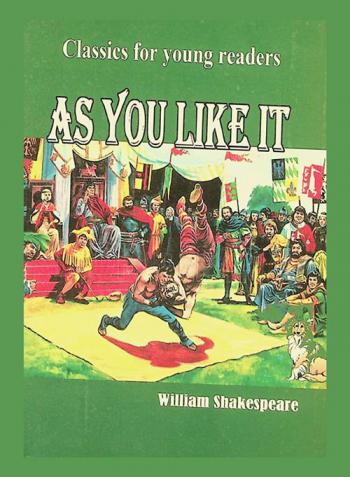
As you like it
As You Like It is considered by many to be one of Shakespeare's greatest comedies, and the heroine, Rosalind, is praised as one of his most inspiring characters and has more lines than any of Shakespeare's female characters. Rosalind, the daughter of a banished duke falls in love with Orlando the disinherited son of one of the duke's friends. When she is banished from the court by her usurping uncle, Duke Frederick, Rosalind switches genders and as Ganymede travels with her loyal cousin Celia and the jester Touchstone to the Forest of Arden, where her father and his friends live in exile. Observations on life and love follow (including love, aging, the natural world, and death) friends are made, and families are reunited. By the play's end Ganymede, once again Rosalind, marries her Orlando. Two other sets of lovers are also wed, one of them Celia and Orlando's mean older brother Oliver . As Oliver becomes a gentler, kinder young man so the Duke conveniently changes his ways and turns to religion and so that the exiled Duke, father of Rosalind, can rule once again.
Book

Prologues to Shakespeare's Theatre
This eye-opening study draws attention to the largely neglected form of the early modern prologue. Reading the prologue in performed as well as printed contexts, Douglas Bruster and Robert Weimann take us beyond concepts of stability and autonomy in dramatic beginnings to reveal the crucial cultural functions performed by the prologue in Elizabethan England.While its most basic task is to seize the attention of a noisy audience, the prologue's more significant threshold position is used to usher spectators and actors through a rite of passage. Engaging competing claims, expectations and offerings, the prologue introduces, authorizes and, critically, straddles the worlds of the actual theatrical event and the 'counterfeit' world on stage. In this way, prologues occupy a unique and powerful position between two orders of cultural practice and perception.Close readings of prologues by Shakespeare and his contemporaries, including Marlowe, Peele and Lyly, demonstrate the prologue's role in representing both the world in the play and playing in the world. Through their detailed examination of this remarkable form and its functions, the authors provide a fascinating perspective on early modern drama, a perspective that enriches our knowledge of the plays' socio-cultural context and their mode of theatrical address and action.
eBook